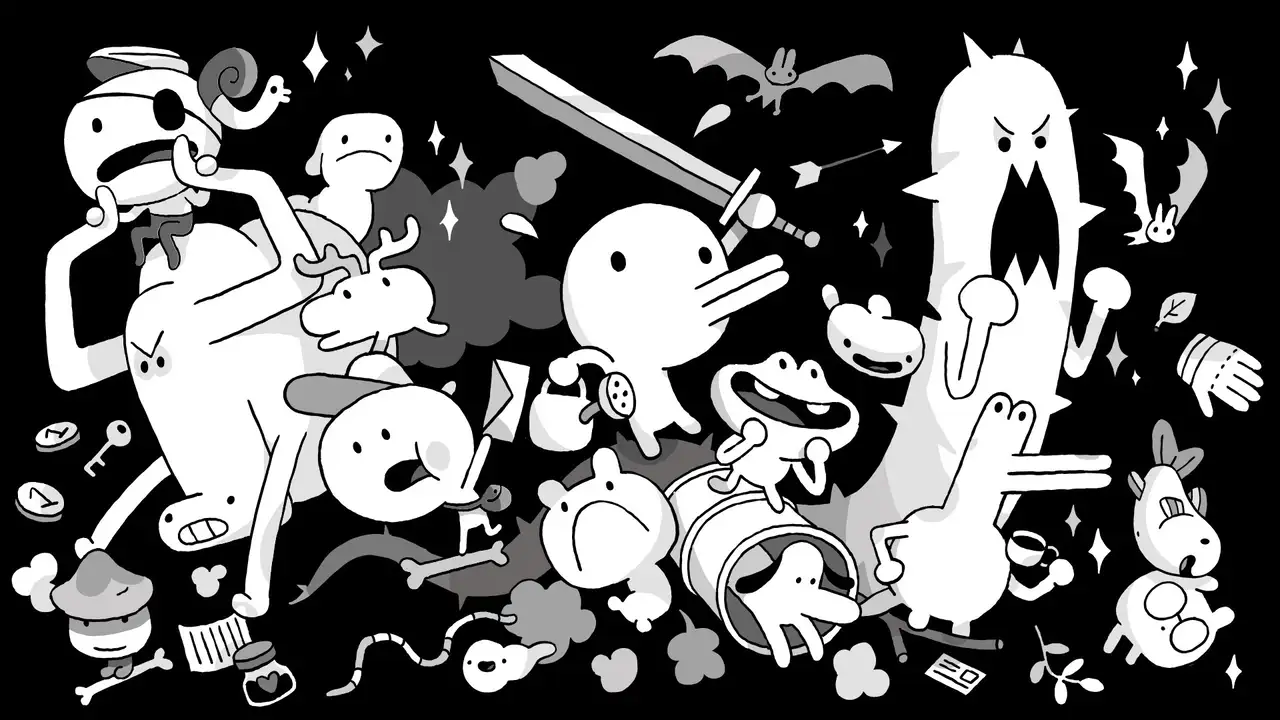
Sixty seconds per life sounds like punishment, and it is actually freedom. Minit builds its entire structure on that inversion: every death restarts the run, but everything gained survives it, so each 60-second sprint becomes one meaningful action compounded into the next. A cursed sword drives the tiny-scale quest through a two-colour island world, following a trail of oddball NPCs towards a factory that needs sabotaging and a blade that needs flushing down a toilet. The premise is deadpan, the scale is minuscule, and the design is brilliant.
The charm and humour carry the whole package. An old man’s stories literally kill the listener, sneaker-hood vendors peddle goods, and a dog steals money without consequence, all delivered in writing with real wit. A vegan settings toggle exists for no reason other than comedy, and the waiting room gag demands nothing but patience. The dry humour never wavers, and the density of character in such a minimal presentation is the game’s quiet achievement. Simplicity plus character beats scale.
The mid-game teleporter unlock is a genuine delight. Suddenly the whole island connects through a fast-travel network that turns the 60-second limit from constraint into rhythm, and the discovery lands as one of the campaign’s best moments. Each progression item permanently opens shortcuts: coffee pushes boxes, the gardening glove cuts trees, flippers open water, speed shoes and the grinder and turbo ink each rewrite what a single life can accomplish. Later runs compound into power, and the growth curve makes every death feel like forward momentum.
The temple’s cryptic hint system is the campaign’s biggest stumble. A riddle about starts and ends and growth stumps completely, forcing trial-and-error spawning through the structure until the solution emerges, and the eventual satisfaction arrives only after genuine frustration. The temple itself earns praise for its total lack of soundtrack, the silence making the space genuinely creepy, but the hint design asks for brute force where cleverness should suffice.
Wayfinding without an overworld map frustrates during cleanup. Tracking down the last coins, hearts and tentacles means navigating from memory, and the sewers’ entrance hides behind an interaction nobody would guess, discovered only by hitting an unremarkable object repeatedly. A more obvious route into the sewers would have saved a facepalm, and the endgame sweep would benefit enormously from even a basic map. The two-colour ultra-minimal art style is a deliberate choice that divides opinion, and the commitment to it is defensible precisely because the charm compensates.
A complete clear runs 120 lives across roughly 80 minutes, with a full 100% achievable in a single sitting. Beyond one clear, the structure invites replays: an incomplete run leaves three or four playthroughs’ worth of content in the package, and the skip route through the sewers maps a genuine speedrun line. Death is so frictionless it becomes the fastest way to travel, using suicide as fast travel, a mechanic inversion that says everything about how well the core idea works.
The Zelda-like structure with a Link to the Past-adjacent overworld gives the compact design real familiarity, and the original-esque pacing keeps exploration tight. Music stays minimal by choice, the creepy temple silence being the standout audio decision. Difficulty never spikes, and the whole campaign holds its register from start to flush.
Overall, this is a brilliant, bite-sized adventure whose 60-second life mechanic turns every death into forward momentum, proof that simplicity plus character beats scale. The cryptic temple hints and the mapless endgame cleanup are real friction, but the compounding unlock structure, the dense humour and the speedrun-friendly design make this a very good game deserving of its reputation.