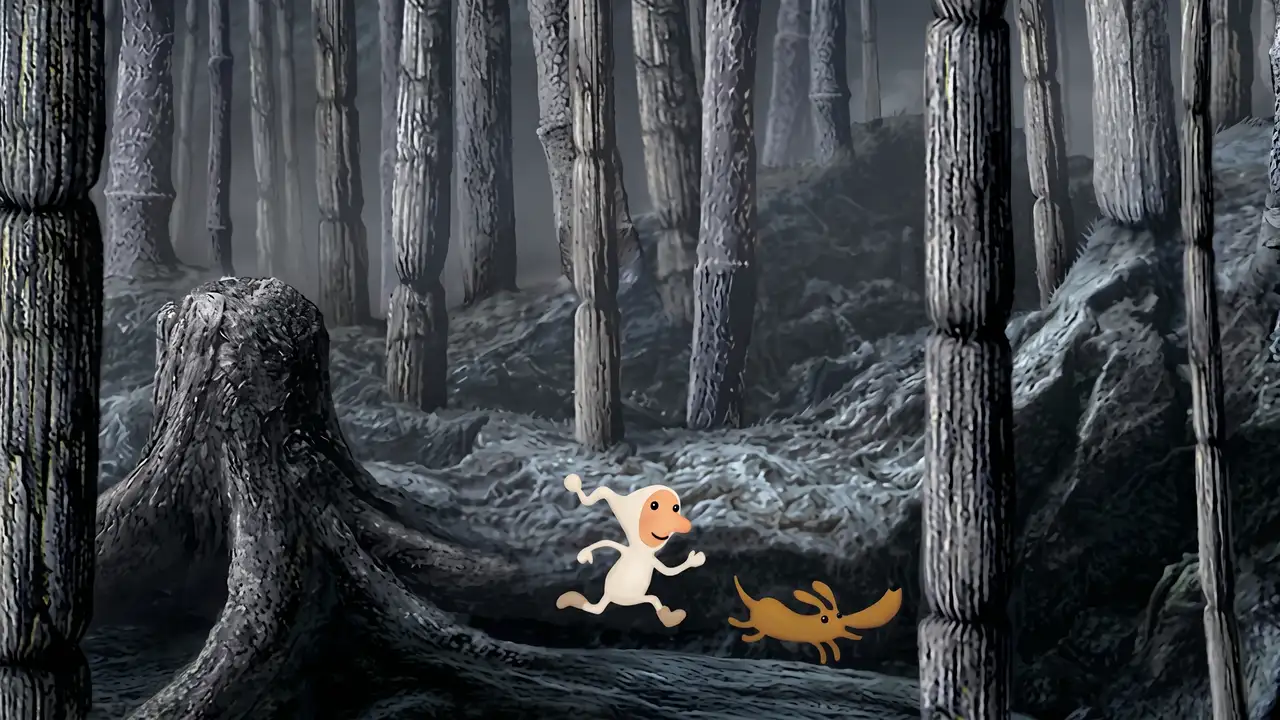
A little gnome in underpants lives on a tiny asteroid, and that asteroid is drifting toward a collision with a larger world. There is no dialogue, no readable text beyond a single password, and no tutorial: everything the game wants to say is communicated through music, animation and imagery that ranges from whimsical to quietly unnerving. The premise is a single sentence, the runtime a coffee break, and yet the thing manages to feel complete, a pocket-sized art piece that almost no modern release attempts at this scale. As the seed of an entire design lineage, its historical interest alone would carry it.
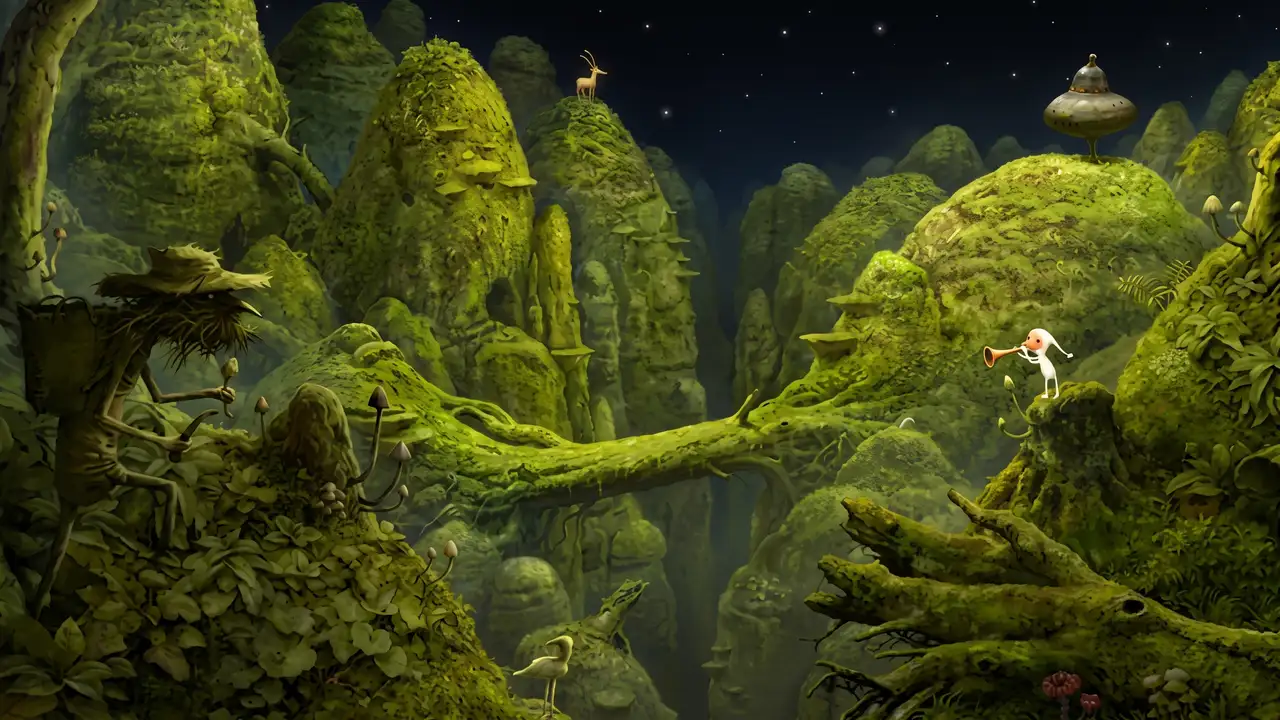
The hand-crafted environments are the clear delight. Each screen is a bizarre, organic diorama: worm-eating plants, singing bird-things, a giant with an enormous nose, all rendered in hand-painted collage that turns every transition into a small revelation. The driftwood texture of the threatened world and the tangled flora of the gnome’s home give the whole journey a dreamlike coherence, and closing the loop back home lands with tidy satisfaction.
Progression runs as a strictly linear chain of single-screen puzzles: click the environment, use found objects, move on. A mushroom serves as a key, a fish bone and a light bulb head find their purposes, and no fail state exists anywhere. One screen presents a password-and-direction riddle that requires genuine decoding; most of the rest resolve on inspection, which undercuts the mental challenge more than once.
The real-photographic faces grafted onto several creatures are the game’s most memorable quality, and its most divisive. Uncanny does not begin to cover it: human eyes on plant-things and beasts give the gentle tone an edge that lingers well past the ending, and the effect repeats across multiple screens rather than being a one-off flourish. It is clearly deliberate, and it works exactly as well as the viewer’s tolerance for the uncanny allows.
Interactive density is thin even by point-and-click standards, with many screens offering little to prod, and once the chain is solved there is nothing to return to. The puzzles that do exist lean gentle, some barely requiring thought at all, and the brisk resolution of several steps robs them of the friction that makes the genre’s best moments sing. Gentle is not the same as empty, but the difference here is narrower than it might be.
None of that matters much at the price, which is nothing. Fourteen minutes of wordless puzzle-play with this much character is a remarkable free curiosity, and the brevity reads as charm rather than a failing: the game promises exactly its scope and delivers it. Technical creaks are minor, a slightly broken-looking opening that settles quickly, and the whole thing runs cleanly otherwise.
Overall, a tiny, free piece of adventure-game history that delivers exactly what its Flash-era scope promises: bizarre, beautiful environments and a handful of gentle puzzles capped by a satisfying rocket launch. The uncanny faces and thin challenge are real marks against, but the hand-painted surrealism and the tidy, satisfying close make this worth the coffee break it asks for, and the perfect prologue to its fuller sequels.