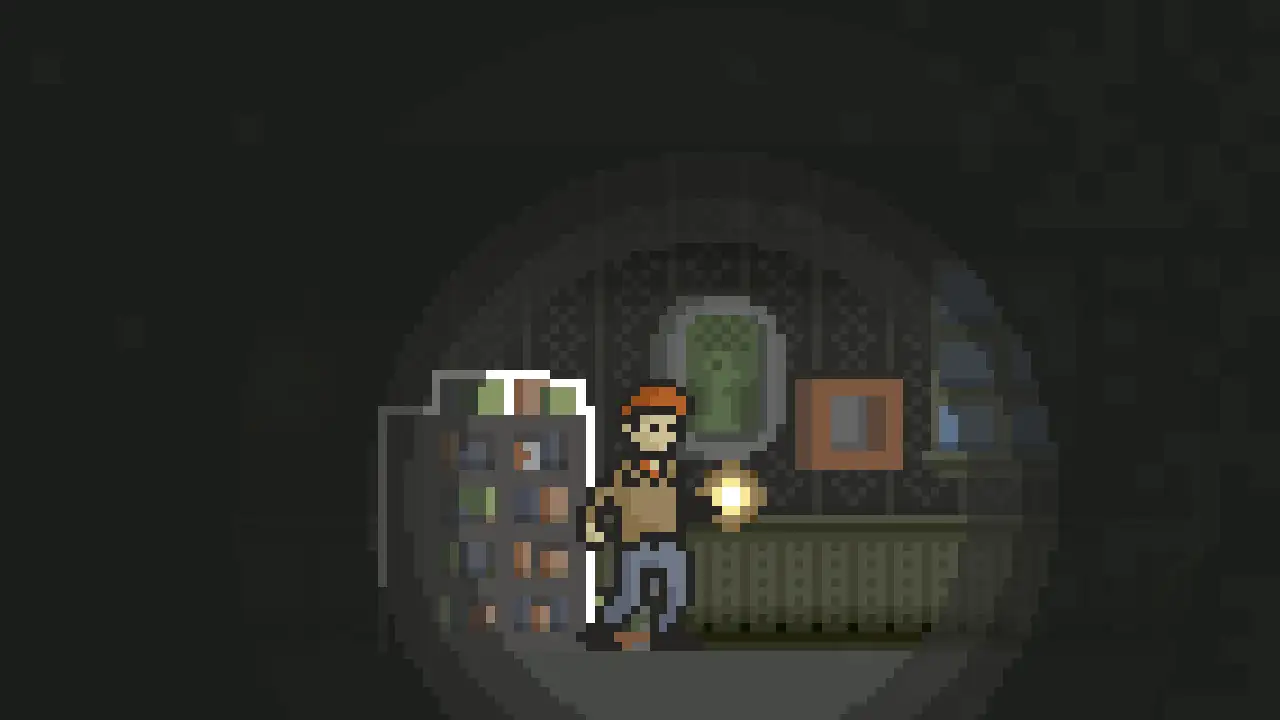
A missing teenage girl, a wealthy household full of secrets, and an investigator who never sets foot inside: Forest Grove casts its lead as the first remote forensics operative, handed a nano deck that snapshots an entire family home and reconstitutes it as an explorable three-dimensional diorama. The framing is immediately distinctive. Rather than walking a crime scene, the whole household sits in the palm of a hand, floors stacked like a doll’s house, zoomable and traversable at will. The tech-noir wrapping is convincing too: nanotechnology, remote forensic law, and a moratorium on AI reconstruction all simmer beneath the surface. What follows is a slow, methodical mystery that trusts the investigator to look closely and rewards the effort with one of the more original detective setups in recent memory.
The nano deck itself is the star. Scanning an object yields fingerprints, DNA, perspiration metabolites and even object biographies, and the forensic loop of swabbing, enhancing and linking evidence delivers the detective fantasy with real commitment. Nano swabs generate samples from window sills, door handles and clothing, and the evidence board ties physical items to household members as the case tightens. It is a loop with genuine texture, and chasing every last sample becomes compulsive rather than tedious. Few investigation games commit this hard to procedure, and the commitment pays off.
Hover cam biotraces are the emotional heart. These nano-form reconstructions of household members replay conversations and images room by room, and the audio-fragment frequency mini-game that unlocks them is clever: slide left and right to find the strongest signal, and clarity builds until the recording resolves. Chasing every fragment becomes its own reward, and the reconstructed dialogue drip-feeds a family tragedy with real momentum. The result is a mystery that earns its dread slowly, through voices rather than exposition.
Hidden rooms deepen the reconstruction. Sealed sections of the house unlock as evidence accumulates, and the reveal of a secret room at the back of the property is a genuine highlight, escalating the case into darker territory. Puzzles gate progress throughout: an antique safe with a fiddly combination dial, a tablet password built from an acronym, and laptop encryption tied to the household’s nanotech paranoia. The safe dial in particular invites criticism, since snapping between numbers would have served far better than free rotation. Each solution still lands, and the Bandon Beach date and Enigma device references give the puzzle-solving a satisfying procedural flavour.
Per-floor case-confidence meters track progress across the diorama, offering a rough sense of completeness as floors fill with scanned material. Fast travel between scanned rooms keeps the back-and-forth manageable, and the reconstructed house grows more legible as coverage improves. It is a smart structural scaffold, even if the meters themselves stay vague precisely when precision matters most. The near-future worldbuilding around surveillance law and nanotech regulation gives the procedural framing extra texture, grounding the fantasy in believable bureaucracy.
The controls are the first real friction point. Cursor sensitivity swings wildly, inspecting objects feels awkward, and movement generally lacks precision throughout. None of it fully derails the investigation, but the awkwardness is constant enough to register, and a more deliberate control scheme would have suited the methodical pace far better.
The endgame is where the design truly stumbles. After the case’s darkest discovery, the final case report demands charges linked to evidence, and the linking logic never becomes legible: charges refuse to map onto the assembled proof in any way that makes sense, and the report can end up filed largely blind. Compounding this, no hint or guidance system exists for missed clues, so the last stretch becomes exhaustive re-searching of already-completed floors hunting unscanned items. A loose narrative thread concerning the identity of a certain attacker is never resolved either, which leaves the resolution feeling oddly incomplete.
Overall, Forest Grove delivers an absorbing, genuinely original forensic mystery whose house-reconstruction premise and biotrace storytelling deserve far wider imitation, even as the endgame squanders much of the accumulated goodwill. The core loop of scanning, listening and deducing is superb, and the family tragedy at its centre carries real weight. Forgiving the final report’s illegible logic and the absence of guidance, the investigation itself remains well worth the effort.