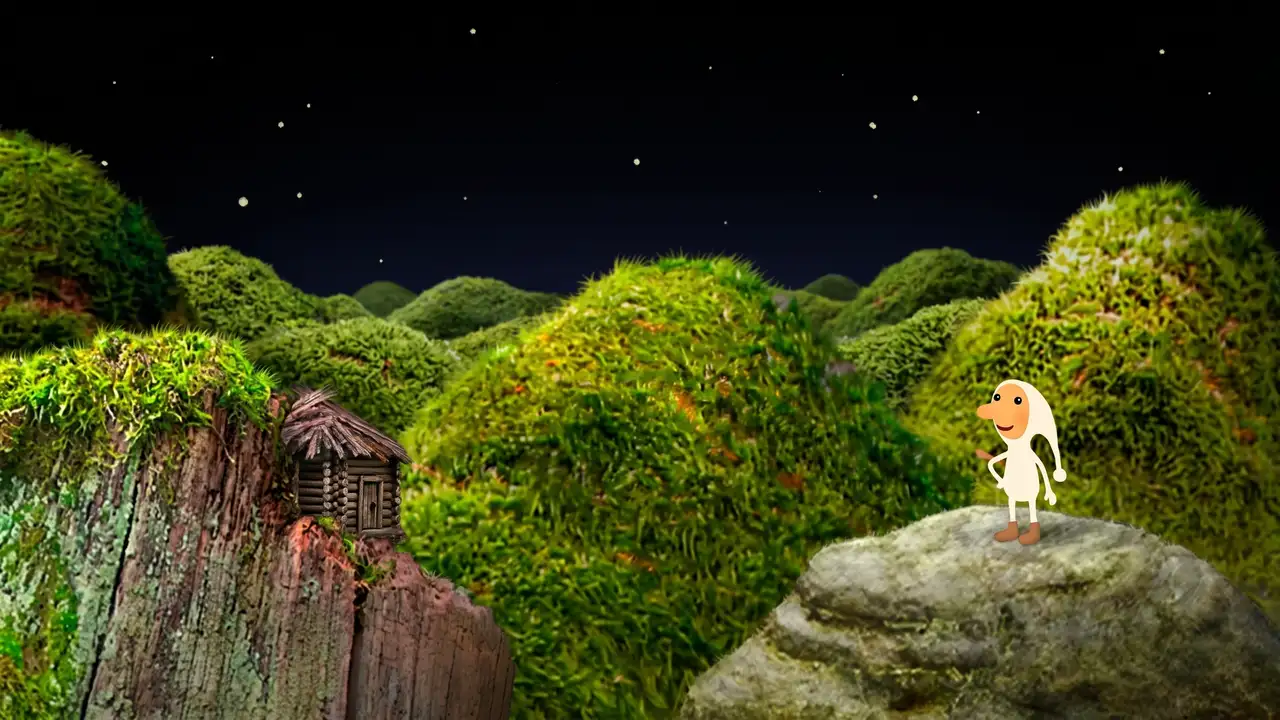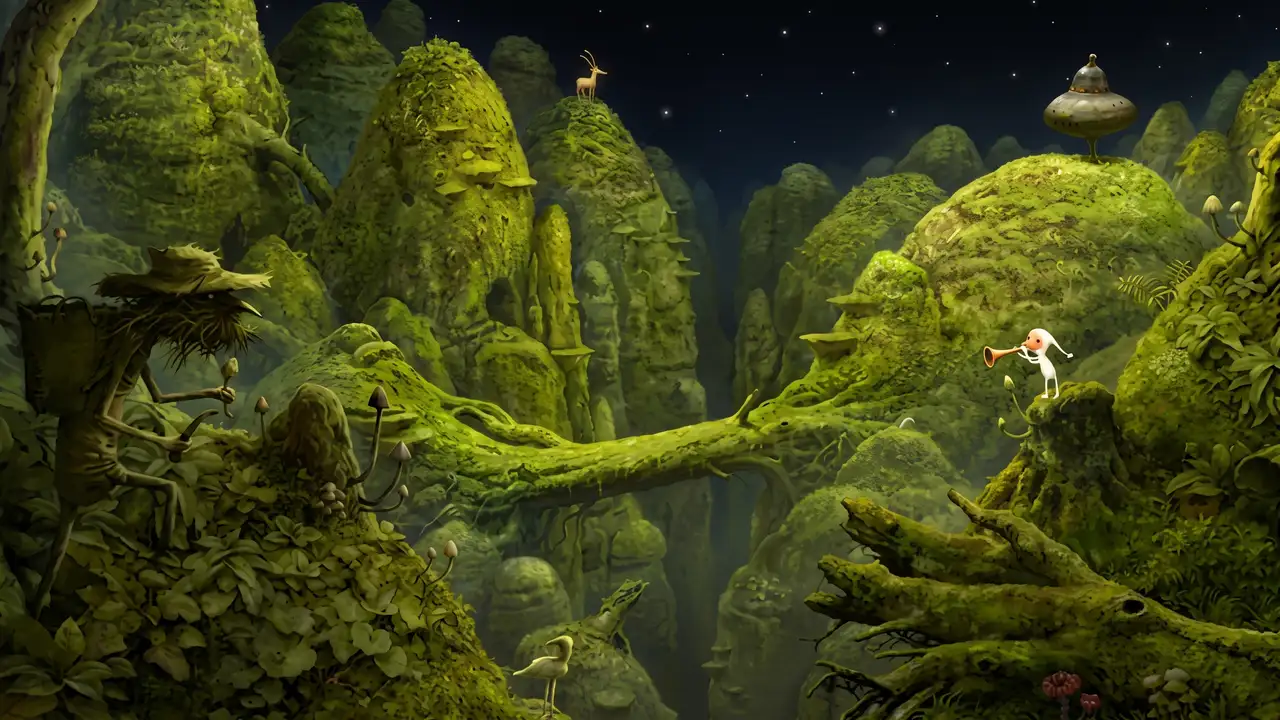
Aliens crash-land near a little space gnome’s home and steal the dog, sending the gnome chasing them across an alien planet and back again. The wordless storytelling holds throughout: characters babble in gibberish, and the whole pursuit is carried by animation, sound and visual gags. The tone lands squarely in whimsical-absurd territory, with a drunk sleeping off the night, a taxi driver who needs fuel, and a creature woken by rum-fish-oil coffee, and the hand-crafted art style is unmistakable, the clear ancestor of the studio’s later, more famous work. A gnome in underpants pursuing dognappers across biologically strange landscapes remains a premise nothing else matches.
The puzzle rooms are the clear highlight, and their variety is the point. Each screen is a small self-contained puzzle of inventory use, timing and environmental manipulation: filling a flask, plugging holes, vibrating objects loose, arranging pipe connections by red dots, timing a balloon fill. No two screens repeat a trick, and solving each builds genuine momentum through the planet-hopping structure. The visual identity impresses from the first screen and keeps earning its place, with animation quality that holds up remarkably well even now.
The scope comes as a genuine surprise for a sequel to a tiny first game. Far more locations than expected and a runtime well past the original’s coffee-break length, the journey stretches across the alien world, its interiors and the long ride home, all without a single line of readable dialogue. The collision of the mundane with the cosmic (pyjamas, coffee, taxis against alien biology) remains the design’s most distinctive trick.
The taxi-fuelling sequence is the low point. A tricky multi-step fuel procedure, capped by the counter-intuitive requirement to jump on the taxi to lower it, produced a stretch where the game seemed broken, with every obvious action exhausted and no feedback pointing toward the answer. The sequence resolves correctly, but the road there depends entirely on the try-everything approach rather than deduction, and nothing in the preceding screens seeds the idea that jumping would matter.
Puzzle logic wobbles elsewhere too. The balloon-timing sequence resists intuitive reading, pacing shifts abruptly in places, and several screens offer far fewer clickable things than point-and-click conventions promise, thinning the interactive texture between the strong rooms. Minor sprite corruption appears on specific screens, attributable to the Proton compatibility layer rather than the game itself, and never rises past an oddity. The protagonist’s plain design, a little figure who looks like a man in pyjamas, amuses throughout and somehow suits the whole enterprise.
The ending restores full goodwill: the dog recovered, an escape by parachute, and a long, satisfying ride home in a wooden flying taxi. The scale reveal lands late and generously, reframing everything before it as a far bigger journey than the opening suggested, and the 2005 Flash-era craft on display is remarkable: smooth character animation, reactive background touches, and organic alien environments that reward patience even where the logic does not.
Overall, a short, delightful point-and-click that still lands two decades on, carried by puzzle variety and a visual identity that ties it directly to its studio’s later masterpieces. The opaque taxi sequence, sparse interactivity and occasional pacing shifts are real friction, but none of it dims the charm of this wordless, hand-drawn rescue mission, and the scope alone makes it far more than a trifle.