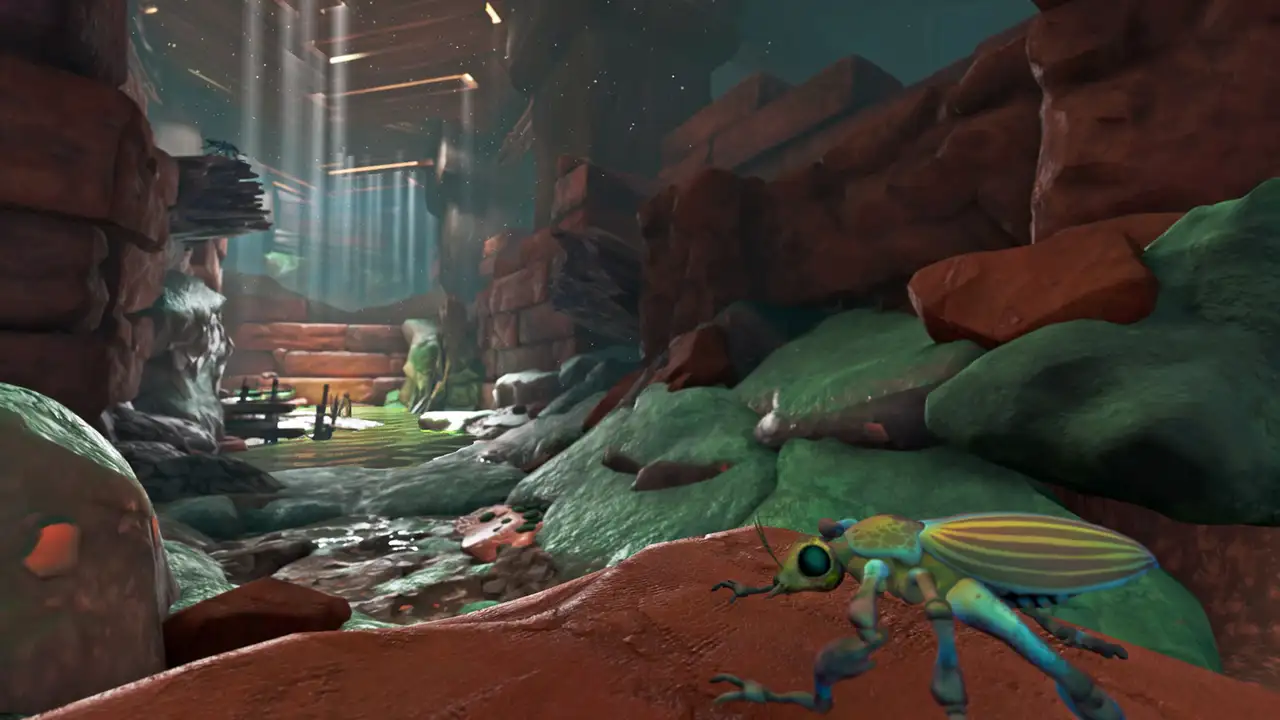
Kafka’s nightmare gets a playable form here, and the premise alone separates it from nearly everything else on the shelf. A man wakes to find his friend transformed into an insect, then follows him into that transformed state: shrunk to bug scale, navigating a bureaucratic insects’ world of boarding houses, lawyer’s offices, gramophone clubs, customs checkpoints, and a cult devoted to a Tower, all to reach the Tower itself and reclaim humanity. Corridors run between floorboards, a boat’s certificate doubles as its sail, and a prison hides inside a desk drawer. It is a loose adaptation of The Metamorphosis crossed with The Trial, and the literary DNA shows in every line.
Writing carries the experience. The satire of paperwork-obsessed insect society lands well, the bug puns earn actual laughs, and the voice work suits the material, particularly in the supporting cast of clerks and schemers. Dialogue crawls at a deliberately ponderous pace that fits the Kafka register even when it tests patience, and the unsettling shrunken perspective sustains the atmosphere of a world utterly indifferent to the protagonist’s size.
First-person puzzle solving happens at insect scale. Climbing furniture, crossing paper streams, and riding pneumatic tubes make traversal itself the puzzle, with the challenge rooted in spatial navigation rather than logical complexity. Inventory-and-environment puzzles (resistors on a gramophone, a certificate machine, a sorting robot keyed to a specific code) stay light throughout, and frequent deaths come from environmental hazards like poison floors and crushers rather than any real difficulty. The platforming across paper streams is brief and unobtrusive.
The Tower ascent provides the structural spine, a pilgrimage through ever-stranger bureaucratic strata that culminates in a finale whose most memorable detail is how small the act of collapse turns out to be. The central mystery of what the protagonist’s friend actually did never resolves, which reads as thematic fidelity to Kafka but leaves the narrative dangling for anyone expecting answers. Two endings differ only in their final half-minute, so the choice carries almost no weight.
Performance history is the cautionary tale. On Xbox One, the game is borderline unplayable past a certain point: paper-heavy zones collapse to 10-20 fps, black screens interrupt, and crashes end sessions. The render resolution appears lowered in an attempt to compensate, which did not work. On Xbox Series X the transformation is total: 60 fps, faster loads, and crisper visuals that make the same scenes look like a different game. The experience on modern hardware is the one this game was built for.
Audio glitches mar the presentation. Dialogue occasionally cuts into static, an intermittent fault that never persists long enough to break immersion but recurs enough to notice. Everything else in the sound mix, from the voice performances to the ambient insect-scale soundscapes, works in service of the atmosphere. The static bursts are the exception in an otherwise careful presentation.
Progress syncing blocks a clean restart of an old save, forcing a continuation rather than a fresh start, and the low difficulty means the game leans entirely on novelty and writing rather than mechanical depth. Neither complaint seriously threatens the experience, but both are worth knowing before starting: this is a four-to-five-hour narrative journey whose replay appeal rests almost entirely on seeing the alternate ending’s thirty seconds.
Overall, this is a genuinely unique literary adaptation, a first-person Kafka simulation at furniture scale that no other game offers, with writing and atmosphere strong enough to carry it. Last-gen performance is disqualifying, audio static recurs, and the endings barely diverge. On current hardware, the premise alone justifies the visit.