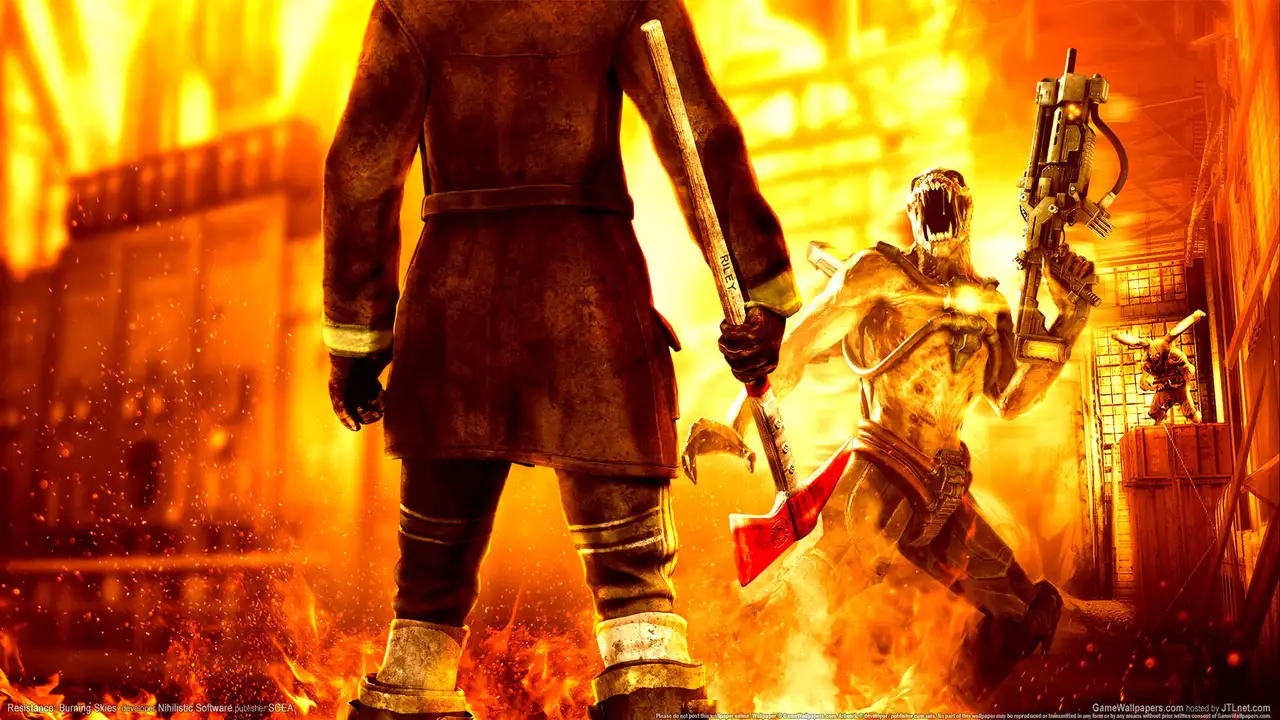
A firefighter protagonist searching 1951 New York for his family during an alien invasion gives this handheld shooter its pulpy 1950s war-drama frame. Propaganda broadcasts, protection camps, and a human-controlled-Chimera experiment on Ellis Island flesh out the setting, while collected intel notes reward lore hunters with the Liberty Defense Project’s secrets. As a side story to the mainline series, it covers familiar Chimeran ground, but the period New York setting and civilian hero give it a distinct register. The tone holds together better than its runtime suggests.
Visually the Vita hardware punches above expectation. Character and creature models sit somewhere between the previous two console generations, leaning toward the newer one, and the Chimeran designs translate convincingly to the small screen. For a handheld first-person shooter of its vintage, the presentation holds up remarkably well, and the environment art in the New York streets carries the atmosphere. It looks like a proper entry in the series rather than a scaled-down spin-off.
Touch controls define both the identity and the liability. Screen taps handle enemy tagging, grenades, weapon-wheel upgrades, and the Auger shield deployment, while the crossbow loads bolts through touch-dragging. Every first-party system gimmick appears, forced into scenarios whether or not they help, and the grenade throwing in particular works poorly enough to cause self-inflicted deaths. Tagging prompts repeat so often they become a running joke, and the design trusts the touchscreen in exactly the moments players trust it least.
The weapon arsenal compensates. Grey Tech cubes unlock upgrades two at a time, the Auger’s cover-piercing fire remains a series highlight, and the Mala’s ammo-free secondary fire releases a glass-shattering burst that clears most encounters without spending a round. Its regeneration is fast enough to border on broken, and the hybrid rail-gun functionality makes it the arsenal’s toy of choice. Grenade supply is generous, and the shooting feel on a paired console controller is genuinely solid.
Level design holds until the finale. Linear corridors and arenas deliver competent mid-2000s shooter structure, then the last level abandons cover entirely and swarms the player with enemies that kill in two or three hits. Hunters two-shot at range, swarms charge from every angle, and retries pile up against encounters with no tactical answer beyond bullet volume. The finale’s difficulty spike comes from removing options rather than adding challenge, and it stains an otherwise well-paced campaign.
A story-scene bug disrupts one mid-game sequence: a cutscene fails to play, a companion says nothing, and the only fix is a deliberate death and a re-approach from a different angle. A hidden new-game option nearly caused a false start at the beginning, buried deep enough in menus to miss. Neither issue is campaign-defining, but both point to a rushed polish pass.
Length runs around four hours, shorter than commonly listed, making it the briefest chapter in its series. The pacing suits a handheld session, and the sombre finale lands with more emotional weight than the pulp premise promises, closing on a register the preceding missions never attempt. Intel collectibles and the upgrade hunt give a light replay hook, though the linear structure limits returns.
Overall, this is a surprisingly playable handheld shooter whose core gunfeel, Auger-and-Mala arsenal, and convincing Vita visuals outweigh its flaws. Mandatory touch gimmicks, a no-cover finale swarm, a cutscene bug, and a buried new-game option are the stains. As a short chapter closing a beloved series, it does the job with more craft than expected.