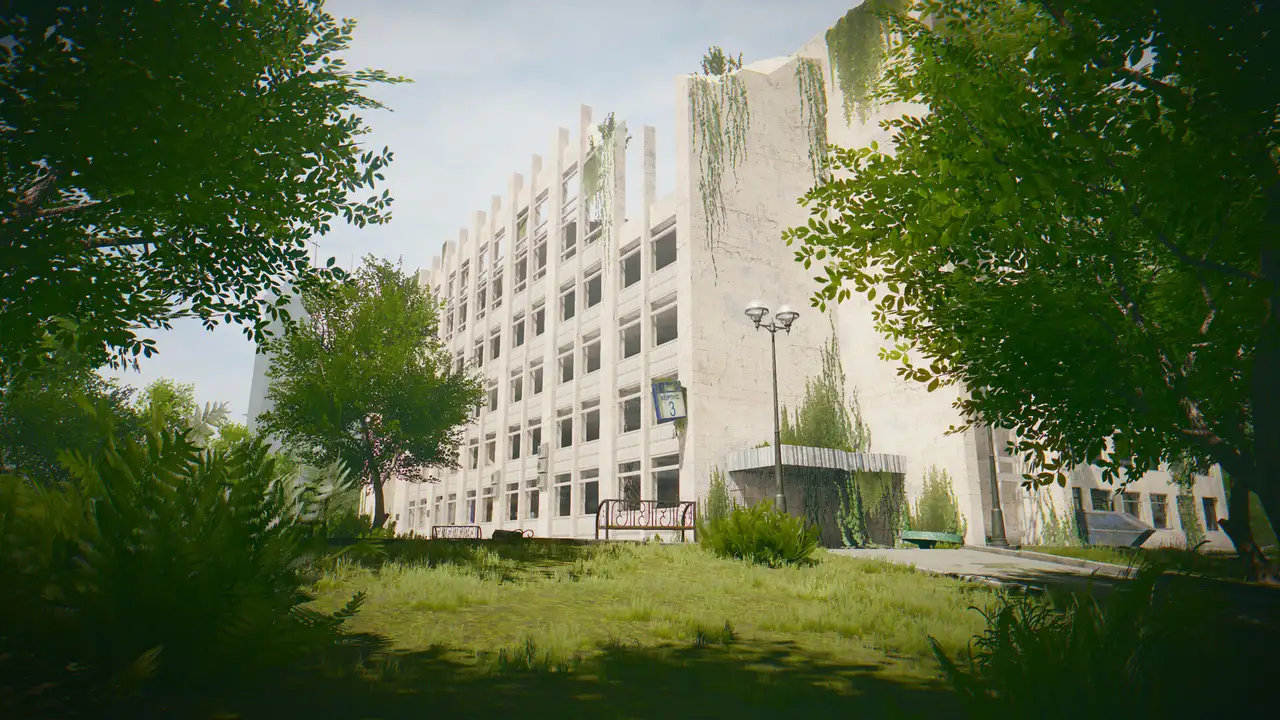
An abandoned Soviet-era institution after an unspecified catastrophe provides the entire stage: one building, plant-reclaimed corridors, untranslatable signage, and found notes that chart survivors herded inside, a ministry call, an air-raid alert, and 638 deaths across 24 days. There is no combat, no death, and no traditional scares; the tension is purely environmental. The wordless storytelling trusts notes, graffiti, and matter-of-fact reports of mass death to build its dread, and the Russian setting gives it an identity apart from Western walking sims.
Atmosphere is the defining achievement. Inanimate objects turn unsettling through silhouette alone, with outline shapes reading as people at the edge of vision; distant faces peer from graffiti; birdsong and Soviet signage layer unease onto every room. The game conjures quiet dread from suggestion rather than scripted frights, and it sustains that register from the first minute to the finale. Few releases of its kind do more with less.
The basement sequence is the peak. Quiet exploration escalates into flickering-flashlight horror with screaming, footsteps, moving shadows, and music that turns the descent genuinely disturbing, and the tonal shift lands hard precisely because the first hour never raised its voice. A lecture-hall projector earlier in the building plants one of the campaign’s cleverest tricks, a figure that is not a person, and the basement pays off every seed the upper floors planted.
Puzzle design splits the difference. Clever touches abound: a note-driven locker order, a 638-person locked-door code, a cryptic film projection, and a fuel can, fuse, and lighter chain that restores power piece by piece. But keyhunts go unhighlighted, and a basement-key bottleneck stranded progress until a wardrobe pushed over in the opening minutes turned out to have been hiding it all along. Objectives never announce themselves, which suits the tone while taxing patience.
The flickering-flashlight sections are the most physically unpleasant stretch. Constant strobing strains the eyes and makes navigation genuinely hard, though the sections are better traversed with the torch off, a solution the game never suggests. A looping air-raid corridor overstays its welcome, and a claw-machine mini-game near the end arrives as a fiddly oddity that baffles more than it challenges. None of it breaks the mood for long, but the strobe in particular needed a gentler hand.
Progression runs about two hours across a light object-hunt: find the keys, restore the power, descend, solve the code, watch the film, and follow the light to the ending. The run button matters enormously; without it the experience would stretch near double. Two genuine blockers occurred, both traceable to player oversight rather than design cruelty, and the game’s refusal to guide is a deliberate stance rather than an oversight.
The found-note storytelling earns its bleakness. Ministry correspondence, survivor accounts, and the mounting death count build a grim picture without ever dramatising it, and the ambiguous final choice leaves the protagonist’s responsibility hanging. The closing register shifts into something ascetic and unsettling, a tonal turn that lands because everything before it stayed so restrained. The ambiguity rewards reflection rather than demanding interpretation.
Overall, this is a short, quietly devastating walking sim whose silhouette-and-sound dread, basement descent, and grim found-note storytelling outweigh the unhighlighted keyhunts, eye-straining strobe, and fiddly mini-game. It demands patience and offers no markers, but rewards them with an atmosphere few games of its scale achieve. A rewarding two hours for anyone after dread over shocks.