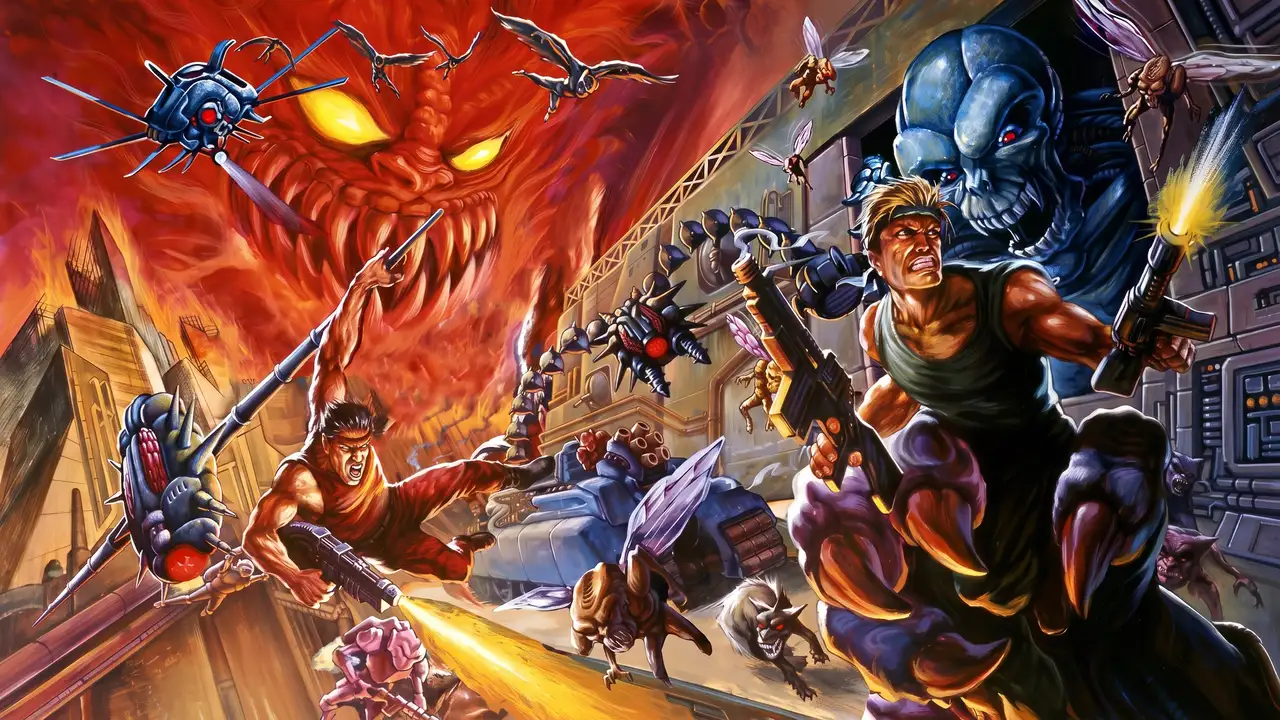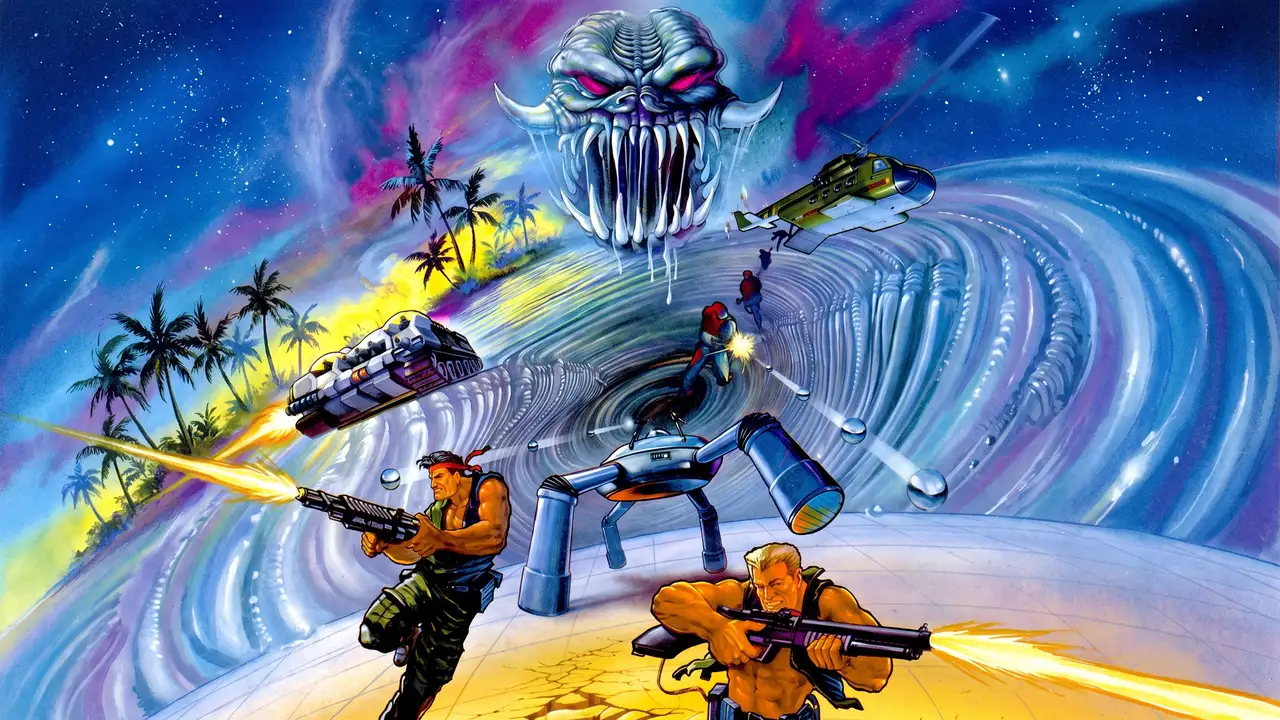
A near-future military thriller opens with an elite squad hunting a rogue colonel who has stolen an alien cell, and the escalation never lets up: betrayals, a mid-game defection offer and a full cyberspace dive sit inside a run-and-gun that once had no plot at all. The premise alone separates this entry from its arcade-rooted predecessors. Absurdity is worn openly, and the conspiracy framing gives the chaos a spine. Few 16-bit action games attempted this much narrative in between explosions.
Four playable characters anchor the variety, including a wolf and a robot with genuinely different kits, and switchable shot types let each run play differently from the last. Climbing on any surface opens routes the older games never allowed, and a health-bar system replaces the series’ one-hit deaths while cheat lives remain available for those who want the classic punishment. The kit is the most mechanically experimental of its era, closer to Treasure’s Gunstar Heroes lineage than to Contra’s arcade origins.
Branching level paths define the structure. Early choices are presented with little explanation of what they mean, which reads as mystery on a first attempt, but each selection leads to genuinely separate levels rather than a cosmetic detour. The payoff turns the campaign into several distinct games in one cartridge. Reaching the boat level through one branch reveals how differently another route must play.
The cyberspace zodiac boss fight shows the design at full stretch: a transformable encounter themed on star signs, fought inside a digital arena that escalates through phases no prior Contra attempted. Transformable bosses recur throughout, each mutating into new shapes with fresh patterns. The doctor’s mutant-laboratory sequence pairs its grotesque creations with the game’s finest music, a driving composition that lifts the fight into the cartridge’s highlight. The final boss fight crowns the set with the densest patterns of all.
The soundtrack is the single biggest artistic achievement. The Mega Drive’s signature crunch gives every track an aggressive texture, and the composition quality holds up across stages rather than peaking once. It earns affectionate digression on its own terms: this is part of the era’s charm, when the same-named SNES and Mega Drive games were entirely different products. Against the doctor and his creations, the music and spectacle lock together completely.
Hazard readability is the main flaw. Screen objects rarely signal whether touching them is lethal or safe, and the ambiguity bites hardest in the finale, where identical-looking effects kill or pass through without pattern. Confusing boss bullet patterns compound the problem when the screen fills with projectiles of mixed danger. Early control confusion over button mapping and shot-type switching adds a short learning curve. All are friction, none fatal.
Difficulty is punishing by arcade design, and the health bars soften only the sharpest edge. What keeps the punishment fair is generosity elsewhere: checkpoints arrive quickly, respawn recovers momentum, and the patterns reward repetition rather than randomness. The spectacle variety does the rest, hurling a new set piece at nearly every stage. Little else of the period tried this many ideas per cartridge.
Overall, this is the most ambitious and story-driven entry the series produced in the 16-bit era, with set-piece variety, branching levels and a soundtrack that outclasses its competition. Hazard readability blurs the rules of the battlefield and occasional pattern opacity tests patience. Neither flaw dislodges the achievement: a wildly inventive high point that plays differently on every route.