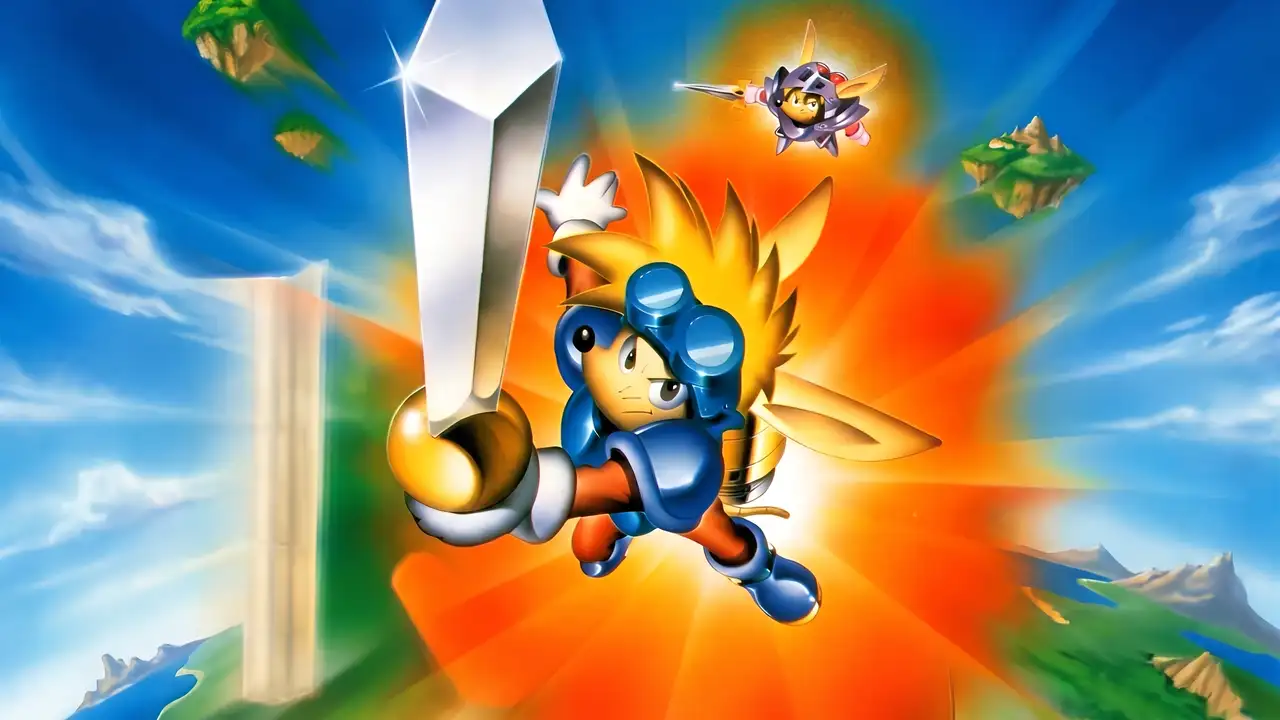
An armoured opossum knight storms the Devil Pig kingdom to rescue a kidnapped princess across six stages of Konami spectacle, and the campaign escalates from forest assaults to an orbital attack on the pigstar itself. The damsel plot is amusingly dated in the way only a 1993 release can be, part earnest action and part mechanical absurdity. Armoured pigs, a casino-style stage and clothing-stripping attacks share the runtime without any tonal conflict. The whole enterprise commits fully to its own nonsense.
The dash and rocket burst give the combat an identity no contemporary matched, functioning simultaneously as attack, mobility and escape. The sword dash closes gaps and deflects threats, while the short-range rocket burst doubles as a projectile and a traversal tool, though commitment is heavy once airborne. Neither control behaves like a standard platformer’s, and that unfamiliarity is precisely the appeal. Few heroes of the era moved like this one.
Every stage ends with a distinctive boss, and the variety carries the entire campaign. A multi-phase gauntlet escalates through the mid-game, a famous counter display tracks a 200-hit duel, and the finale stacks ship battles against an approximately sixteen-hit closing brawl. Each encounter behaves by its own rules, and none repeats another’s structure. The parade of inventions gives the six stages a rhythm of constant escalation that ordinary level design rarely sustains.
Difficulty lands in demanding-but-fair territory, with kind checkpoints placed inside stages to soften the blow of section restarts. Deaths send the clock back only to the nearest marker for most of the campaign, which keeps momentum alive through the harder stretches. Stage restarts on death still sting in the longer levels, and repeated boss loops turn from lessons into chores when a fight drags. The balance holds until the final act, where the generosity thins noticeably.
The pigstar ship interior and the ship gauntlet that follows it repeat long sections after single deaths, and this is the most punishing stretch in the game. An approximately sixteen-hit closing boss that restarts wholesale on failure turns the endgame into a memory test as much as a reflex one. Two stages earlier, the minecart race and the lava ride are outright bad, built on instant-death hazards with no control once committed. Air control after a jump is minimal throughout, making some hazards feel like pre-written deaths rather than recoverable mistakes.
Visual craft impresses for 1993 hardware, with water effects, reflections and background detail that exceed expectations for the sound chip’s limitations. The audio is a pleasure in itself: crunchy, characterful Mega Drive synthesis with boss music that justifies the repetition it underscores. Unclear hit feedback occasionally clouds the picture, since damage sources such as propellers, fans and an overcharged shot that explodes in hand cause confusion deaths. Hard mode alone unlocks the true ending, a gate that reads as cheap from the normal campaign’s conclusion.
Overall, this is Konami’s Mega Drive craft at close to full power, and the parade of inventive bosses alone justifies the trip. The dash-driven combat, strong presentation and mostly kind checkpointing carry six stages, while the minecart and lava rides, wholesale restarts in the ship gauntlet, and a hard-mode-locked ending leave visible rough edges. Every stage earns its ending, and the recommendation follows from that.