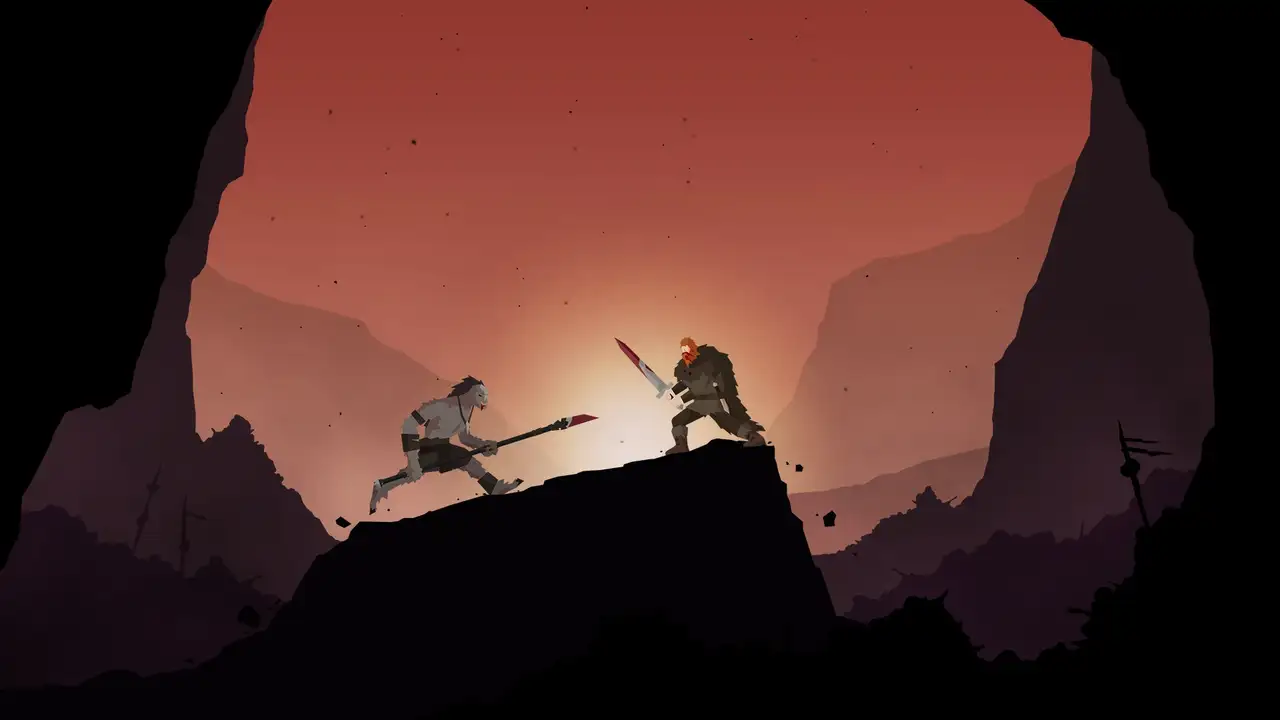
A faceless warrior crosses a hostile wilderness toward family, and the game tells that journey entirely through environment, item descriptions and gesture. No dialogue, no faces, no tutorial hand-holding; the opening offers nothing as conventional as a prompt, and the bleakness of the trail, littered with other travellers’ remains and abandoned supplies, says everything the script refuses to. Austere is the operating word, and the game commits to it completely.
Traversal itself is the first statement. The journey runs right to left, a direction of travel almost nothing attempts outside the occasional Metroidvania, and the reversal makes every route read as unfamiliar. Combined with a power dynamic where nearly every creature can kill in a few hits, the weakest-thing-out-here framing turns simple movement into a decision. Scavenging supplies herbs, sticks, bones and leather, and crafting converts them into torches, tonics, bone armour and daggers at campfires.
Combat is deliberate and readable. High and low attacks telegraph clearly, blocking and reposting reward patience, ducking handles spear thrusts, and shoulder bashes break shield users. The system asks for observation rather than reflex, and once its rules click at the first campfire tutorial, fights become conversations rather than tests. Generous checkpointing backs the demanding-but-fair design; death never costs meaningful progress, so the difficulty reads as intent rather than punishment.
Pacifist routes are a genuine highlight. Trading herbs, offering totems and flashing neutral signs let whole encounters pass without a fight, and the game honours avoidance as a legitimate playstyle rather than an exploit. Most confrontations can be talked, traded or gestured past, and choosing restraint feels like a real choice with real rewards. Few combat games extend that respect to non-violence, and the option reframes every fight beforehand: knowing a peaceful exit exists makes each aggressive choice a deliberate one rather than the only path forward.
Supplies never quite run dry, but the pressure never fully lifts either. Finite resources force genuine triage between torches for dark stretches, tonics for the wounded and armour for the road ahead, and item descriptions carry much of the storytelling burden, grim little notes that document previous travellers’ ends. The economy is tight enough that scavenging feels purposeful without ever becoming grind, and the crafting menu stays small enough to hold in the head. Survival here is texture rather than bookkeeping, which suits the journey’s pace.
The dream-sequence sparring at campfires is the balance’s one soft spot. Fully healing every wound for free, it functions as an oversight the design never intended, and leaning on it drains the survival pressure the scavenging loop otherwise builds. The compass system, by contrast, earns its simplicity: a quiet navigation aid that never interrupts the wordless tone.
Rolling off ledges drops sword and supplies, punishing Souls-trained reflexes repeatedly, though the fault sits closer to cross-game muscle memory than design cruelty. The black-screen launch and minimal opening signalling do make the first minutes opaque. Neither issue undermines what follows, but both add friction the austere presentation does not need.
The final boss is the campaign’s one genuine wall. Its attacks cannot be blocked, it dodges through the player’s, its moveset switches mid-animation, and dodge hitboxes feel unfaithful; a long stretch of repeated deaths against rules that contradict everything the combat has taught. The spear-troll gauntlet earlier serves as a fair difficulty spike by comparison, a lesson the finale ignores.
Overall, this is a short, fair, quietly distinctive journey home whose readable duels, pacifist respect and austere confidence outweigh a muddled final duel and a healing exploit. The right-to-left traversal, the hostile-weakness power dynamic and the wordless storytelling mark it as genuinely rare, and the generous checkpoints make every death a lesson rather than a loss.