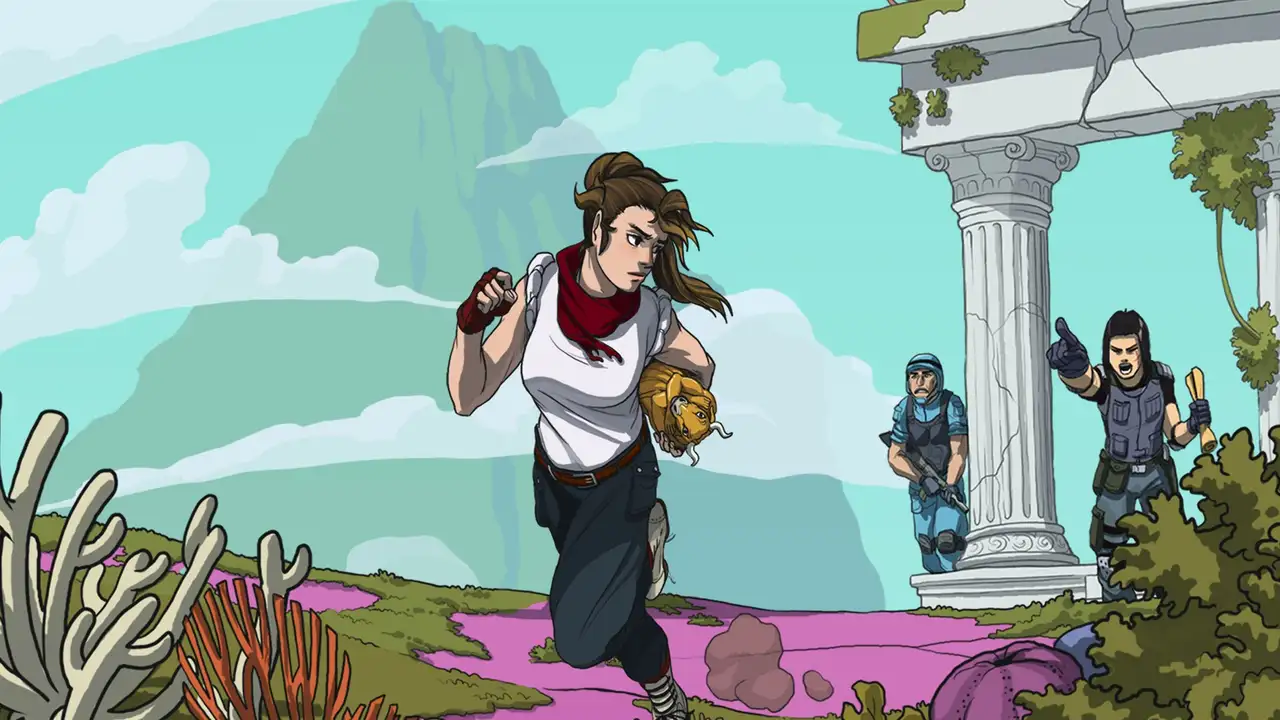
A resurfaced Minoan island hides its secrets behind a time loop, and Treasures of the Aegean turns the excavation into a side-scrolling parkour expedition told through ghostly spirits, murals, translated Linear A tablets and story chapters set years before the collapse. Council hierarchies, priestesses and the Poseidon myth layer the lore with real archaeological grounding, and the prophecies’ historical descriptions hold up under scrutiny. The art style charms from the opening frame, and the genre resists easy classification, wearing a metroidvania’s shape while withholding the one thing that genre depends on: new abilities.
Momentum is the entire toolkit. Rolling builds speed, wall-running carries across chasms, auto-climbing eats vertical faces, and rope swings stitch the traversal together, all of it combat-free. Discovering the roll’s extra momentum is the turning point, the moment unreachable treasures become possible and the huge map contracts into something fast and satisfying. The character’s burst of speed makes the absolutely massive terrain feel smaller with every cycle, and traversal stays enjoyable from the first sprint to the last.
The interlocking puzzle web is the design’s quiet triumph. Cogs, gems, medallions and murals feed puzzles in other areas, and everything connects in a way that rewards planning each cycle around one clear goal rather than wandering. The structure invites direct comparison to The Legend of Zelda: Majora’s Mask, with mini-quests completable within a single cycle and prioritisation as the core skill. Each loop’s timer extends as treasures are found, and multi-cycle campaigns, such as the final treasure hunt, reward genuine planning.
Progression splits in a way that stings as often as it satisfies. Treasures, shrines and knowledge persist between loops, and the persistence is wonderful, but key quest items such as gems and the eye reset every cycle, so a near-miss at the timer’s edge means redoing the entire legwork. Knowledge-gated rather than ability-gated progression keeps the subversion consistent, with momentum as the only ability that ever changes. The loop counter climbing toward the finish gives the whole structure an arc that the credits cap cleanly at everything complete.
The map is both selling point and frustration. Its sheer size impresses, yet the black marks charting unexplored squares are ambiguous, some squares fill only by hitting ceilings, and most marks turn out to be the edge of a wall rather than anything important. Full charting becomes an obsession precisely because the system refuses to say what matters, and hundred-percent completion demands patience with that ambiguity. Reaching a handful of treasures seems genuinely impossible until the roll-momentum trick clicks, with the gold-snake swing and a far-altar dash the worst offenders, and the opacity borders on maddening before the breakthrough.
One crash interrupts an otherwise stable package. Opening the map at a cycle’s end locks the game and costs that loop’s finds, annoying but recoverable, and the damage is bounded by the persistence rules. Grammatical slips dot the localisation. Neither flaw dents the core loop, and the final verdict holds after every treasure is collected and the full prophecy is complete.
Overall, Treasures of the Aegean is a genuinely different, combat-free time-loop explorer whose momentum-driven traversal, interlocking puzzle web and Majora’s Mask-style cycle planning reward focused, deliberate play across a massive island. Ambiguous map marks, reset quest items and one mid-loop crash are honest costs, and the whole adds up to a cult gem worth finishing.