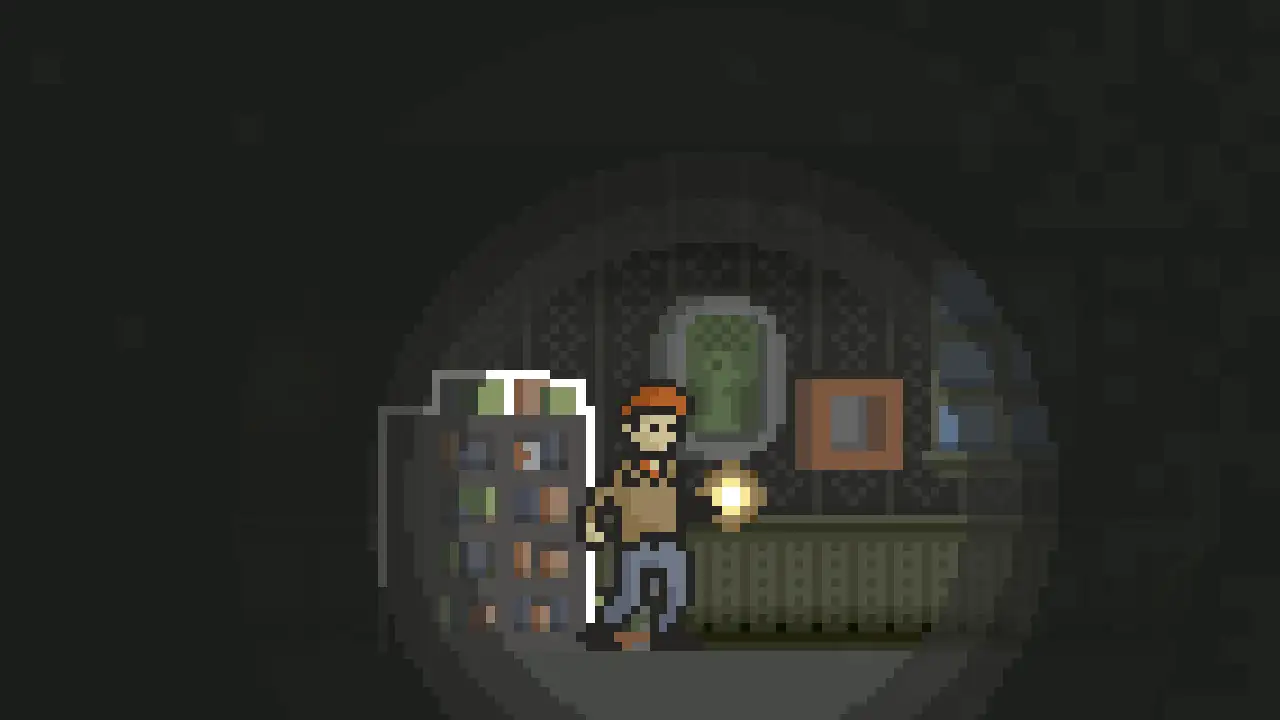
A lonely girl is summoned into a castle built from a cast-out goddess’s memories, and LOVE ETERNAL builds its fiction on death-jump rooms that form an increasingly sinister act of friendship. The story arrives through deliberately jarring fragments: a tablet-reading narrator, a too-eager classmate, a family that eats from dog bowls. Small details (the dog-bone house plaque, the eye behind the manga, the bone-shaped nameplate) recontextualise everything the longer the game runs, and the unease accumulates precisely as designed. The atmosphere’s power comes from discomfort rather than shock, and it never loosens its grip. This is a short game that makes every scene count.
The core loop is a flip-gravity platformer of the VVVVVV school: run, jump, one mid-air gravity flip, with red stones to regain the flip ability. Rooms are short, screen-sized trial-and-error puzzles with a checkpoint on nearly every screen, generosity that keeps the pixel-tight flip timing fair. The jump sound is the most satisfying thing about the game, a small reward repeated hundreds of times. Difficulty spikes come from momentum management rather than raw execution, and the trial-and-error design suits the short format. As pure platforming, it is competent and occasionally brilliant.
The creepiness is genuinely effective, with unsettling character designs and forced friendliness that curdles the longer it holds. The dog-bowl breakfast and the goddess’s charm offensive linger long after the scene ends, and the middle act’s slow-burn pacing earns its discomfort. The unsettling quality comes from what is implied rather than shown. Horror through hospitality is an underused register, and this game owns it. The creeping unease is the campaign’s most memorable quality.
Inconsistent momentum turns some platforming rooms frustrating rather than challenging, with the physics refusing to settle into a predictable rhythm when the pixel-perfect timing demands exactly that. The red-stone tutorial arrives well after the mechanic first mattered, oddly sequenced teaching that should have opened the first room needing it. The 4:3 aspect ratio shifting on and off mid-game can disorient when intention is unclear. A permanently blocked right-hand path teases curiosity the game never resolves. These friction points are real but small against the whole.
The structure keeps its own counsel about where it is going, and the ambiguity serves the sinister-friendship framing well. Scenes of apparent warmth sit beside rooms of laser-tight platforming, and the dissonance between hospitality and hazard is where the dread lives. The pacing alternates pressure and stillness deliberately, giving the trial-and-error rooms time to sting before the next unsettling conversation. Nothing outstays its welcome, and nothing tips its hand early. The restraint is a design virtue few short games manage.
Roughly two to three hours covers the story in one sitting, and the density of ideas justifies the brevity rather than apologising for it. The checkpoint generosity makes the masocore tendencies approachable, and the slower stretches give the middle act breathing room. The finale’s structural confidence lands with genuine force, reframing the journey without invalidating the platforming. Short, clever and unsettling, the game earns its send-off through disciplined execution and a willingness to keep its secrets.
Overall, LOVE ETERNAL is a short flip-gravity platformer whose creeping unease, generous checkpoints and unsettling detail work deliver one of the most memorably uncomfortable few hours in recent memory, held back only by inconsistent momentum, a late tutorial and an ambiguous aspect ratio. The atmosphere and the trial-and-error craft are the twin reasons to play. A short, clever, unsettling game that keeps doing more things right up to the credits.