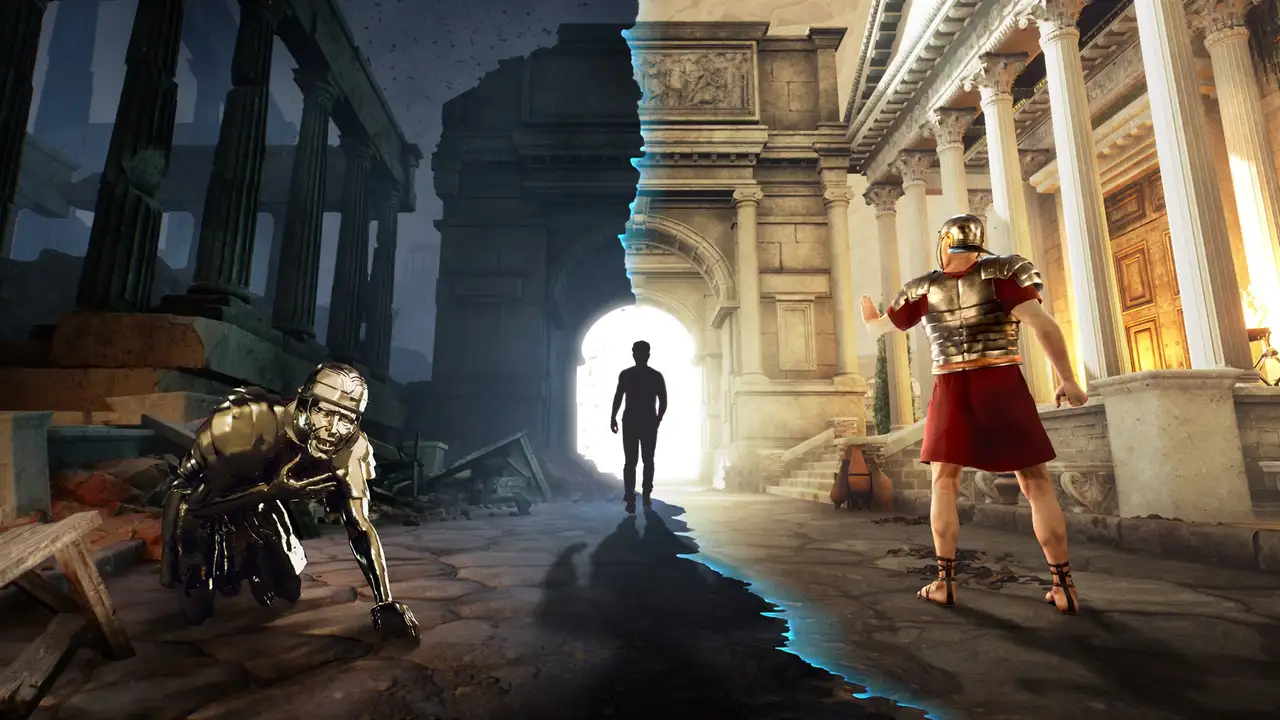
A stranger wakes in an underground Roman city where a single supernatural law binds everyone: commit one sin and the whole population turns to gold. Twenty-three residents go about their day under that threat, and the newcomer’s task is to work out who among them might break it before the punishment falls. The premise sounds like a whodunit, and it plays like one for a while, but the mystery keeps unfolding into stranger and more ambitious territory. What began as a fan mod grew into a full standalone release, and the transition shows in how confidently the writing carries the whole structure.
Dialogue is the core mechanic. Nearly every problem yields to conversation: gathering testimony, cross-referencing stories, exposing contradictions, and eventually out-arguing opponents in formal Socratic exchanges that engage on their philosophical merits rather than existing as filler. The writing stays sharp throughout, dense with quotations worth remembering, and the cast (a cheerfully smiling water-carrier chief among them) gives the city genuine warmth. Choosing a fugitive background exists purely for the sprint-speed bonus, and even that choice reinforces how much of the game is spent running between conversations.
The time loop structures everything without pressuring anyone. Each loop covers a repeating day, and nothing punishes slow exploration; the only timers attach to achievements. Better still, solved tasks can be delegated to Galerius on subsequent loops, easing the tedium of repeating errands while freeing time for new threads. The delegation feature has drawn criticism elsewhere, but the reasoning holds: repeating identical conversations manually adds friction without depth, and handing them off turns the loop into a detective’s case board rather than a chore wheel.
The Diana shrine bow heist stands out among the set-piece puzzles, a plan built around stealing an artifact, managing a double-cross, and improvising when the scheme wobbles. Elsewhere an obelisk puzzle ties four civilisations’ plaques into a single translation challenge, and the mythological layering (Greek, Egyptian, and Sumerian accounts of the same gods, each plagiarised from the last) rewards reading every inscription. Trickier objectives, such as arranging a fatal confrontation with an assassin, resolve through dialogue and preparation rather than force.
Combat is deliberately minimal. A golden bow appears in only a few areas, used to shoot cursed statues that petrify on sight, and the physics of kicking one into a curtain provide the game’s only real action comedy. The statues themselves watch silently from their pedestals, less menacing than a certain Doctor Who villain but unsettling all the same. Anyone expecting an action game will find almost none; the design bets everything on investigation, and the bet pays off.
Visuals split the difference between spectacle and budget. Ray-traced marble, dramatic underground lighting, and the landscape itself impress constantly, while character models and lip-syncing lag well behind, stiff enough to undermine otherwise strong conversations. Zip lines suffer a similar half-measure: they exist, but reaching most of them requires climbing higher than the destination, which strips out their convenience. The whisper hint system helps more than it harms, though it hands over puzzle answers early enough to deflate a few solutions, and NPCs stopping to rotate fully toward you before every exchange wastes an accumulative amount of time.
Multiple endings give the mystery real replay structure. Four conclusions reward different approaches to the city’s central problem, and the loops make experimentation cheap: knowledge persists, delegation accumulates, and each run moves faster than the last. An epilogue set in the modern day closes every saved citizen’s arc with a warmth that lands after the darkness underground, and the museum setting doubles as a victory lap for the writing. Roughly nine hours covers full completion, with the second run going faster even without skipping dialogue.
Overall, this is a remarkably smart dialogue-driven mystery whose philosophical writing, mythological worldbuilding, and forgiving time loop reward a second full playthrough. Stiff character models, over-eager whispers, and cosmetic friction are the only blemishes on an otherwise confident debut. Out-arguing the ruler of the dead in a formal debate is worth the price of admission alone.