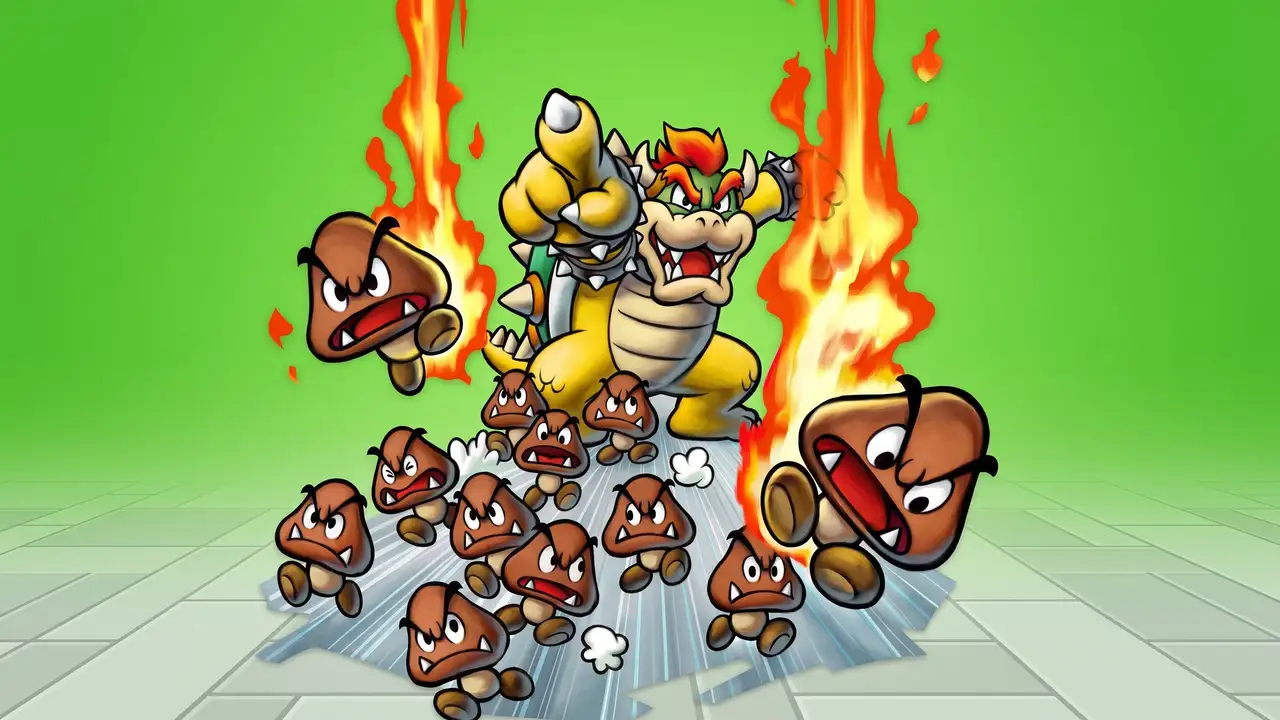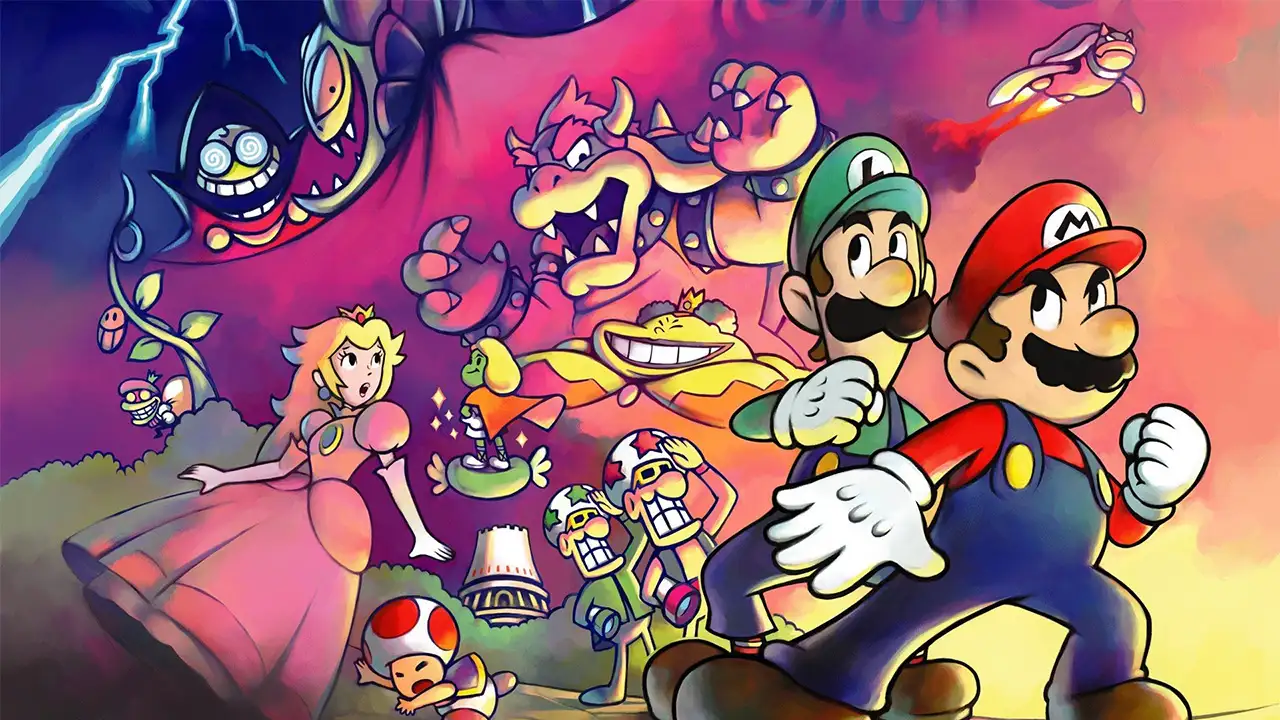
A time-travel plot pairs two adult plumbers with their baby selves on a rescue mission into an occupied past, and the dual-era structure gives the campaign a shape no predecessor attempted. The invader roster swaps the usual Goombas and Koopas for an alien menace, and the dungeons run from deserts through volcanoes to a mothership and the castle of the past. Writing and character work are consistently strong, and the cast carries the whole adventure. The formula’s second entry chooses experiment over refinement, and the results are mixed but fascinating.
The comedic writing is the campaign’s standout, measured even against the series’ celebrated first outing. A rambling talking suitcase delivers tutorials-speak with genuine charm, a bean-obsessed returning villain steals his cameo with incomprehensible proclamations, a koopa reporter works her schtick, and a double-act between a steward and his younger self supplies running gags. The cobalt star twist lands as a genuine surprise followed immediately by a fight. Few role-playing games of any era write this well, and none of it is accidental.
Four-character party combat adds real depth, with every attack carrying an adult and a baby variant. Piggyback jumps and baby-slam hammers turn the two-tier party into a genuine tactical layer, and badge-based passive builds (the Cure Badge’s per-turn healing becomes a sensible default) reward planning. Enemy attack tells are generous, timed action commands stay responsive, and the instant-save system is a genuine quality-of-life revelation over the previous entry. The combat system, once learned, is the best in the series to that point.
Bros. Items replace the unique Bros. Attacks with consumable special moves, and the trade remains genuinely conflicted from start to finish. Cannonballer, Trampoline and Copy Flower are great fun, and one flower combination is powerful enough to trivialise encounters when its rhythm is maintained. Yet the items are cheap and spammable, lacking the identity that named attacks gave the first game, and the balance holds only because bosses carry health pools in the thousands. The experiment is interesting rather than successful.
The opening hour is a tutorial barrage of remarkable density, teaching even item use in explicit steps and spelling out puzzle solutions through the suitcase. Compared with the first game’s near-perfect tutorial spacing, the hand-holding grates on any experienced player, and progress in the first session crawls. Status effects compound the frustration, lasting far too long and stunning characters to death repeatedly. The four-button control scheme also causes constant mis-inputs on the most elaborate combination attacks. These three flaws account for nearly all of the friction.
Item generosity is extraordinary, dungeons are straightforward with little reason to revisit, and areas feel one-and-done by design. Reviving enemies annoy in the late game, and the finale’s no-healing constraint nearly defeats the party twice despite the encounter itself being well designed. The catchy soundtrack runs throughout, memorable enough to hum along to across most areas. Difficulty sits low throughout, with item spam trivialising regular encounters, but the polish and pacing of the late campaign recover much of the momentum.
Overall, the comedic writing, four-character combat depth and catchy music make this a charming and generous handheld RPG, and the series it belongs to ranks among the finest the platform ever hosted. The tutorial barrage, long-lasting status effects and identity-less item attacks are experiment-shaped blemishes rather than structural failures. What the design attempts, it mostly lands, and the journey justifies the rough edges.