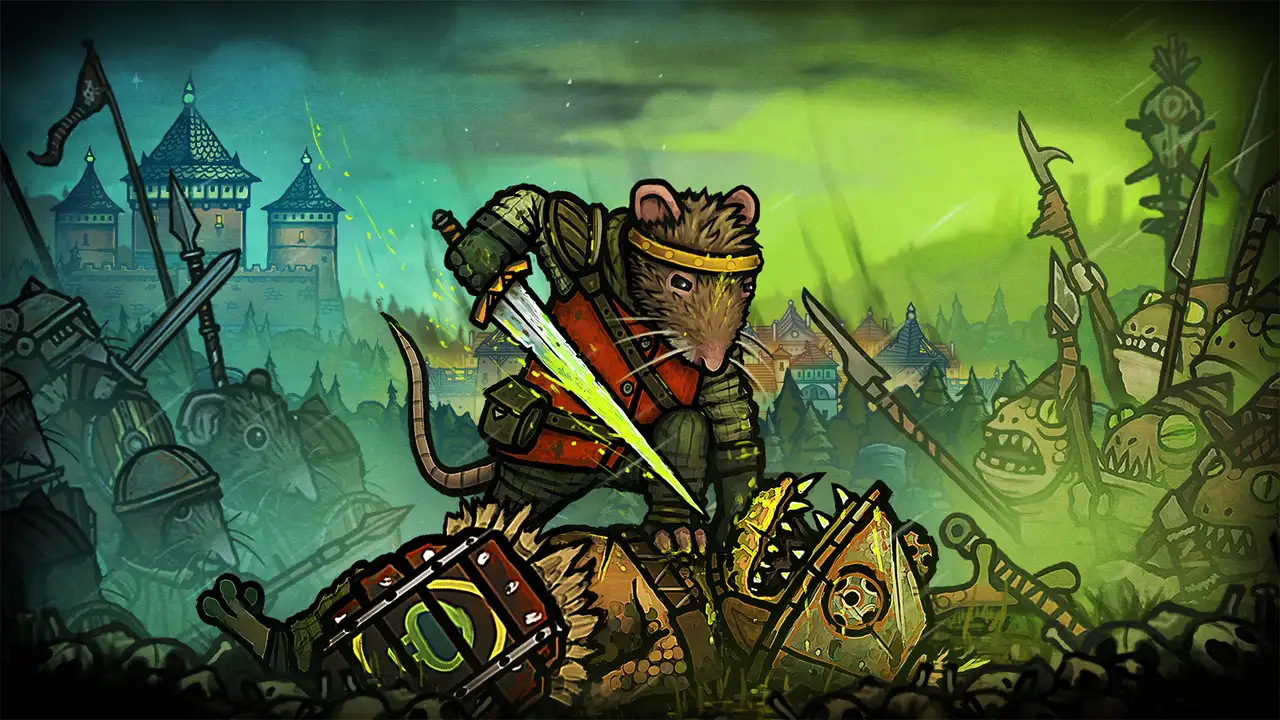
A rat prince inherits a burning kingdom after a frog warlord’s horde kills his father, and Tails of Iron builds its entire identity around rebuilding it. The premise sounds like a children’s storybook, and it looks like one too, hand-illustrated art and gravitas-laden narration carrying the fairy-tale tone from the prologue onward. The narrator is the Witcher’s own voice actor, a choice jarring for the first minutes and delightful for every one after, while the rats’ recorder-honk speech adds a Banjo-Kazooie-like charm to the war epic. Hooks sink in within twenty minutes and refuse to let go, pulling sessions well past their planned ends and sustaining a full completion inside eight hours. Few short campaigns grip this hard.
The world visibly heals as quests complete, and the effect is the best worldbuilding touch in the game. Bridges rise, villages restore, and sunlight breaks through parting clouds over the Crimson Fort as the frogs’ devastation recedes, a transformation seen rather than told. Side quests fund the castle rebuild through faction boards for the village elder, the rangers and the arena, though the loops behind them stay repetitive, with grub-culling fetch jobs repeating the same shape. The funding destination is satisfying enough to forgive the funding method, and the cycle of earning, repairing and watching the kingdom mend carries the middle of the campaign.
Combat borrows Souls grammar without the stamina system, a subtraction that suits the two-dimensional format perfectly. Red unblockables, yellow undodgeables, parries and shield bashes structure every fight, and four weapon categories split cleanly between spear, sword, axe-hammer and ranged with speed-versus-damage identities that make the spear’s reach a natural main throughout. Weight classes gate dodge animations, with light armour emerging as mechanically dominant, and the fully scripted equipment-drop economy means progress is planned rather than prayed for. Poison behaves unlike any other game’s version, weakening enemies rather than ticking damage, an oddity that confuses before its defensive value earns appreciation.
Mole civilisation delivers the campaign’s strangest delight. Electricity, blasters, a tram and an arena fight club hide beneath the storybook surface, with gun-wielding moles arriving as friends rather than enemies, and the technologically advanced republic gives the rodent war a sci-fi underbelly no comparable game claims. Reference humour runs constant alongside it, from a Mjolnir hammer to a Verminstein abomination, and a crypt-borne undead infestation plus a secret abomination in the king’s chambers deepen the late story with fittingly dark turns. The bittersweet ending, with allies lost along the way, lands well.
Boss difficulty runs front-loaded. The earliest encounters give the most trouble, with a hammer-wielding Thor boss standing as the campaign’s hardest, while late bosses fall in a first or second try, an inversion that flatters late builds but starves the endgame of challenge. Getting juggled without invincibility frames after a hit is the most disliked mechanic in the game, brutal against fast multi-attack bosses where one mistake compounds into a stun-lock death. Two-dimensional depth confusion and awkward hitboxes cause occasional cheap hits, a nitpick beside the juggling but a real one.
Audio glitches strike during the final tournament, with missing sound effects and stuttering audio forcing a restart, the campaign’s only serious technical fault. The post-launch tournament questline forms a proper finale, and a hundred-percent sweep, including full armoury completion, fits comfortably within eight hours. A chat-spoiled four-statue quest stung, but the twist still fit.
Overall, Tails of Iron is a storybook action adventure whose addictive combat loop, memorable narration and visibly healing world make it one of the most compulsive short campaigns of its year, with juggling without i-frames, late audio stutter and repetitive side quests as rough edges against a superb whole. The charm far outweighs the friction, and the kingdom’s restoration is worth every grub culled along the way.