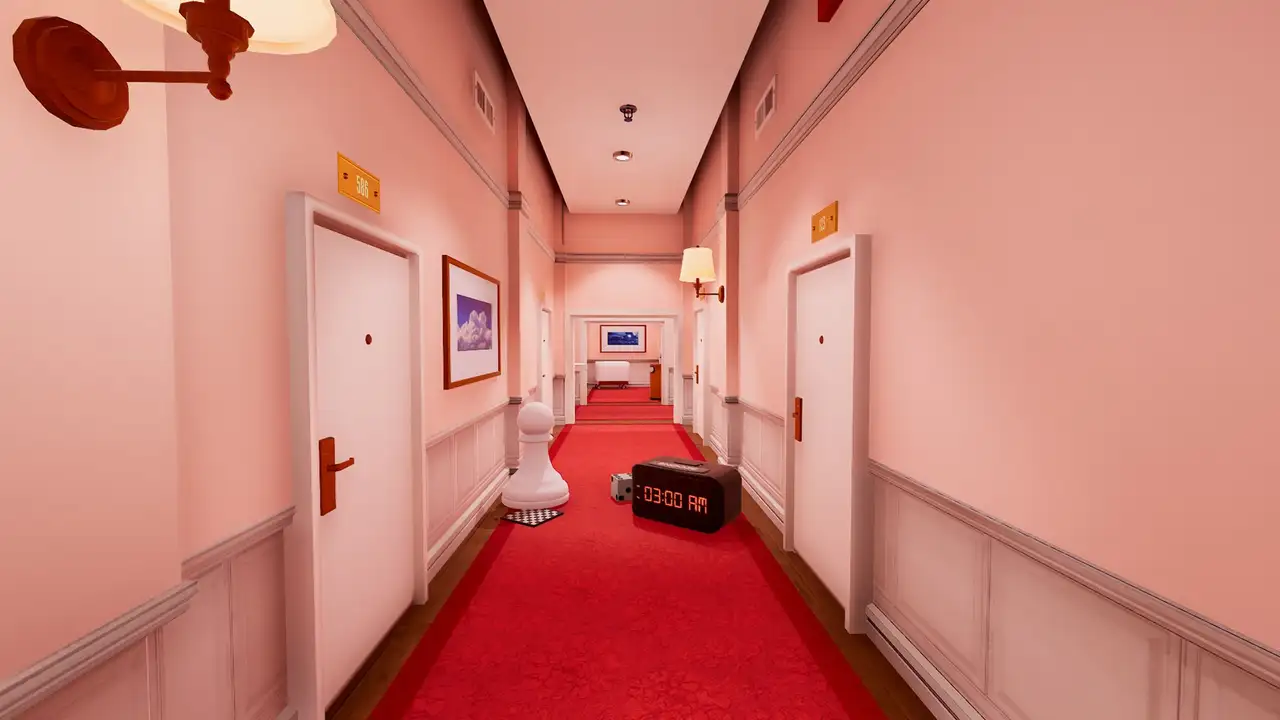
A sleep-clinic dream therapy programme called SomnaSculpt has gone wrong, leaving a patient stranded inside a facility where perception itself bends to the hand. Superliminal is a first-person puzzle game built on a single brilliant trick: grab an object and it scales according to how it sits against the horizon, so a chess piece the size of a thimble can become a ramp the size of a building. Few games commit this fully to one idea, and fewer still keep finding fresh corners of that idea for eight straight chapters. Dr Glenn Pierce’s increasingly frazzled radio updates and the machine’s passive-aggressive orientation protocol carry the narrative, and the writing is funnier than most comedy games manage. What begins as deadpan gags ends somewhere surprisingly sincere about perception and problem reframing, a pivot that lands rather than jars.
The core scaling mechanic remains a marvel from first puzzle to last. Objects obey dream logic rather than physics: pick up a doorway, drop it into a wall, walk through; pluck an apple from a bowl and clone it into an infinite staircase. Forced perspective, depth illusion and the horizon rule combine into puzzles that feel discovered rather than solved, and the game weaponises them in ways its genre rarely attempts. It is Portal’s spiritual cousin working from the opposite direction, replacing portals with perspective itself. The concept never wears out because the presentation keeps mutating around it.
Level variety does the heavy lifting in sustaining that novelty. The Optical chapter plays with paintings on walls, Cubism fragments geometry into slabs, Blackout strips light away so only scale logic remains, and Cloning turns single objects into cascading staircases. Dollhouse shrinks the world into a model home, the Labyrinth buries the trick inside a clinical maze, and White Space reduces everything to void until Retrospect loops the corridors back to where the game began. Roughly fifteen minutes a level keeps the pacing brisk, and each new theme recontextualises the grab-and-scale rule rather than merely decorating it.
The hall maze spanning halls one through five is the clear low point, the only stretch where confusion replaces delight. It is trial-and-error in the least flattering sense, a disorienting clinical loop whose solution feels arbitrary next to the elegance of everything surrounding it. Nothing else approaches a wall, which makes the stumble more conspicuous. The maze proves that the game is at its weakest precisely when it abandons perspective play for conventional navigation. A more elegant solution in that chapter would have made an excellent game nearly flawless.
Elsewhere the difficulty sits low by design, with puzzles leaning towards delightful rather than demanding. Most challenges admit essentially one intended solution, so a completed level offers little reason to return, and replayability is thin as a result. That trade-off suits the game’s shape, but it does mean the cleverness is consumed once. The soundtrack deserves explicit credit alongside the visuals, underscoring the dreamlike tone without ever crowding the jokes. Soda-vending gags and inventive loading screens add playful texture between chapters.
Two late problems deserve honest mention. Bright optical-illusion sections in the final stretch are genuinely punishing to look at, with eye strain an unavoidable cost of the game’s boldest visual ideas, and the finale’s sincerity, however earned, arrives after chapters of comedy that never prepared for it. Neither flaw undoes the whole. The illusion discomfort is inherent to the premise, and the tonal shift pays off in a closing run through corridors that circle back to the opening spaces with quiet purpose.
Overall, this is a two-hour perspective-puzzle gem that sustains one brilliant idea through constant reinvention, carried by sharp comedy and an unexpectedly warm conclusion. The scaling mechanic alone justifies the price of admission, and the chapter-to-chapter evolution keeps the concept fresh from chess piece to closing credits. Judge it as a clever, carefully authored experience rather than a long one and it delivers on every front that matters.