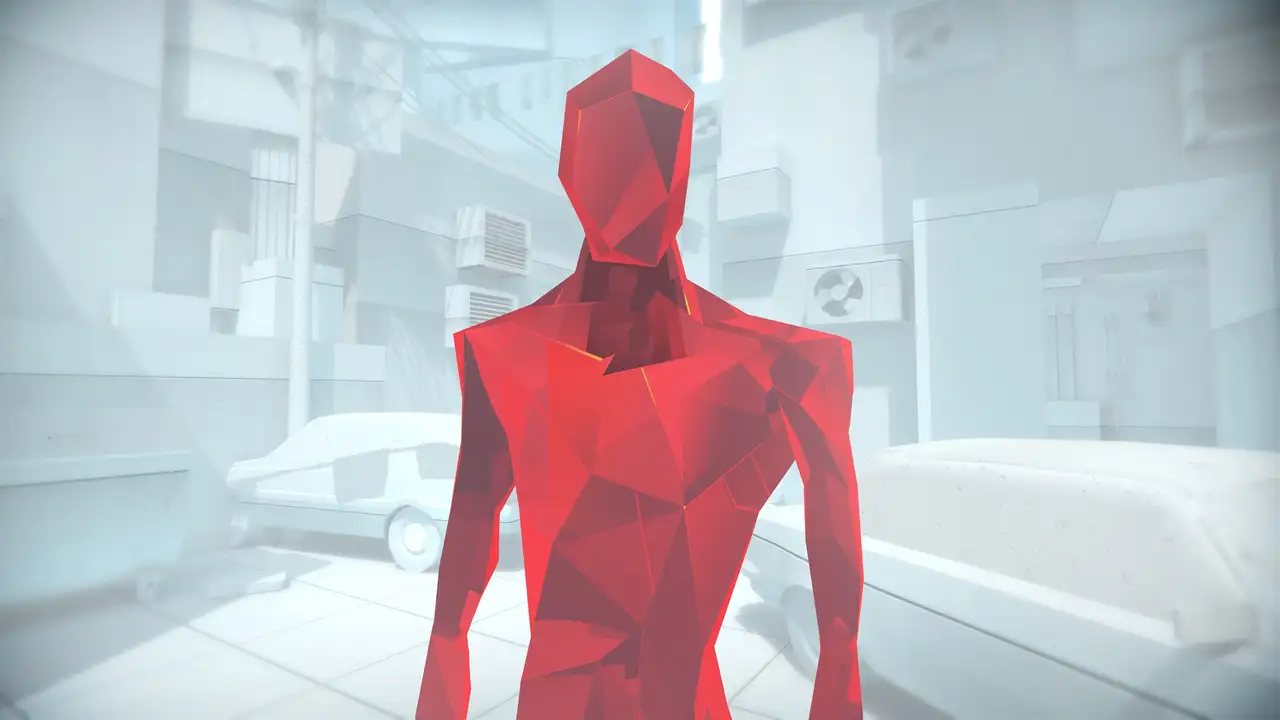
Red crystalline figures shatter into porcelain shards across stark white rooms, and none of them move unless movement happens. That single rule, time advancing only when the player moves, reframes what a shooter can be: patience replaces reflexes, every firefight becomes a solvable puzzle, and every kill can be staged like a choreographed action beat. A bottle thrown across a room buys half a second; a weapon knocked from a hand hangs in the air long enough to be snatched and emptied. Around the gunplay sits a metafictional wrapper, a pirate copy distributed through a chat with a friend, a system that watches back, and menus that corrupt as the story tightens. It is a design confident enough to plant its own tagline, and the game mostly earns the brag.
Trial and error drives the loop, and the design says so outright. Levels reset in a breath, so failure costs nothing but the seconds spent learning where the next threat waits. Body shots work fine, which simplifies aiming considerably, and pistols carry more rounds than the two-shell shotguns, a small resource lesson that reshapes loadout habits. The katana stands above everything else, capable of splitting incoming bullets mid-flight, and landing the cut once converts a player for life. Disarming a goon, catching the flying weapon and turning it on his friends never stops being the best moment available, and the loop of frozen-tableau decisions holds fresh across roughly thirty compact levels.
Hot-switch arrives late and changes everything. Swapping bodies mid-fight, ideally by throwing a shovel at one target and materialising in his skin to grab a nearby gun, adds a genuine strategic layer to what could have stayed a pure reaction toy. Chaining switches across a room, leaving a trail of collapsed shells, produces the closest thing the genre has to planning an action sequence frame by frame. The mechanic appears late enough that the campaign’s final act feels like a second game layered over the first, and it re-energises the loop exactly where most shooters are running on fumes.
The campaign’s difficulty spikes hard in the closing stretch. A corridor level demands frame-perfect dodges through crossing fire, and a meeting-room gauntlet arms every occupant of the room at once, forcing continuous kills with no breathing space. Occasional deaths feel unjust, a bullet that visibly passes wide still connecting, and the instant-restart loop demands patience with repetition. None of it breaks the design, but the margin between elegant and punishing narrows noticeably in the final hour.
White void interludes between story beats strain the eyes. The stark high-contrast aesthetic, striking in the action levels, becomes genuinely uncomfortable during the elongated void and cell segments, where nothing moves except text and the brightness sits at maximum. Elsewhere the presentation stays disciplined: the red-and-white palette reads instantly, weapon throws arc with satisfying weight, and the title’s chant punctuates each cleared level like a drum hit. The audio design deserves equal credit, each shattering body marking time in a soundscape that otherwise holds still.
The metafiction earns its keep without overplaying the horror. A friend’s chat messages turn paranoid, a red box warns that this is not a game, the menu degrades with each chapter, and the system addresses its user directly at escalating frequency. Played straight it would be thin; played with a wink it becomes part of the joke, a thriller that knows it is a fiction and invites the audience to enjoy the machinery. Two bonus ASCII mini-games hide inside the fake operating system after the credits, and the inclusion of throwaway relics inside the shell shows how much care went into the wrapper.
Endless mode, challenges and replay sharing unlock after the brief campaign and extend the life of the toybox considerably. The core levels run two to three hours, which is the honest ceiling of the concept: the puzzle loop is so concentrated that longer would dilute it, yet the unlockables give the mechanics room to breathe without narrative scaffolding. Sharing replays of a particularly clean katana chain or a four-switch sequence gives the stylised violence an audience beyond the screen.
Overall, a sharply engineered concept that converts patience into spectacle and never lets its central rule grow stale across a tight, well-paced campaign. The katana, the hot-switch chains and the corrupted-shell storytelling add up to something genuinely distinct, and the post-campaign modes stretch the value beyond the brief runtime. The white voids sting the eyes and the final act bites hard, but neither dents the verdict.