Descent closes the reboot trilogy mid-crisis and never lets the pressure drop. Klein deactivates the self-destruct nodes armed at the end of Assault, mocks the protagonist over the intercom from every speaker aboard, and the ship spends the entire campaign actively tearing itself apart: flooding chasing the player between objectives, decks collapsing in sequence, darkness pressing in from every vent. It is the trilogy’s most apocalyptic staging, and the disaster-film framing gives the top-down formula a momentum the earlier volumes never found. Carol Wentworth’s diary returns as the emotional spine, her account of the antagonist’s voice filling her mind the best writing in the series.
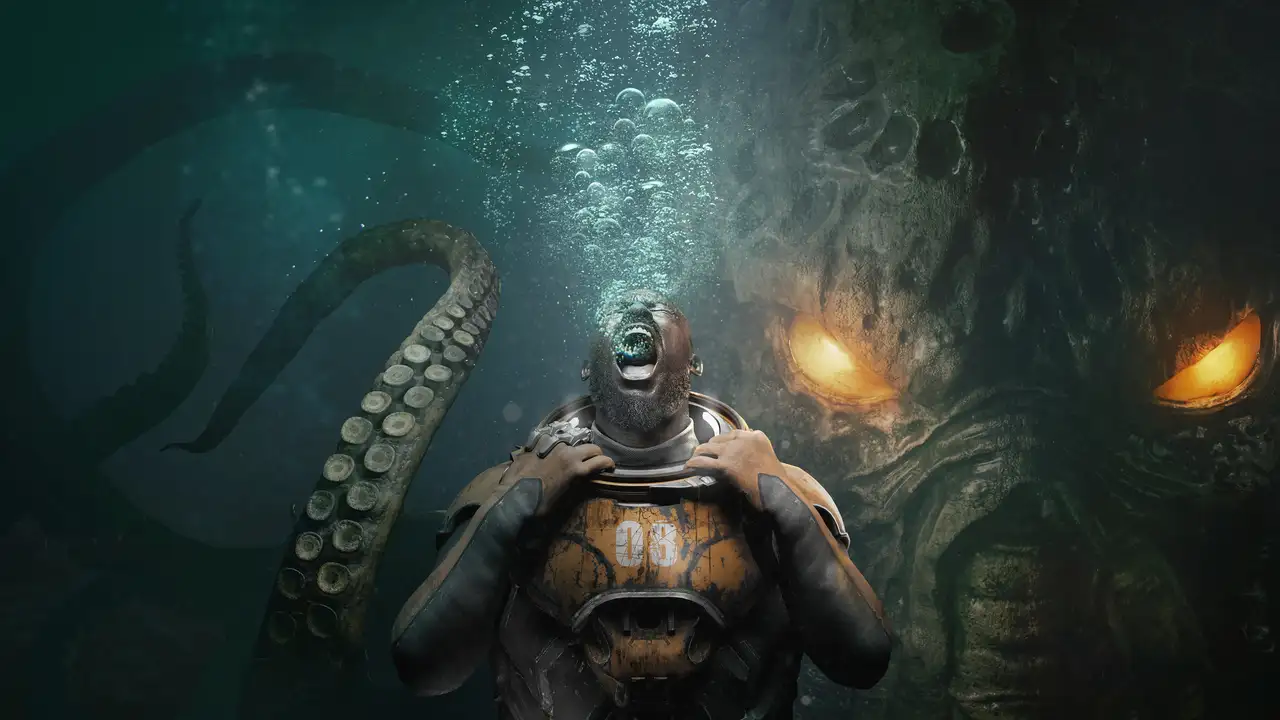
Staging is where the finale most clearly surpasses its siblings. Vacuum space-walks take the camera behind the character’s back for the first time, breaking the isometric plane the series has never previously left; elevator descents rattle and shudder; and the collapsing-ship finale plays out with a scale and camera variety the trilogy has never attempted. These sequences are strange and effective in equal measure, and they rescue the formula from routine whenever the detour structure threatens to flatten it.
The boss work repays the second volume’s structural sin directly. Assault ended without a proper climactic fight, and this finale delivers two: a corrupted fusion of a former ally and the alien queen, fought as both spectacle and tragedy and ended by reversing her fusion cell, then a final queen gauntlet that shows genuine restraint, pairing the queen with the human antagonist without spawning a single unit of fodder. Knowing when to stop is rare in horde shooters, and the clean two-party final encounter is exactly the right call.
The Project X launcher deserves its own sentence. Arriving late with deliberately stingy ammunition, the heavy weapon outperforms every expectation, clearing rooms with a punch that makes its scarcity feel like good design rather than deprivation. Electro-shocker enemies add stunlock pressure that occasionally frustrates, and venomous sentries behave erratically, sometimes ignoring the aliens entirely as though reprogrammed, but the arsenal overall is the trilogy’s most interesting.
Formula fatigue is the finale’s heaviest tax. The something-is-broken-find-the-long-way detour loop, tolerable across one game, has now persisted three volumes deep, and the repetition finally breaks: every breaker detour is predictable before the objective even appears. Klein’s reality-bending taunts, a it-was-all-a-dream register that questions whether anything mattered, sour the storytelling at its climax, and the ambiguous survival ending leaves the protagonist’s fate for the credits to shrug at. None of these choices ruins the campaign; together they blunt an otherwise strong close.
Technical friction adds an unplanned variable: a mid-run controller failure forces a keyboard-and-mouse conversion halfway through, awkward and nearly fatal once before being mastered by the finale, and an invisible-wall hang plus a weapon-display bug add minor insult. No sprint exists for much of the run, the cursor vanishes intermittently, and stunlocking electric enemies punish crowds unfairly. The Intex shops and core shoot-loot loop remain solid underneath, and the escape-timer finale gives the closing hour genuine urgency.
Overall, this is a satisfying trilogy finale that pays its structural debts and stages its apocalypse beautifully: the behind-the-back vacuum walks, the restraint of the final boss and the Project X surprise are the series at its best, even as the three-games-deep detour formula and the dream-logic taunts wear thinnest. As a close to the arc it lands warmly, and as a top-down shooter it is the most confident staging the series ever managed.