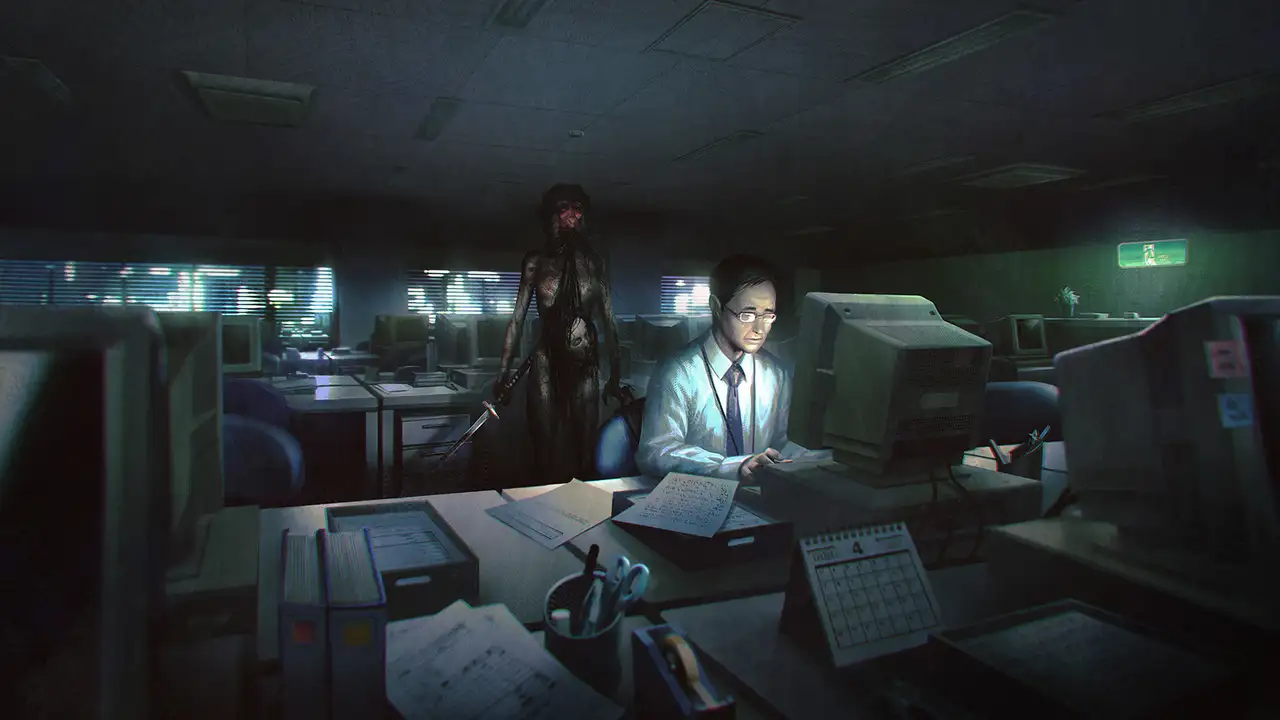
A black postcard arrives carrying nothing but a riddle, and within days a delinquent high-schooler’s little sister has vanished. Spirit Hunter NG builds its supernatural thriller from that premise: a 1999 Tokyo of payphones and pedestrian sprawl, where a doll-like girl compels the protagonist through a series of “games” against urban-legend spirits. The structure runs through self-contained rumour cases rather than a sprawling campaign, each one a mystery to be tested, unravelled and resolved. A supporting cast gathers quickly: a yakuza’s son, an occult-obsessed idol, a hard-boiled journalist, an inscrutable magician. The tone sits firmly at thriller rather than horror, mystery-flavoured from the first case to the last, and the register suits the material.
The genre-splicing investigative loop is what the whole game exists to serve. Each case opens with a rumour that must first be tested like a field folklorist, whether that means throwing a rock into a lake or offering a snack at a shrine, before the spirit behind it can be purified. This test-then-solve structure is an urban-legend simulator in a way few games attempt, and the setups are consistently cool. Purification itself runs through Survival Escape confrontations where the correct item or word combination banishes the haunting. Success hinges on deduction rather than combat, and the loop of research, hypothesis and resolution repeats with enough case-to-case variation to stay fresh.
Condensed map design is the clearest improvement over the series’ previous entry. Where Death Mark sprawled across larger haunted grounds with plenty of dead space spent wandering between objectives, every case here packs what matters into a smaller area, and the pacing benefits immediately. Everything needed to solve a rumour sits within a few connected rooms, so investigation never stalls on wayfinding. Returning musical tracks from the predecessor deepen the continuity for those who know where to listen. The structural discipline is the sequel’s defining quality, and it makes the whole campaign read as tightly authored rather than padded.
The Blood Machine power gives the investigation its most distinctive tool. Reading a spirit’s memories through collected bloodstains turns environmental scanning into narrative archaeology, reconstructing how each haunting took root. The Oshima Woman case demonstrates the loop’s potential early, while the Kitaro of Kentucky case delivers the campaign’s sharpest shock and its first genuine taste of dread. Killer Peach pushes further with a time-looping elevator set piece that takes a left turn far outside the jurisdiction of regular detectives, and Demon Suomi closes the case roster with its own flavour of wrongness. D Man’s collectible card riddles thread a secondary hunt through everything.
The partner system adds mechanical texture to the investigation. Hazuki distracts guards, Amomi lifts pockets, and each case rewards picking whoever fits the scene. The vending-machine side investigation rewards poking at the game’s margins, and New Game Plus carries a gallery of loss scenes for those who want every failure documented. The ending’s crisis choices can be replayed to chase the best outcome, and the mirror-seal ritual that closes the mystery recontextualises the doll-girl’s obsession with a blood-kin explanation that feels earned rather than cheap. The finale lands as satisfying rather than startling, which suits the mystery-first register.
Spirit encounters and body horror are where the predecessor keeps its crown. Death Mark let two items be chosen together against a haunting, producing combinatorial problem-solving that this game simplifies, and its imagery pushed harder into visceral territory. NG’s confrontations are cleverer but softer, and the comparative weakness shows most in the mid-game cases. Jump scares are bolted on rather than integrated, landing as interruptions that take the player out of the mood instead of deepening it. Neither shortcoming sinks the campaign, but both are honest reasons to prefer the first game’s craft in specific moments.
The save system confounds throughout. Progress saves automatically on sleeping or completing an investigation, with no manual option at any point, and the rhythm of when a save actually triggers feels arbitrary even after hours of play. Dialogue-heavy visual-novel pacing compounds the fatigue, since stretches of reading between investigative beats test patience. Soft puzzles occasionally hinge on choosing the right dialogue option three times in a row, which flattens some confrontations into trial and error. These frictions sit at the margins of an otherwise well-tuned design.
Overall, this is a highly satisfying sequel that trades its predecessor’s scares for a smarter, richer mystery, and it mostly gets away with the exchange. The investigative loop, the condensed case design and a finale whose reveal earns its weight all justify the verdict. Encounter design remains the one arena where the older game stood taller.