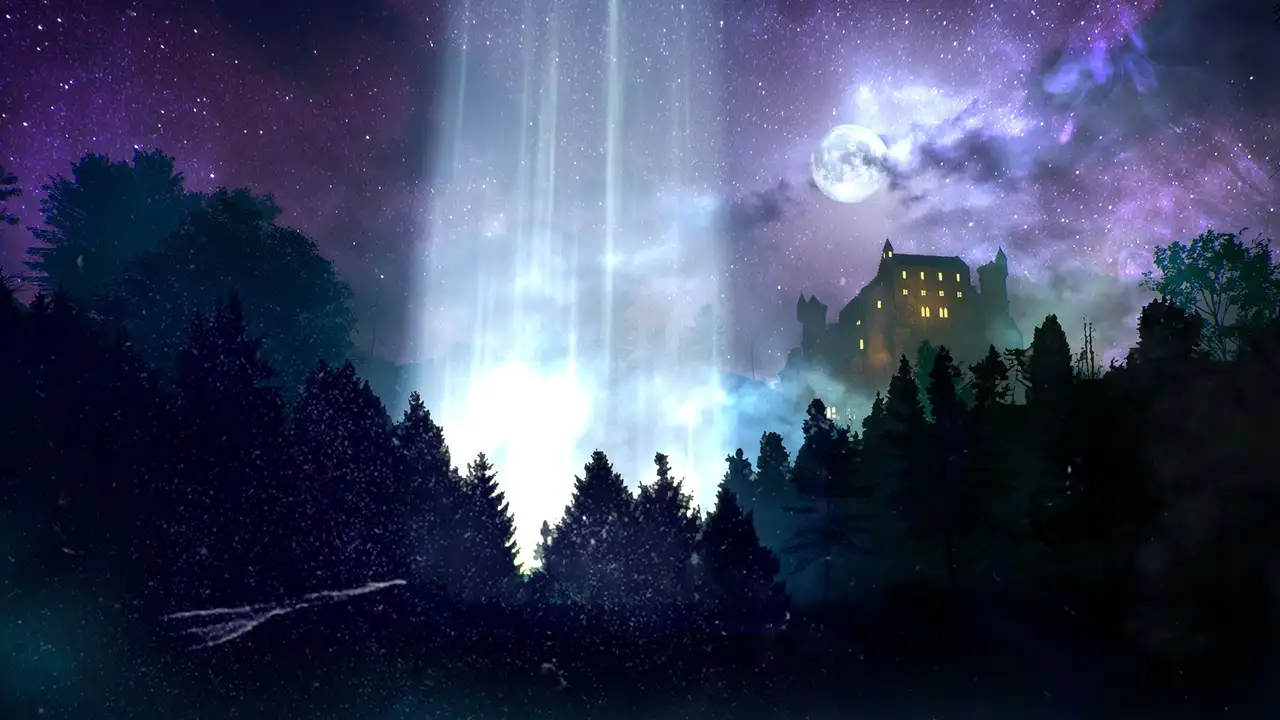
Edward’s Island hosts an annual senior-class beach party, and a small group of teenagers arrives by ferry to find a night that will not end cleanly. The setup sounds familiar: a door to a time-torn dimension opens, the dead of a 1943 naval sinking want to live again through the living, and a recurring song drifts from every radio on the island. What elevates the material is the grief running underneath, a drowned brother haunting every conversation, a friend whose cruelty has a wound at its centre, and a stepbrother mourning his own mother through the night. The writing treats teenage talk as naturalistic overlap rather than exposition delivery, and the ghost story grows out of that texture instead of interrupting it.
Dialogue steering is the central system. Choices arrive on a timer while characters keep talking over each other, and the branching web stretches all the way into the epilogue, where the fate of individual relationships shifts according to what was said hours earlier. The cost is structural: selecting a response cuts off whoever was mid-sentence, forcing a constant choice between hearing everyone and missing the window to speak. It is the design’s most persistent irritation, and it never quite resolves across an entire night.
The portable radio works as both puzzle key and séance device. Tuning at anomalies opens gates and replays voices of the dead, radio locks require reading frequencies rather than hunting three separate signals, and possession set-pieces resolve by tuning triangles under pressure. The call-and-response protocol that opens the bomb shelter and the ghost crew’s games of hangman and I-spy turn trauma into play without tipping into camp, and the framing treats the sunken crew as frightened children rather than villains.
The Adler excavation storyline rewards a slower run. Notes hidden via radio clues at the antique shop, lighthouse, graveyard and roosting tree dismantle the island’s official history, revealing the sunken ship’s true cargo and the circumstances of its loss, and a chest combination at the estate ties the hunt together. Twelve anomalies collected across the map add texture, and the treasure-hunt structure deepens rather than pads, turning the island’s past into an archaeological project the teenagers undertake almost by accident.
The island itself loops time as well as space. The in-game clock runs from a ten o’clock ferry landing through sunrise, and scenes reset when tears in the dimension snap shut, requiring the magnetophone anchor to be found and retuned. Set-piece puzzles stay light, and the night’s pacing leans on conversation rather than mechanical challenge, which suits the material even when the walking between scenes slows the middle stretch.
A soft-lock bug at the Adler estate interrupts the flow at its worst moment: a radio lock fills in and refuses to open, forcing a full area reload. Stairs traversal is similarly awkward, with angled descents feeling clumsy for no apparent reason. Neither flaw breaks the night, but both surface exactly where the game asks for immersion.
Overall, the naturalistic teen dialogue, the radio-dial séance mechanics and a grief-laced ghost story built to stick in memory hold up years on, and the choice-driven ending web rewards a fuller second engagement. Dialogue cutoffs, one soft-lock and clunky stairs are real blemishes, but the island’s long shadow is what remains once the credits roll.