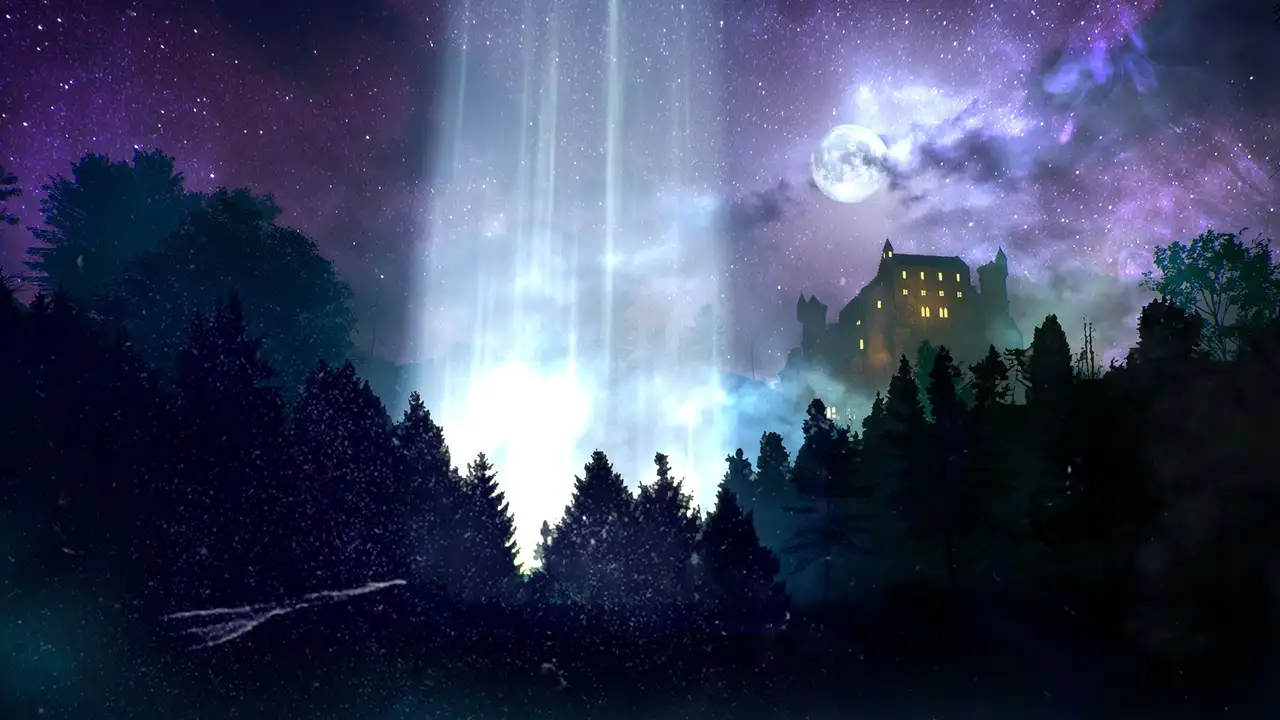
Camena, a small coastal town, provides the stage for one long night of signal-chasing. An environmental researcher named Riley returns home to plant transducers for a shadowy laboratory, pairs with a hapless handyman called Jacob, and finds a triangular rift hanging over the local island. Cult flyers paper the bus stops, red lightning traces a triangle across the sky, and walkie contacts slowly realise the evening is going wrong. Atmosphere arrives through accumulation rather than shock, and the town itself feels lived in before anything supernatural occurs.
Dialogue handling is the headline repair. Where the original cut speakers off the moment a response was selected, conversations here wait until the other person finishes before the chosen line lands, letting exchanges breathe and giving the branching weight it always claimed to have. The Riley and Jacob double act forms the emotional spine, and the writing around them stays warm without tipping into quippishness. Their dynamic anchors scenes that could otherwise drift, and the relationship develops through small talk about work and family rather than declarations.
The walkie-talkie operates as the true central system. Five contacts, Evelyn, Nick, Shelly, Hank and Maria, each carry their own subplot that advances whenever called in, turning a piece of hardware into a living switchboard of side characters. Some calls deliver warmth, others deliver dread, including a warning to a ranger that a dead relative may be trying to reach her. The radio dial doubles as an exorcism tool during possession sequences, with survival reduced to tuning the correct frequency under pressure, a simple but effective fusion of narrative device and mechanic.
Time tears hop between eras to solve puzzles, letting objects shift across 1899, 1930 and 1952. The mechanic impresses despite light usage, appearing only a handful of times, and each occurrence rearranges a map in ways that feel like a genuine idea rather than a gimmick. Rope-climbing gates open the map gradually, collectible Adler letters reward thorough exploration, and the night’s clock, running from eleven in the evening to four in the morning, paces the story without a visible timer.
Pacing sags in the middle stretch. Movement is deliberately slow, an earlier letter can derail navigation so thoroughly that the route back becomes a puzzle in itself, and repeated climbing tutorials pad the opening. Light puzzle opacity in the first hour compounds the drift, and the overall trudge between areas asks patience the story eventually repays but never quite earns back during the long walks.
The epilogue’s meta-stat callouts, tallying choices against the wider player base in percentage form, puncture the fiction even as the data amuses. It is a charming idea that arrives in the wrong voice, sitting outside the story’s register at the exact moment the night should close quietly. Similarly, the ghost-hunting side quests, including Hank’s EMF boosters and a delivered spectral shoe, feel underpowered, with the radio’s non-possession uses so thin that the hardware’s second function barely justifies carrying it.
Overall, the dialogue fix alone justifies the sequel’s existence, and the walkie-cast, the Riley and Jacob pairing and the era-hopping tears build a night worth staying up for. Sluggish traversal, mid-campaign backtracking and epilogue stat callouts dent the polish without disturbing the core, leaving a coastal ghost story that lands its emotional weight and closes its account cleanly.