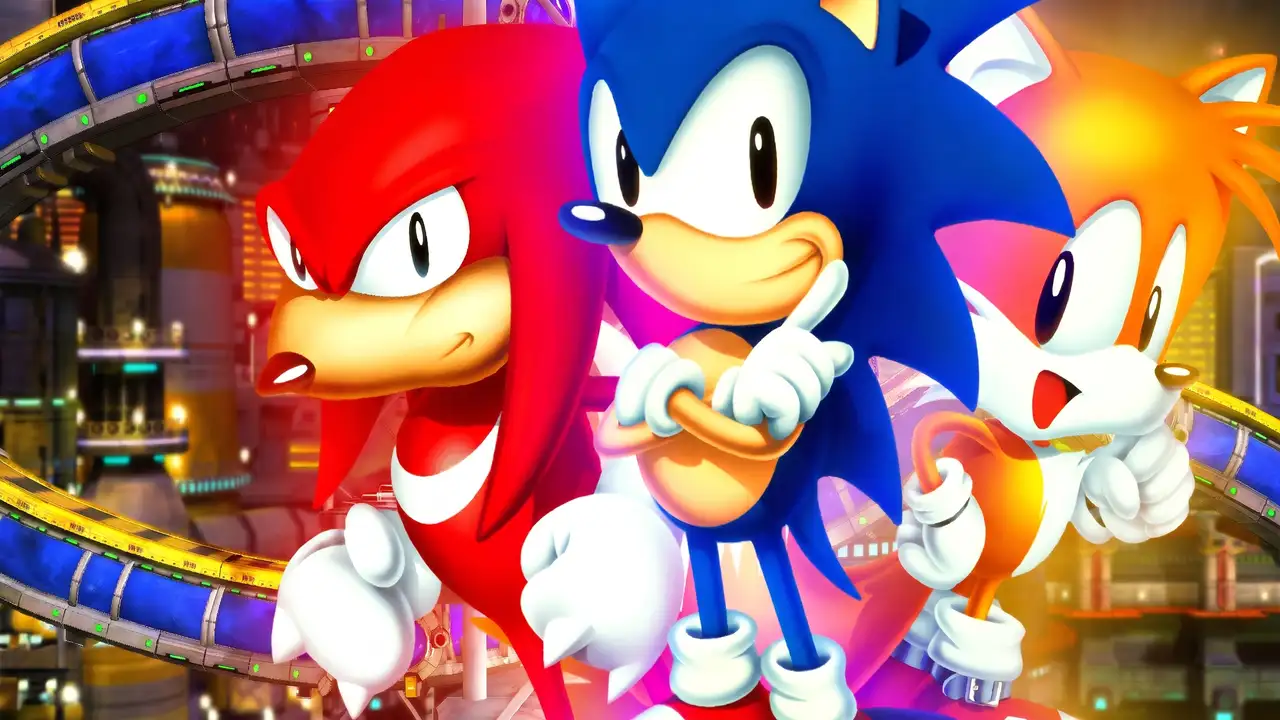
Mushroom Hill’s autumn canopies give way to a flying battleship, a wavy desert, a lava forge, a floating palace, ancient ruins and finally the Death Egg itself, the crashed doomsday station rebuilt above the clouds. Seven zones carry the campaign, each visibly larger than anything in the preceding trilogy entries, with first acts that routinely outlast their second halves. The echidna who served as an antagonist rejoins the cause without much explanation, a narrative handwave typical of the era, and his wall-climbing rewrites route options for anyone playing as him. The expansion feel is intentional and visible: assets, bonus stages and design language carry over from the split release this cart tops, making this less a sequel than the scaled-up second half of one enormous game.
Chaos Emerald special stages remain the standout system despite their difficulty. Ring-hoarding entrances open portals to half-pipe chases that demand sharp reflexes across escalating phases, and each success banks an Emerald that alters the finale. The stages themselves rank among the era’s most distinctive mini-games, fast, readable and rhythmic, and the pursuit of them gives the zone-clearing loop a second objective beyond reaching the goal post. Landing even one from limited opportunities feels like an achievement, and the temptation to chase the full set drives replays through stages otherwise cleared.
Sky Sanctuary delivers the campaign’s most affectionate stretch. Returning boss designs from the series’ first two entries reappear as modernised set pieces, sprite callbacks staged as if the ruins themselves are replaying the franchise’s history. The recognition lands as pure spectacle rather than lazy reuse, each homage rebuilt with the current game’s palette and physics. Few series of the era trusted their own back catalogue this openly, and the sequence rewards anyone who knows the earlier games while playing perfectly well for those who do not.
The Death Egg finale overstays its welcome. The concluding boss demands eighteen hits across two hand phases before the true fight even begins, a war of attrition longer than any prior series confrontation, and the extended sequence tests patience long after the spectacle has registered. Upside-down gravity sections inside the station compound the friction, flipping controls at moments that demand precision, and ledge grabs read as hit-and-miss in a game otherwise built on reliable physics. The two-fight structure distinguishes the finale from its predecessor’s, but distinction is not the same as improvement.
Sandopolis supplies the mid-campaign highlight and the mid-campaign stress in equal measure. The heat-wavy desert visuals sell the environment beautifully, and the act two ghost enemies that emerge in darkness create genuine tension, memorable precisely because they break the game’s usual confidence. Physics oddities surface elsewhere: sand platforms that refuse to sink underfoot break the illusion the visuals work to build. Mushroom Hill’s bonus stage suffers the opposite problem, a mini-game so poorly explained and awkwardly controlled that most players will bounce off it before understanding the rules.
Doomsday Zone locks the campaign’s best content behind full Emerald collection. The requirement turns the special stages from optional flourish into mandatory mastery, and without them the true finale stays unreachable, a complete stage withheld rather than a cosmetic ending tweak. The standard finale compensates with the Earth hanging in the background as the station burns, a genuinely climactic visual, but the knowledge that more exists just past the skill barrier colours the closing minutes. The bad ending accepts itself philosophically; the locked stage does not.
Per-zone music carries the presentation throughout, each stage paired with a composition that matches its theme, from Mushroom Hill’s bouncy lead to the industrial menace of the Death Egg. The campaign’s pacing suits a single sitting, nine stages of five-to-ten-minute runs with the checkpoint structure honouring the arcade lineage, and the difficulty ranks below the series’ second entry despite the finale’s length. Whether the finale outranks its predecessor’s double-fight remains arguable; that it comes close says more about the campaign’s quality than its flaws.
Overall, a scale-driven cap to the classic trilogy whose longer zones, per-zone soundtrack and Sky Sanctuary homages deliver escalating spectacle across seven memorable stages. The eighteen-hit final boss drags, the upside-down sections and fiddly ledge grabs frustrate, and the finest content sits behind the era’s most demanding special stages. The campaign remains a rewarding single-session run with or without the Emeralds.