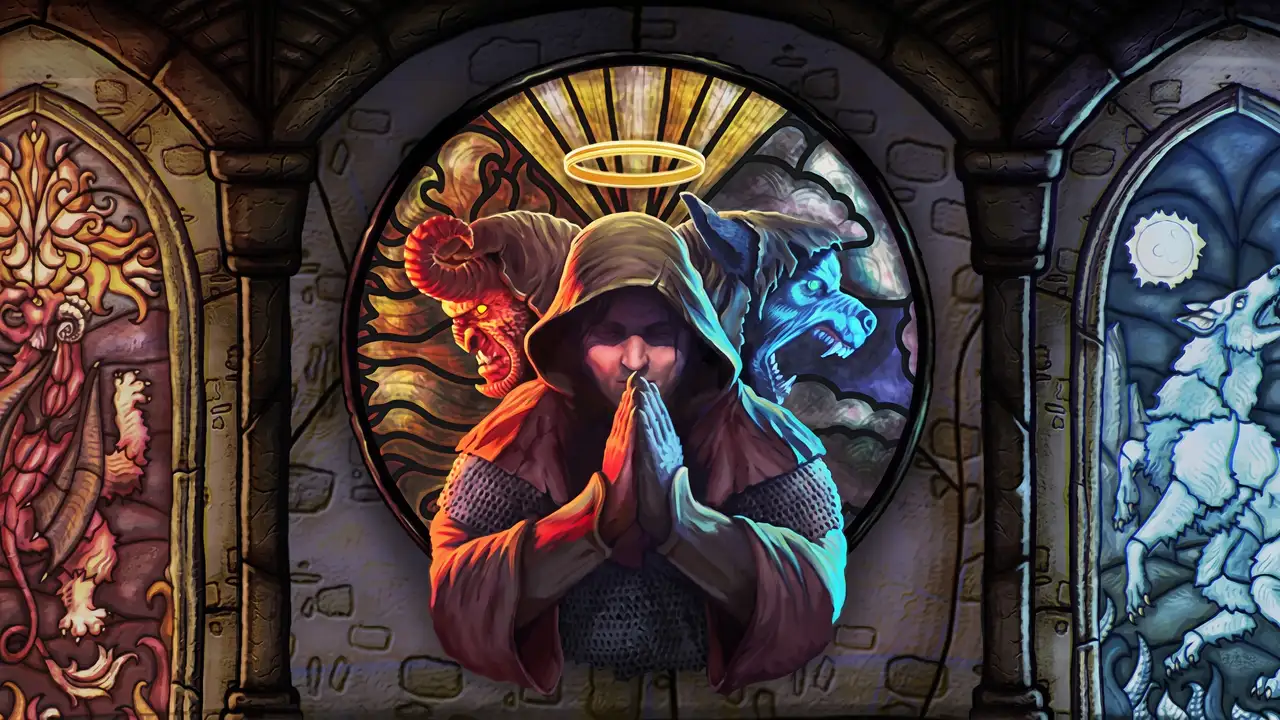
Every surface of Saga of Sins is rendered as living stained glass, from the morphing creatures to the cutscenes to the four screen-edge borders framing the action, and the aesthetic does not so much decorate the game as constitute it. A crusading cleric returns to a plague-stricken village and descends into the minds of its inhabitants, manifesting as the monsters painted on the chapel walls, and each descent becomes a 2D action-platformer chapter. Grotesque demon designs, creeping dream logic and confession scenes laced with black comedy sustain the medieval-religious dread throughout. Few games marry this iconography to monster-morphing combat, and the result earns its identity immediately.
Each of the seven sins receives its own themed level with a distinct mechanical gimmick, and the variety is the design’s showpiece. Greed floods its stages with coins, gluttony sends drunken brawlers staggering through its taverns, sloth paces itself around sluggish puzzles, and envy’s gold-stealing enemies force a constant defence of the purse. Wrath turns the lights out entirely and attacks for a third of the health bar with relentless pressure, while pride inverts gravity for platforming so pixel-perfect it borders on punishing. The gimmicks never read as palette swaps; each chapter plays by its own rules.
Transforming between stained-glass creatures drives the combat. The werewolf’s triple-shot rewards spacing, the gargoyle’s fire breath clears crowds, and the griffin’s upward shot handles threats from above, with a final Unholy Spirit form arriving late. Dashing through enemies kills instantly and pays double gold, feeding a Madonna-statue skill tree that shapes upgrades. The loop is fast, arcadey and satisfying, though dash hit detection runs inconsistent enough that instant-kill dashes occasionally fail to register.
Boss encounters subvert expectations more often than they reward them. Many replace traditional duels with chases, auto-scrollers or gauntlet sequences, and the shift reads as uneven rather than bold; some land as highlights, others as missed opportunities for the creature-form kit to shine. Difficulty swings wildly between sins, with wrath’s darkness and pride’s inverted jumps spiking far harder than anything surrounding them. The final unlocked power, of all things a form of invincibility, arrives too late and matters too little to justify its slot.
The economy invites exploitation and punishes carelessness in equal measure. Death preserves banked gold while checkpoint restarts respawn enemies, so a single farming loop of roughly 108 gold per run can be repeated dozens of times toward the 10,000-gold threshold, and the grind becomes genuinely compulsive once discovered. A single quit-to-menu error, though, wipes the entire banked sum, a fragility that stings precisely because the farming works so well. The insistence of the power-dash double-gold tutorial nag compounds the friction, repeating long after the lesson has landed.
Occasional clarity lapses punctuate the charm. The griffin creature reads ambiguously enough that its role in certain encounters confuses, and a handful of level mechanics go under-explained mid-run. A redemption ending exists behind replaying every level, a substantial additional commitment the pacing does not necessarily earn. None of these issues derail the core loop, but they add up to a layer of roughness beneath the polish.
Overall, Saga of Sins delivers a gorgeous, arcadey action-platformer whose stained-glass identity and sin-per-level gimmick structure make every chapter feel distinct, and its late narrative turn lands with genuine surprise. Unconventional bosses, wild difficulty spikes, the fragile economy and the unskippable tutorial nag hold it back from greatness, yet the artistry and mechanical variety carry it comfortably to a recommendation.