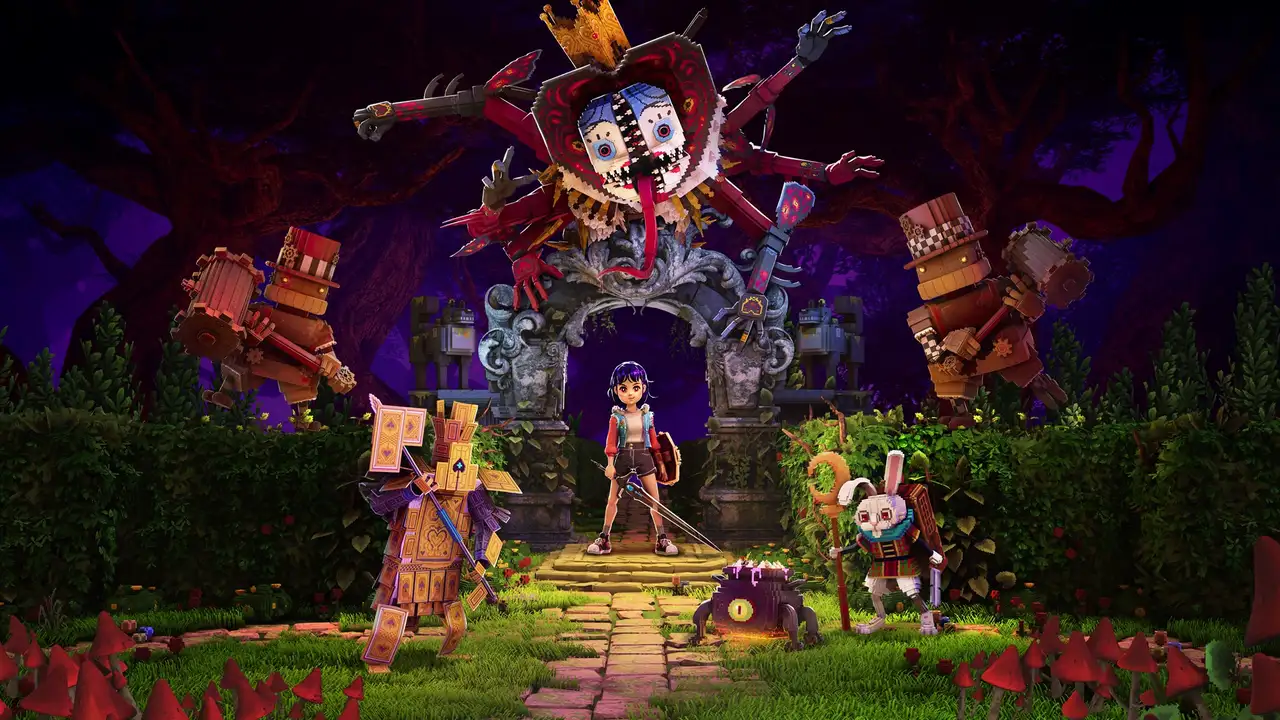
A girl with raven hair falls through a mirror into the realm of Dunia, is declared a prophesied hero, and sets out to slay three beast-wardens and gather their relics, and every step of that journey is rendered in a voxel fairy-tale style of insane detail. Landscapes glow with vibrancy, the toybox-adjacent tone stays cosy rather than dark, and the art direction is the game’s defining achievement. The Alice-in-Wonderland framing supports petting the dog, collecting hats and dancing to earn figurines, and gentle environmental storytelling, such as the botanist’s tragic experiments, deepens the whimsy without breaking it.
The quest design funnels everything into the critical path without busywork. Side content blends into the main chain so naturally that the structure becomes noticeable and praiseworthy in its own right, in the same way the studio’s previous RPG folded its optional tasks into the critical path of progress. Quest chains built around item-fetch loops between areas loop back elegantly, with each realm requiring a return trip through a previous area to continue, a rhythm that rewards familiarity rather than punishing backtracking. The realms themselves vary wildly: mushroom forest, mask mansion, tea party, labyrinth, clock tower and greenhouse each carry distinct silhouettes and gimmicks.
Combat is honest about its ambitions. Sword swings, blocking and dodging with four unlockable skills and a quick inventory of potions and bombs make for serviceable button-mashing, and the game never pretends otherwise. The forgiving dodge removes fail-state anxiety, and ice spells cheese the tougher gauntlets when patience runs out. The Labyrinth’s cockatrice chain stands as the difficulty spike, an enemy gauntlet that takes two attempts more through persistence of the birds than any lapse in play, and the two-phase final Queen fight closes the campaign with a proper showcase.
The level curve is the progression’s sore point. Feather-based XP doubles per level until the curve stops mid-game, and the suspected twenty-level cap arrives while the story is only partway through, deflating the incentive to fight anything beyond obligation. Shops, fast-travel mirrors and a quick inventory keep the rest of the systems light and frictionless. The cap matters less in a four-hour package than it would in a longer one, but the deflation is real while it lasts.
Object placement occasionally hides its interactables too well. The tutorial’s shield takes an embarrassing stretch to locate, and late-game collectibles sit in spots passed repeatedly without notice. The new-game flow fights the save menu at the start, refusing to simply overwrite and briefly souring an otherwise smooth opening. A technicality-prone frog quiz and the frozen-runestone temple puzzle add small logic bumps that resolve quickly.
Completion is achievable in a single sitting, and the package rewards it: every figurine, every achievement, max level and the full quest chain all fall within one blind playthrough. Dancing collects the eighteen figurines, hats dress the dog, and the whole checklist design makes a hundred-percent clear feel like the intended way to finish rather than an optional grind. The modest scope is a deliberate choice, and the game is honest about it.
Overall, Ravenlok is a gorgeous, deliberately small fairy-tale action-RPG whose voxel artistry, elegant quest-blends-into-critical-path structure and cosy completion checklist make it a superb palette cleanser, with shallow combat and an early level cap as honest costs. Nothing here needs to be massive or fantastical; everything here is fun, and that is enough.