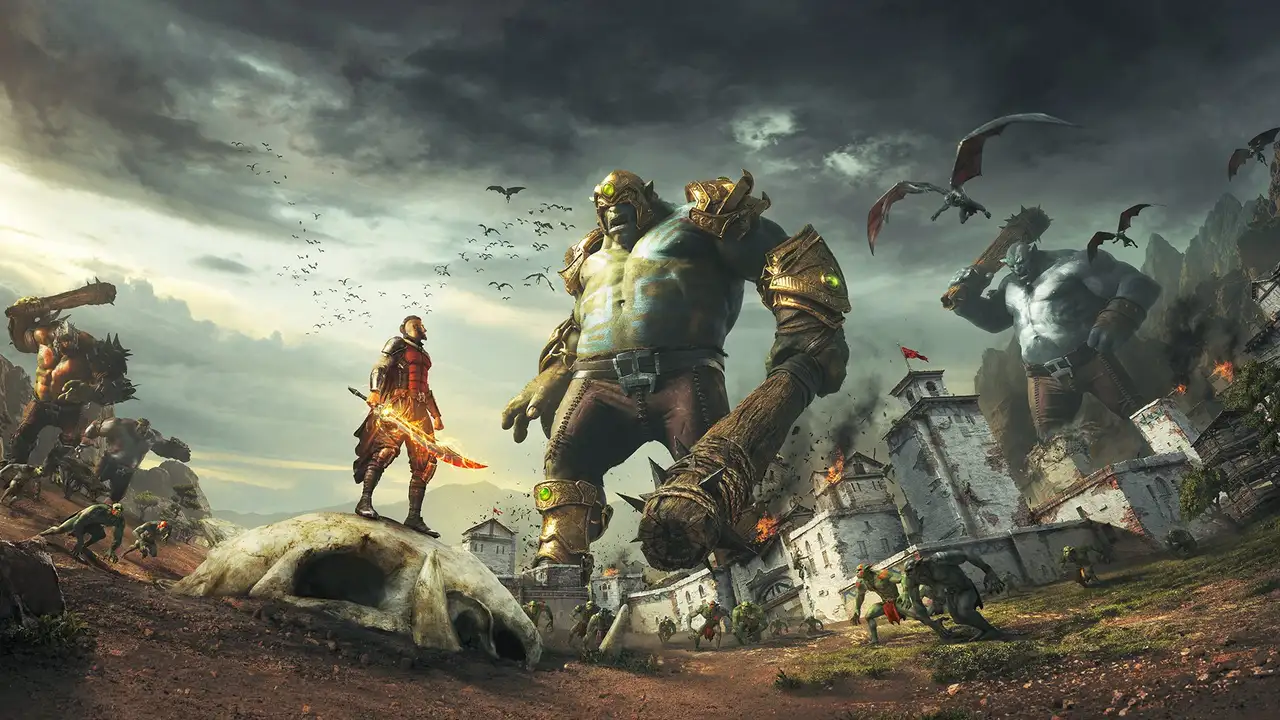
An EverQuest-adjacent dark fantasy unfolds across five acts, as orcs and goblins unite to invade the elven forests and the pursuit of a scheming orc-faced villain leads through gnome warrens, a vampire’s mansion, cloud giants and ultimately the Plane of Hate itself. The writing carries self-aware sarcasm in its idle dialogue, calling the adventurer out directly, and the quest givers have genuine character. A mayor’s daughter wants her kitten rescued, a blood-vine-starved vampire makes her terms plain, and a king asks for a noble execution. The licence is used for personality rather than mere branding.
Combat refuses to let mashing win, and blocking is a genuine skill rather than an optional extra. Certain enemies demand a raised shield, and builds reward deliberate design over brute force, as a Shadow Knight built around Disease Bolt, Disease Shield and life tap demonstrates across the whole campaign. Elemental weapon imbuing (fire, ice, disease, poison), gemstone augmentation and stat allocation on level-up supply the theory-crafting depth. Five classes and randomised dungeon floors complete the Diablo-mould foundation.
The difficulty is relentless in an unusual way: everything hits shockingly hard, from the first goblin to the final confrontation, and the character never stops feeling fragile. Bosses spike far above the surrounding content, with the orc leader, the Plane of Hate arena beast and the planar finale all demanding potion stockpiles or save states. The arena beast in particular resisted defeat until reloads gathered more than one hundred and sixty potions for a brute-force attempt. These fights produce the campaign’s sharpest frustration and its most satisfying victories in equal measure.
Enemy wizards revive their fallen endlessly with no limiting mechanic, the worst single behaviour the bestiary exhibits, though the revives do supply an unexpected farming bonus for experience. Fast-moving crowds and long-range attackers punish carelessness in the later acts. The glass-cannon balance is clearly intentional, and it works more often than it irritates. Endurance, not level advantage, is what the design actually tests.
Carrying capacity is the campaign’s dominant annoyance, forcing shop trips so frequent that the experience threatens to become mostly commerce. The inventory is clunky and slow, there is no equipment compare button, and a persistent bug despawns equipped trousers on fast travel for reasons that defy explanation. Manual fast-travel logic via gate scrolls adds further menu friction. Quality-of-life of this vintage is an acquired tolerance rather than a feature.
Act One offers optional dungeons in abundance, but the structure turns largely linear from Act Two onwards, and the openness never returns. The seven-curiosities fetch quest is the signature late detour, and New Game+ tiers extend the loop through Adventurous, Courageous and Champion difficulties for anyone wanting escalated replays. A shared two-weapon-set setup and disease-based crowd control round out systems no contemporary quite replicated. The linearity is a quiet loss after such a varied opening.
Overall, the blocking-based combat, sarcastic writing and Diablo-mould depth make this the EverQuest-flavoured Action, RPG the licence deserved, and its difficulty remains honest nearly two decades later. Carry-weight tedium, missing quality-of-life and boss spikes that demand potion hoarding are era-typical flaws rather than fatal ones. The jank is inseparable from the charm, and the recommendation follows naturally.