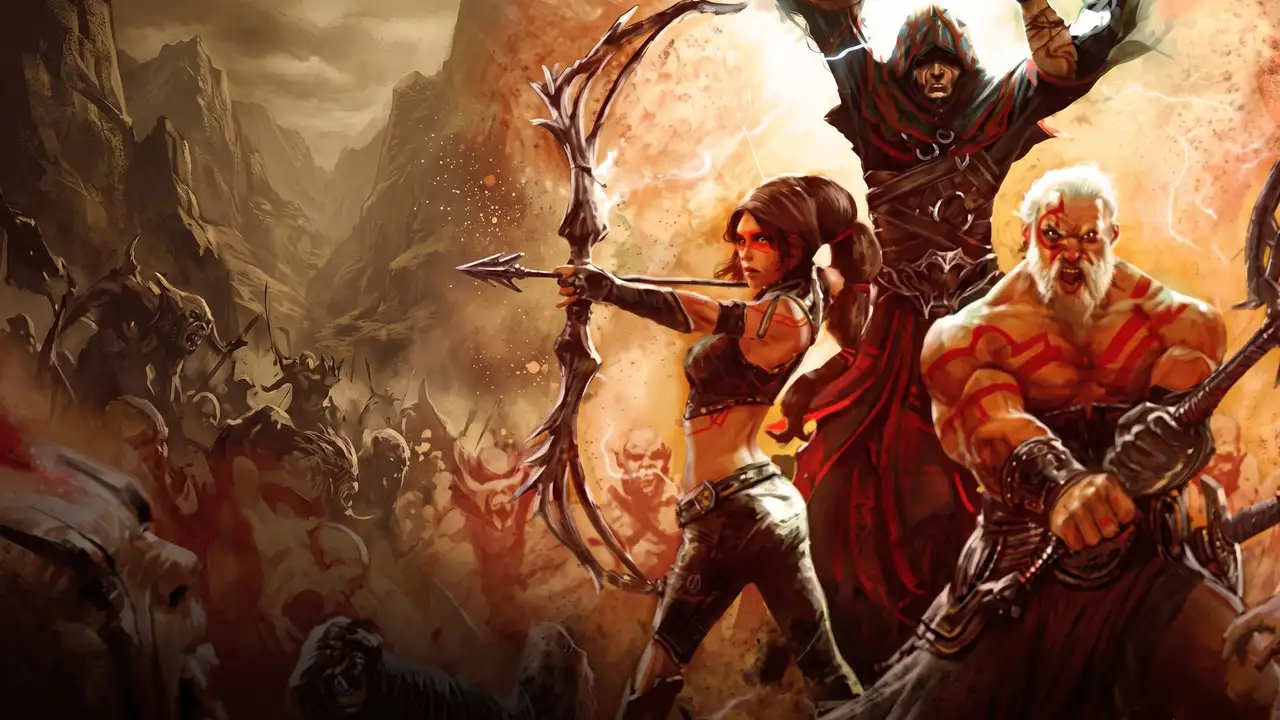
A fantasy kingdom faces annihilation by ogre-like giants and their jackal scouts, and its last defender arrives with an ally to secure the king’s alliance. The premise is disposable B-movie fantasy delivered in brief cutscenes, and the tone borrows openly from a certain titan-slaying anime from the opening minutes. A city-health bar, ticking down as civilians die, supplies genuine if stressful stakes. Atmosphere never rises above generic, but the structural idea of a city that dies with its people has real teeth.
The core loop is functional arcade fun in isolation. Missions task the defender with rescuing civilians using escape crystals, cutting down jackal scouts, charging rune energy and then climbing a Reveni to sever armour and limbs before the beheading. The climbing and limb-severing is reasonably satisfying when it works, even if it falls well short of the colossus-hunting inspiration that the marketing invoked. Fast, fluid movement is the single best mechanical trait, carrying the player across rooftops and up arms with genuine speed. As a foundation, all of this works.
The resource economy beneath it is fundamentally broken. Rune energy gained from rescuing civilians and killing jackals is far too small to sustain the finale missions, where executing a giant instantly and completely drains the meter. Energy sources are too sparse, spawns dry up, and the meter’s total drain on execution rather than partial loss makes the arithmetic unwinnable. A 30 percent extinction-meter bonus objective on the fourth mission is effectively impossible. The design’s central transaction simply does not balance.
Mission four exposes the flaw in full, sending two surprise follow-up giants after the first with no meaningful telegraph, and the encounter defeats the unprepared twice over before its mechanics become legible. Every mission repeats the same template, rescue, kill, charge, climb, execute, making the campaign feel like a collection of carbon-copy levels. Chained extra appearances arrive with poor signalling, and failure teaches nothing the previous failure had not. Five missions in, the loop has shown everything it has.
Progression offers little remedy. A compact skill tree carries movement and rescue upgrades behind confusingly gated unlocks, bonus objectives grant no visible skill-point rewards, and the tree initially looks far smaller than it is. Nothing earned meaningfully changes the energy arithmetic that breaks the late missions. Upgrades polish a loop whose economy is already failing, which leaves the progression feeling decorative. The design never addresses its own central flaw.
The one genuinely distinct idea deserves more than the structure gives it. Executions powered by the lives saved, and a city whose health is its population, is a clever transaction that a better-balanced game could have built a campaign around. Instead, the loop repeats identically across missions, the difficulty spikes on an economy failure rather than a challenge design, and the anime-and-colossus borrowings never deepen into anything of their own. The concept is left as a promising sketch.
Overall, this is a giant-slaying score-attack game with one clever idea, genuinely fluid movement and a resource economy that collapses exactly when the campaign asks the most of it. Carbon-copy missions, a total-drain rune meter and untelegraphed chained encounters bury the strengths, and the colossus-climbing never approaches its inspiration. The central transaction cannot sustain the missions built upon it, and the recommendation is a firm pass.