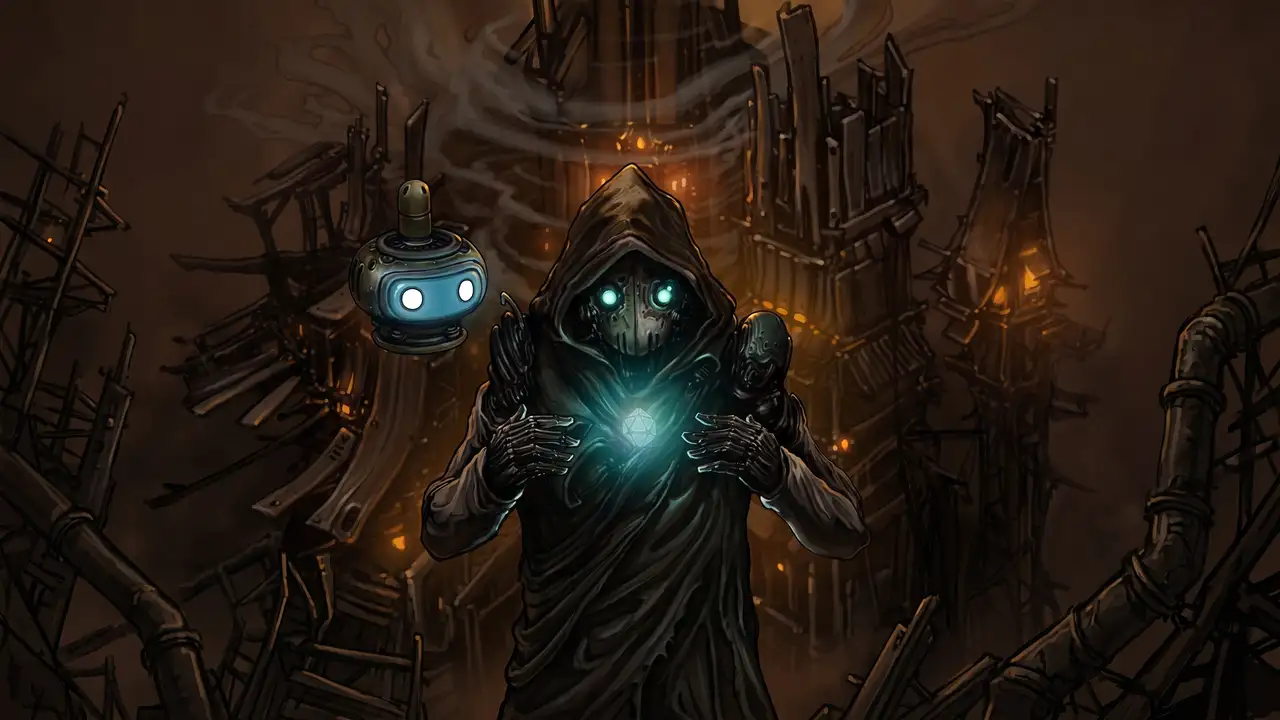
A desert of dead cities opens this adventure, patrolled by two robots adrift in the ruins of humanity. When a stolen power core forces a journey to Metropol, the promised city of glass and light, the premise reveals its true shape: the apocalypse’s survivors are machines with a theology. A machine religion worships long-dead Man as the All Builder, complete with scripture, shrines, and schism. The voice acting treats this absurdity with total sincerity, and the sincerity is what makes it work.
Worldbuilding of this density rarely arrives in the genre at all, let alone with this much humour attached. The Gospel of Man’s humanist robots argue doctrine, a court system operates with actual case law, and legal philosophy becomes puzzle material rather than window dressing. The conflict between the worshippers of Man and the AI who rules the city gives the setting a genuine theological axis. Few adventures fuse lore this rich with dry robot comedy, and fewer still let the two share every scene.
The cast deserves particular credit. A floating sarcastic sidekick serves as the comedic engine, trading insults and self-deprecation across every screen, and his “garbage in greatness out” riposte sets the tone for the whole script. Around him sits an oddball roster: a bully, a chillingly serene enforcer, an administrator, and a prime-number poet. Each voice actor commits fully, and the game’s text-heavy conversations reward anyone who talks to everyone.
The memorius kiosk hidden-word puzzle is the campaign’s mechanical high point, a treasure hunt through corrupted data that turns archival reconstruction into deduction. Around it sits classic inventory-based point-and-click structure: scavenging the dunes, building an energy sensor, hunting coordinates, then navigating the city’s social puzzles. Legal judgements, trades, a binary-switch elevator, and a multi-fragment council code assembled from four separate NPCs each demand different reasoning. The variety keeps the middle act moving where lesser adventures stall.
Not every solution lands fairly. A detonation code and the council-code assembly both turn on obscure recall rather than deduction, and one sequence demands building the same energy sensor repeatedly in what feels like busywork. A crowbar from the crash site opens the underworks, but only after the game has already mentioned the destination, an interaction hole that punishes curiosity. The Reptile-bot repeats a single line of dialogue on every approach, a stilted echo that an infamous fog-town horror comparison fits uncomfortably well.
Stability holds for all but one moment. A single crash interrupts the middle act, with a near-repeat lurking near the finale, and generous saving softens both. The opening act’s slow scavenge puzzles also test patience before the story finds its footing, but the shrine sequence’s absurdist theology converts scepticism into affection early.
The branching finale deserves praise for letting conviction matter. Rejecting the machine ruler outright produces one outcome; a more considered path through the “I need to think about it” option, transmitting the Forfeit virus instead of surrendering or destroying, produces another. Multiple endings give the moral questions actual weight, since the city’s fate genuinely hangs on the judgement made.
Overall, this stands among the best-written adventures of its decade, a post-apocalypse where theology, law, and machine comedy share every scene and the writing never once condescends. Some puzzle solutions lean on obscure recall and a couple of rough edges remain, but the world’s depth and the cast’s charm carry the experience far beyond its friction.