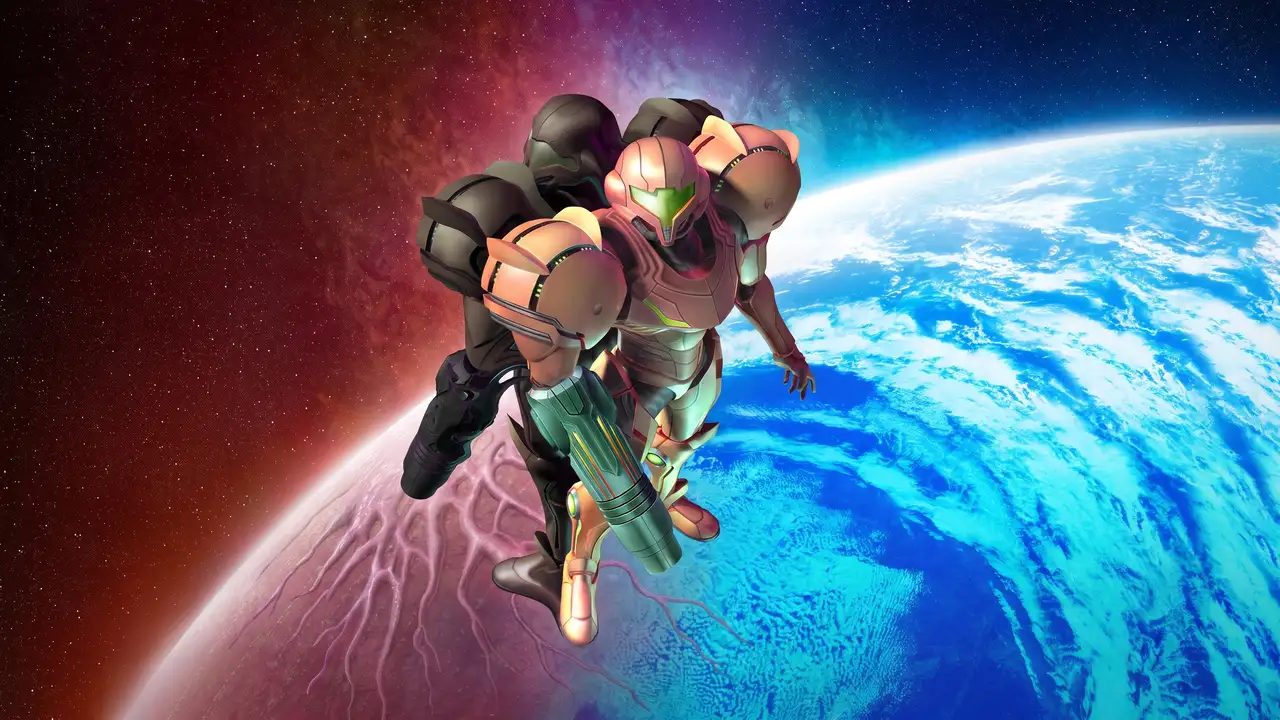
The Prime trilogy’s finale opens with something unprecedented for the series: voice acting. Phazon corruption spreads via Leviathan seeds across Bryyo, Elysia and the Pirate Homeworld, with the bounty hunter and three rival hunters chasing the source, and the layered worldbuilding (Bryyo’s science-lords lore especially) rewards the attention. The hunters’ corruption arc lands well, telegraphed early enough to feel like foreshadowing rather than surprise. Ally NPCs and inter-planetary travel change the series’ isolated tone, and the change mostly works in a finale’s favour. As a story-driven close to the trilogy, the setup is the richest the sub-series attempts.
Upgrade pacing is the game’s pacing genius. Space Jump arrives from the start with no need to regain it, Screw Attack lands a mere seven hours in, and the best mobility arrives earlier than either predecessor dared, making the early hours far more fun than the series norm. Hyper Mode sacrifices one energy tank for temporary super-weaponry with an overload risk, a genuine risk-reward core. Grapple Lasso, Voltage and Ship Grapple, Seeker and Ice Missiles, Nova Beam, Spider Ball, Hazard Shield and the X-Ray Visor stack toward a full kit. The generosity extends to completionists, with maps and pickup access built in.
The landing-pad structure deserves specific praise as pacing genius in its own right. The gunship travels between landing sites mid-area, letting the ship be called to a different point after travelling on foot, and ship upgrades (bombing runs, cargo hauling) weave the vehicle into puzzles and combat rather than leaving it as a menu. Traversal stays fresh across planets because the structure keeps recontextualising distance. The controllable gunship is unique in the trilogy. No other entry integrates its vehicle this thoroughly.
Motion controls work far better than feared once the sensor bar position and button mapping are sorted, with pointer shooting feeling genuinely more accurate than stick aiming. The physical cost is real, though: wrist cramp accumulates and constant confusion between jump and shoot buttons plagues the early sessions until the remap (shoot moved off the default trigger) settles the muscle memory. The Wii pointer demands setup patience the other entries never asked. After the fix, the controls become a genuine asset. The initial friction is a setup problem more than a design one.
Enemy hyper-mode inflation is the clearest combat frustration, with large numbers of enemies periodically activating hyper mode to become damage sponges that take so little damage the fights turn tedious. The Leviathan-infant pre-boss encounter is the low point, an effectively unlimited health pool attached to a baby entity that raises the fair question of why it needed defeating at all. The Berserker-carriage puzzle and Metroid Hatcher fights draw mid-run frustration before the Omega Ridley fight and final phases redeem the back half. The finale fuses the antagonist with Aurora Unit 313 in a proper trilogy-closing spectacle. Difficulty sits comfortable on Normal, with Veteran as the true original-difficulty experience.
The bewildering internal game clock under-reports real playtime by hours, a long-running series nitpick that persists here. Scanner voice acting hides a small delight, with characters’ eyes visibly tracking the cursor. The scanning and lore integration remains the trilogy’s signature, and the science-lords histories are the best of the bunch. A hundred-percent completion runs roughly fifteen and a half real hours, the fastest of the three despite the inflated clock. The trilogy closes as the most accessible and story-driven of the set.
Overall, Metroid Prime 3 Corruption closes the trilogy as the most accessible and story-driven entry, whose front-loaded upgrade pacing, gunship-integrated structure and pointer-accurate shooting deliver an excellent finale, held back by hyper-mode enemy inflation, an over-tuned infant Leviathan and the physical cost of pointer play. Ranking alongside the original is a fair assessment. The trilogy ends on a high that sparked a lasting love for the genre.