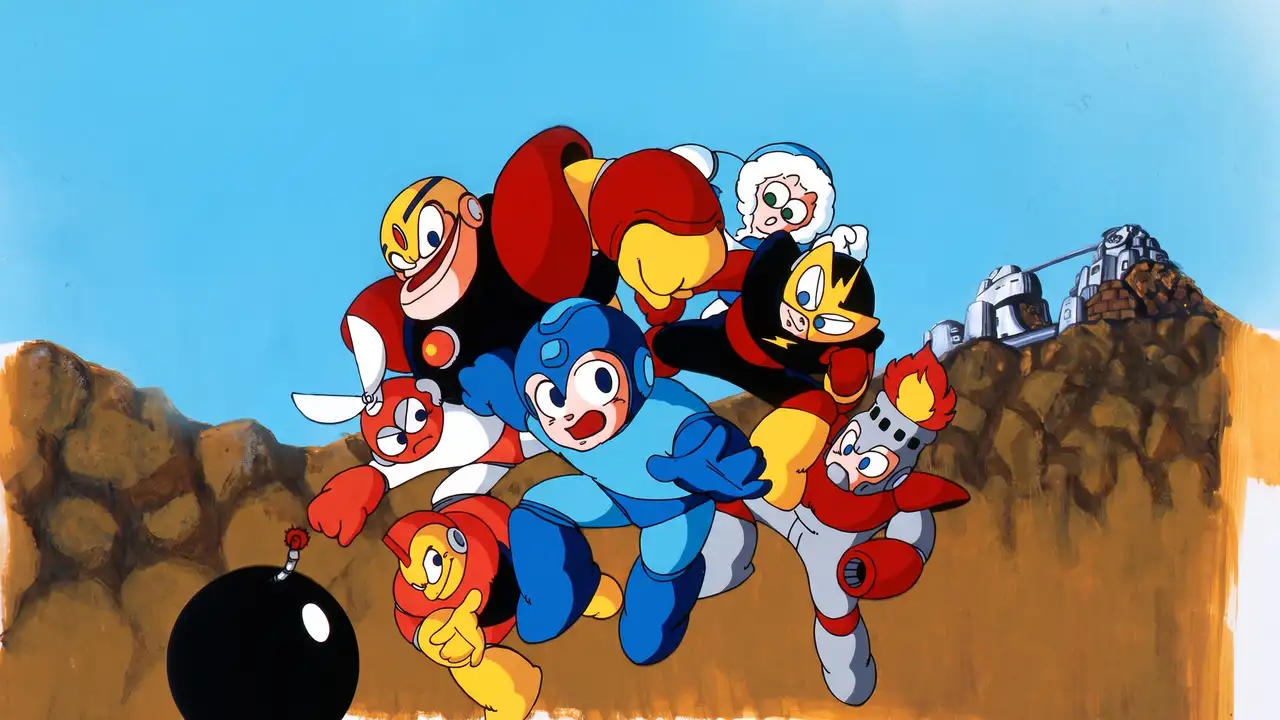
There is no story to speak of beyond a title-screen premise, and the game never pretends otherwise. What Mega Man offers instead is the origin point of nearly everything the series became: the weapon cycle, the stage select, the score-attack pop-ups and the rule that the fortress must be beaten in one life all begin here. Six Robot Masters open the campaign, and the official order runs from Bomb through Guts, Cut, Elec, Ice and Fire before the fortress climb. The presentation is pure NES, abrupt stage themes and all, and the campaign clears in roughly half an hour at a competent pace. Everything later entries refined was first attempted here, rough edges included.
The weapon-cycle flow through the six Robot Masters is the game’s core pleasure. Each defeated master yields a tool the next stage wants, and the loop of hunt-and-convert plays as cleanly here as anywhere in the series. Elec Man’s theme stands as the most memorable track in the game, a genuinely strong piece of NES composition. Cut Man is a pushover, Fire Man falls first try for anyone with a working strategy, and the roster’s spread gives the stage order real meaning. The Thunder Beam carries the endgame, and the Fire Storm and Thunder Beam pairing fells the final machine.
The Yellow Devil is the wall. The rock monster’s pattern demands memorisation of every piece of its trajectory, and avoiding each fragment without a trick is genuinely brutal; the Elec Man Thunder Beam trick exists precisely because the legitimate route is beyond reasonable patience. The fortress boss gauntlet must be survived in a single life, sparse checkpoints compound the pressure, and the Wily machine fight caps a climb that front-loads its difficulty into hazards rather than bosses. The Guts Man jump, Elec Man’s electricity gauntlet and the pit lethality all test precision in ways the era demanded.
Shield enemies are the defining annoyance. Nearly every enemy carries a shield it does not need, and the density here sits at the series’ peak, scaled back sharply from the second entry onward. The shields force specific weapon usage and slow the pace of every stage, and the design reads as a first attempt at enemy variety that later games abandoned. Bomb Man’s weapon is the weakest of the eight, its delayed detonation demanding timing that contact explosion would fix entirely.
The weapon economy punishes without mercy. Weapon energy is scarce, deaths drain reserves, and enemy farming becomes mandatory in the late stages, which is why the weapon-refill-on-death hack exists and why it saves at least half an hour of grinding. This is not really a cheat so much as a convenience the game should have shipped with. Infinite lives round out the quality-of-life layer, and the difference from a hacked first attempt that relied on save states is stark: no save states needed this time, and the campaign flows.
The Ice Man stage’s enemy-platform gimmick is buggy. The platforms sometimes fail to register as surfaces, dropping the hero straight through after a clean landing, and the unreliability turns a clever idea into a lottery. The original jump physics carry gravity quirks every later entry corrected, and the fortress’s one-life rule makes each boss attempt a complete commitment. The score pop-ups track performance honestly, and the stage themes, while abrupt, land with period charm.
The ending text wishes for everlasting peace with earnest 1987 sincerity, and the one-word versus two-word title spelling inconsistency remains a pedantic delight for anyone who checks. The identity here is foundational: benchmark everything against this entry and the shield prevalence, the Yellow Devil’s difficulty and the jump gravity all read as problems the series spent its next entries solving. As a starting point it is unmatched, and as a game it remains hard and very fun.
Overall, this is the hard, very fun foundation stone of the series, where the weapon cycle, the stage select and the one-life fortress rule all began, and its rough edges are the ones every later entry sanded down. The Yellow Devil wall, the shield-enemy density and the punishing weapon economy are real obstacles, but the core loop still plays beautifully and the half-hour campaign earns its reputation honestly.