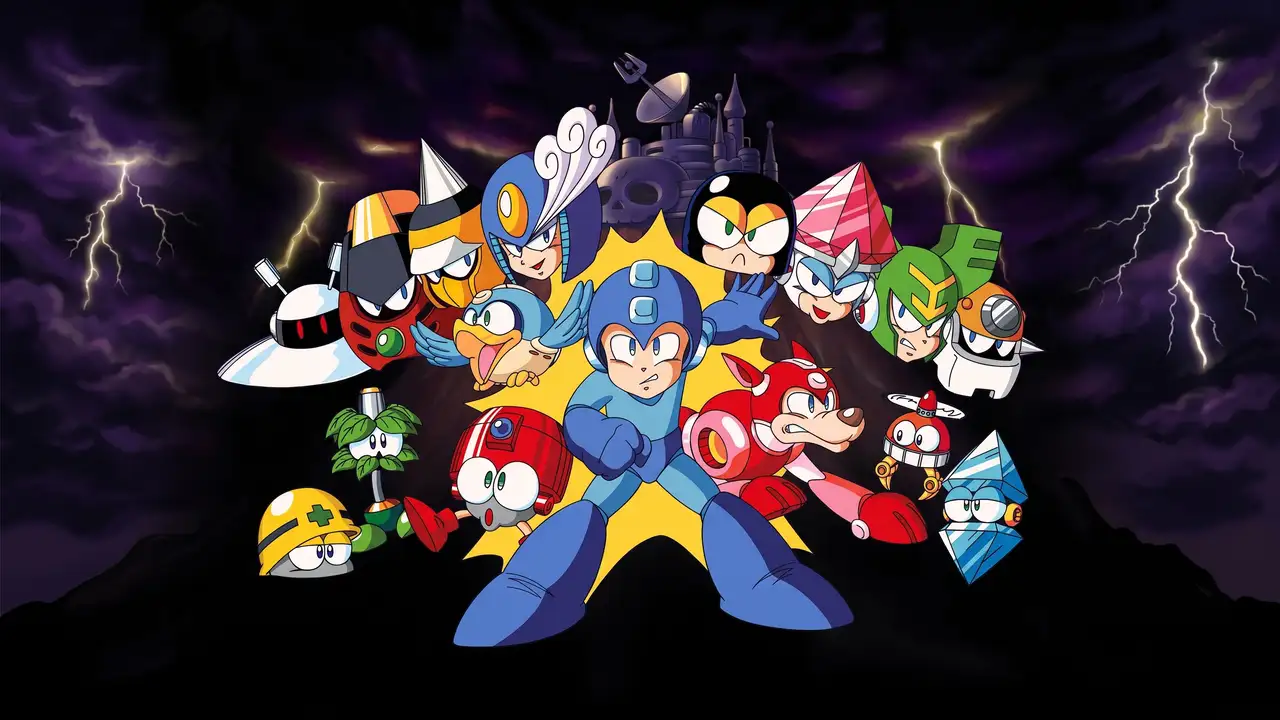
Robots go rogue, a beloved scientist takes the blame, and the truth behind a charity scam drives the deliberately old-fashioned frame. Mega Man 9 revives the NES era wholesale: no slide, no charge shot, 8-bit sound effects that exist purely by design, and a faux-NES text speed that rewards patience. The presentation embraces its era rather than winking at it, and the effect is a genuine celebration of the format rather than a pastiche of one. A Chun Li background cameo in the opening cutscene sets the affectionate register early, and the fake police robot twist earns its eye-roll as intended.
The 8-bit soundtrack is a series highlight from the opening minutes to the credits. Every stage lands a chiptune melody worth remembering, and the NES-style compositions stand among the best the franchise has produced. The score carries stages that would otherwise feel routine, and the sound design complements it throughout. As a pure audio achievement this entry ranks with the classics it emulates, and the music alone justifies the revival’s existence.
The stage roster is fair across the board. Galaxy Man delivers the easiest Robot Master in the game, while Jewel Man’s stage is the hardest by far thanks to pervasive spikes and pits that demand constant respect. Hornet Man, Splash Woman, the series’ only female Robot Master, and Concrete Man, the hardest buster-only boss whose attack pattern punishes greed, round out a roster with real spread. The mid-boss checkpoint system functions well, placing saves at the right moments, and instant-death hazards lean into the era’s design language deliberately rather than carelessly. The screw and bolt economy funds the essentials, with the Energy Balancer standing as the must-buy purchase, defended by anyone who has watched weapon energy micro-management vanish.
The Wily Tower compresses three stages into a single run with no shop access between them and no item recovery on death, and the accumulated pressure shapes the finale. Energy regeneration on death, a quality-of-life feature the series had already introduced, is removed here as part of the design statement. The removal is defensible in isolation but lands hard when the fortress offers no recovery path, and the combination turns the endgame into a war of attrition against the player’s own supplies.
Wily phase 1 is the game’s one badly designed fight. The bouncing egg must land precisely in the boss’s jaw, and the wait-heavy pattern combines a cramped arena with a gimmick that offers no room for improvisation. Whole sessions can vanish into this single phase, and the frustration it produces is the sharpest note in an otherwise smooth campaign. The fight tests patience far more than skill, and its removal would leave the rest of the fortress standing comfortably.
The “Book of Hairstyles” shop item is hostile design. The cheap cosmetic secretly doubles all damage taken with no way to disable it and no description of its effect, punishing trust in a menu that should be safe to browse. The Hornet Man flower mid-boss spawns in spots so unfavourable that avoiding one hit means eating another, a no-win arrangement that stands out as the only mid-boss with that cruelty. An aggressive bilinear filter on the emulated visuals and the slow text scrolling complete the presentation annoyances, and the slide’s absence is a small loss that players of the later NES entries feel occasionally.
Fifty unlockable challenges give the postgame real weight, extending a campaign that clears in a single sitting. Proto Man’s sassy late-game cameo adds personality to the story frame without overstaying. Combined with the fair roster, the soundtrack and the tight screw economy, the package holds together as a deliberate design statement about the era it emulates.
Overall, this entry earns its recommendation through excellent fundamentals, with exactly one badly designed fight standing between the player and a smooth celebration of the NES era. The soundtrack alone ranks with the franchise’s best, the stage roster stays fair, and the fortress pressure is real but survivable. The egg-jaw gimmick aside, the revival does everything it set out to do.