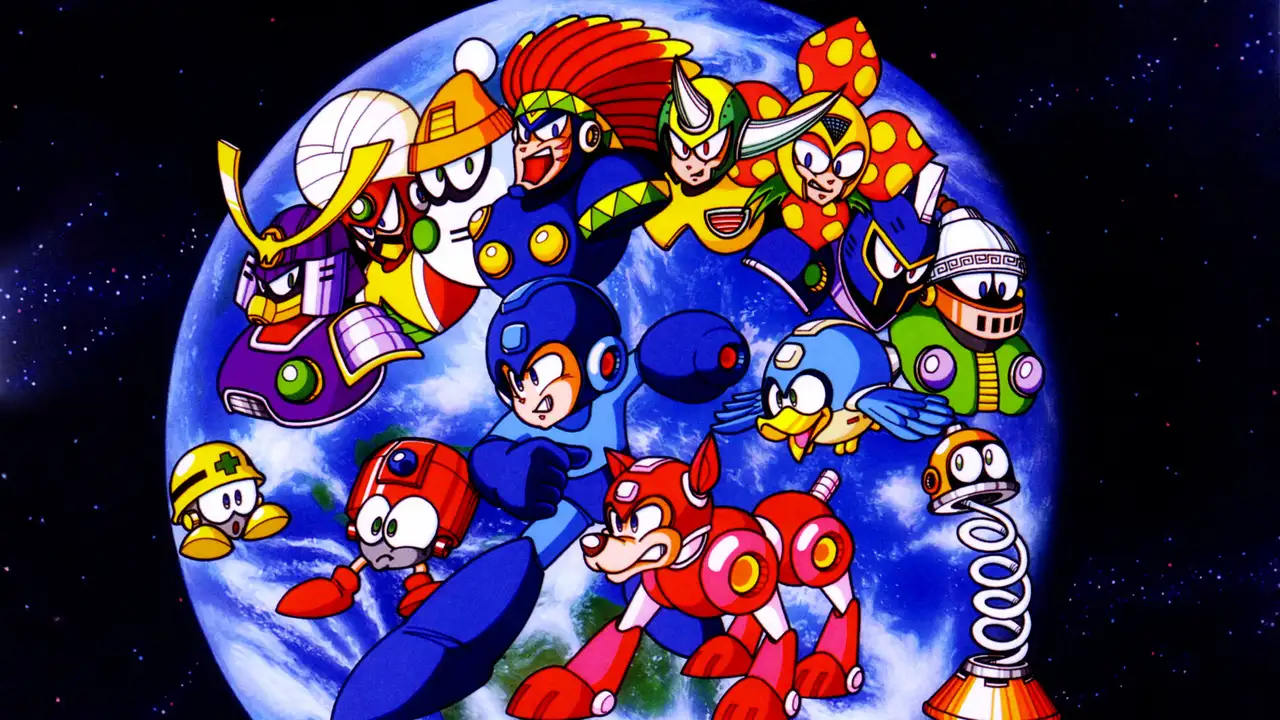
A masked host opens a world robot tournament, and nobody believes for a second who is behind it. Mega Man 6 closes the NES era with the series’ most transparently suspicious premise, played with full awareness of its own absurdity, and the inevitable reveal lands exactly as the eye-rolling expects. Fan-designed Robot Masters fill the roster, a first for the series, and each arrives with stat screens that treat the tournament framing with mock seriousness. The ending even carries a tongue-in-cheek typo gag that winks at the localisation. The tone is affectionate, the structure familiar, and the finale of the 8-bit run wears its series history lightly.
The Rush Adapters are the mechanical hook. Rather than summoning the robot dog, the hero wears him: a jet pack for flight and boxing gloves for powered punches, both attached and available constantly. The jet pack in particular transforms traversal, opening routes the levels gate behind its use and unlocking the Beat letters hidden throughout. If in doubt, jet over, a failsafe that forgives platforming mistakes and changes how the campaign plays. The adapters reshape both combat and exploration, and leaning on them constantly is the intended way through.
The Energy Balancer earns its place as the most useful item in the game. Weapon energy picked up while any weapon sits full would normally vanish, but the Balancer routes it to whichever weapon needs it most, eliminating the series’ oldest micro-management chore. The stage-select progress icons track completion neatly: one icon for fully cleared, another for a missed letter, and the palette actually shifts on replaying a stage after collecting its prize. These small touches add up, and the quality-of-life layer here quietly outpaces every predecessor.
The difficulty balance splits in two. The Robot Masters are pushovers with simple two-move attack patterns and low damage output, making this the easiest classic entry by a clear margin. The stages themselves stay sharp: Tomahawk Man’s spike fields, the Rune Mine’s conveyor gauntlets and upside-down water segments provide the real challenge, and the fortress keeps spike-heavy instant-death stretches. Weakness damage is deliberately downplayed, most bosses fought without their weakness, and the series’ power creep toward gentler design is obvious. The two-act fortress carries the longest boss gauntlet in the series to that point.
Plant Barrier is the roster’s low point. The weapon works, even shining in one specific matchup, but it demands standing directly next to the enemy to land its shield, an awkward contact-range requirement that makes every use a risk. The Beat letters are a downgrade as a collectible system: only four exist, all clustered in the bottom-right stages, where the previous entry scattered eight across the whole game. Beat himself is neutered in battle, summoned but barely useful against the fortress bosses, presumably balanced down from a previous dominance that broke the game.
Input drops interrupt the fortress. Jump presses intermittently fail to register during the Wily stages, the run’s only technical complaint, and the timing of the failures during instant-death platforming makes them sting. A hoard of E-tanks carried into the finale absorbs the punishment, and the spike-laden final dungeon remains the hardest thing in the game despite the gentle bosses. The contrast between easy bosses and honest stages defines the whole experience.
The NES hardware peaks here. The sprite work pushes the 8-bit capabilities to their limits, particularly in animated backgrounds and boss intros, and the era closes on a note of technical polish. The clear time runs briskly, aided by the adapters and the forgiving roster, and the tournament framing keeps the structure varied from stage to stage. As a send-off to the NES run, the entry balances warmth with challenge in a way the earlier games never quite managed.
Overall, this is the easiest of the classic entries and a warm send-off to the 8-bit era, with the attached Adapters, the Energy Balancer and the honest stage design compensating for pushover bosses. The weakened Beat, the awkward Plant Barrier and the fortress input drops are real flaws, but the package remains a good game that closes its era with confidence.