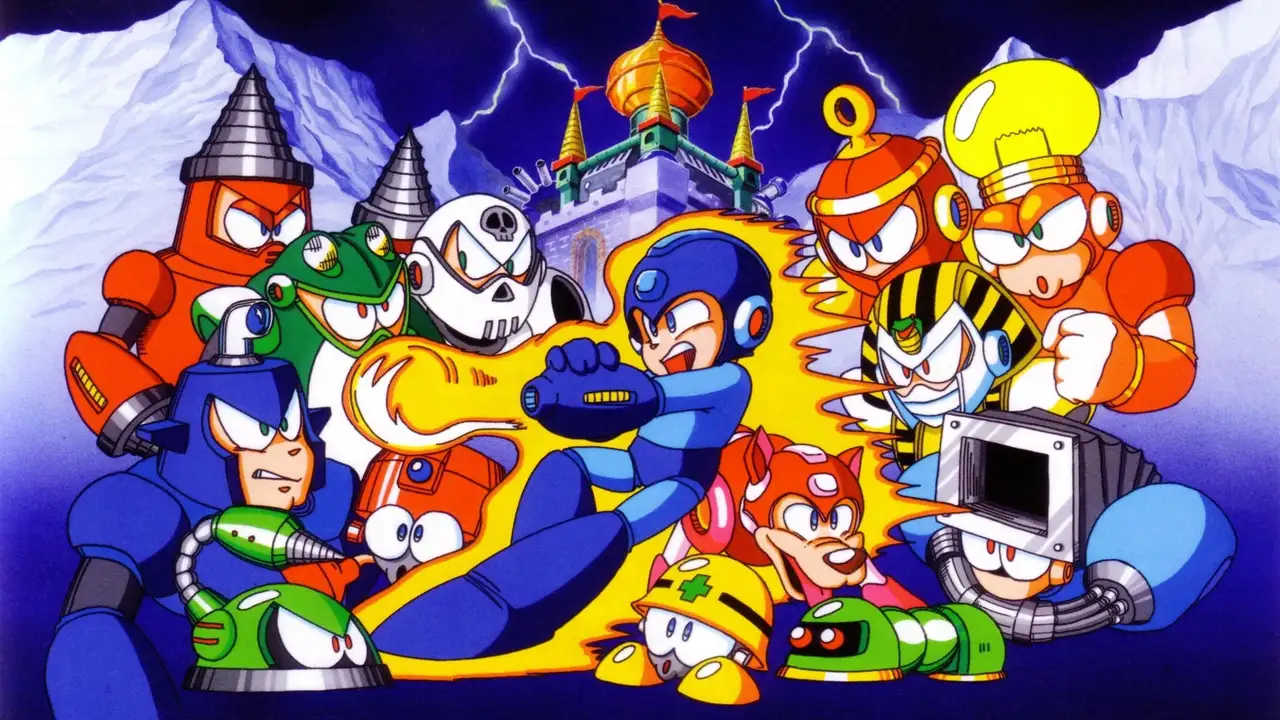
For the first time, the classic series has an antagonist who is not the usual suspect. Mega Man 4 builds its story around a captured scientist and his daughter, and the hostage reveal plus redemption arc give the campaign a narrative moment its predecessors lacked. The eventual reveal behind everything earns the full sarcastic treatment it invites, but the character beats around the framing land sincerely. The intro sequence also clarifies series lore that earlier entries never bothered to explain, and the trademark eyebrow gag makes its affectionate return. Structurally the game is a bridge, but the story ambition is new.
The chargeable Mega Buster debuts here, and it changes the series permanently. Charging happens almost accidentally at first, then the Pharaoh Shot reveals it charges too, and the only real flaw is a charge-up time just slow enough to make the Buster occasionally not worthwhile. The debut matters more than the usage; every later entry inherits this mechanic. Skull Barrier, Dust Crusher and Pharaoh Shot stand out as the roster’s best, with Dust Crusher’s surprisingly good behaviour a genuine find, while Dive Missile earns its place as the dud of the set.
The one-screen weapon menu is a welcome quality-of-life fix. The previous entry’s scrolling list vanishes in favour of every power on a single page, a change that feels small and plays enormous. Optional Balloon and Wire adapters hide in stages, exiting to the map on pickup and adding a replayable hunting layer, with the Balloon specifically worth chasing to complete the set. The adapters meaningfully change traversal, the first time side pickups in the series do so, and the two weakness loops across eight Robot Masters give the roster its shape.
Weakness damage is bafflingly weak. Using a Robot Master’s stated weakness often does barely more than the Buster, a dramatic comedown from the punchy one-shot kills of the second entry, and the Dive Man matchup makes the case painfully. The design softens the weakness loop into a suggestion rather than a mechanic, and combat defaults to the Buster as a result. Whether that softening was deliberate balance or a miscalculation, the effect is a campaign that underuses its own best idea.
The “continue” option is a design trap. It silently restarts the current stage from the beginning, and the label’s meaning only becomes clear after a full stage replay is lost to it. Paired with the boss and player health bars refilling painfully slowly from the first boss onwards, the UI layer accumulates genuine friction. The Rush Jet rework compounds the confusion: vertical-only movement after the previous entry’s free flight feels like a downgrade, even conceding that the original was probably broken.
A cheat carried over from the previous game’s softlock fix backfires spectacularly in the boss gauntlet, preventing bosses from registering as beaten until the wrong item is diagnosed and disabled. The live debugging session becomes the campaign’s most memorable technical moment, more than anything the game itself scripts. The finale spans the Cossack and Wily fortresses and runs longer than expected, though the soundtrack never rises to meet it. The music is forgettable, a clear step below the second and third entries, and it remains the game’s biggest atmospheric knock.
The game runs longer than expected and the NES performance holds up without slowdown, a small but real improvement in stability. The fortress stretches give the adapter pickups room to matter, and the redemption arc closes the story with more warmth than the series had attempted. Nothing here is broken; everything here is simply serviceable in the shadow of its neighbours.
Overall, this is a solid, unremarkable bridge entry whose chargeable Buster, adapter pickups and hostage-redemption storyline outshine its anemic weakness damage and forgettable soundtrack. The “continue” trap and slow health bars add needless friction, and the music never justifies the campaign. It is not a bad game, just a fairly forgettable one in a run of classics.