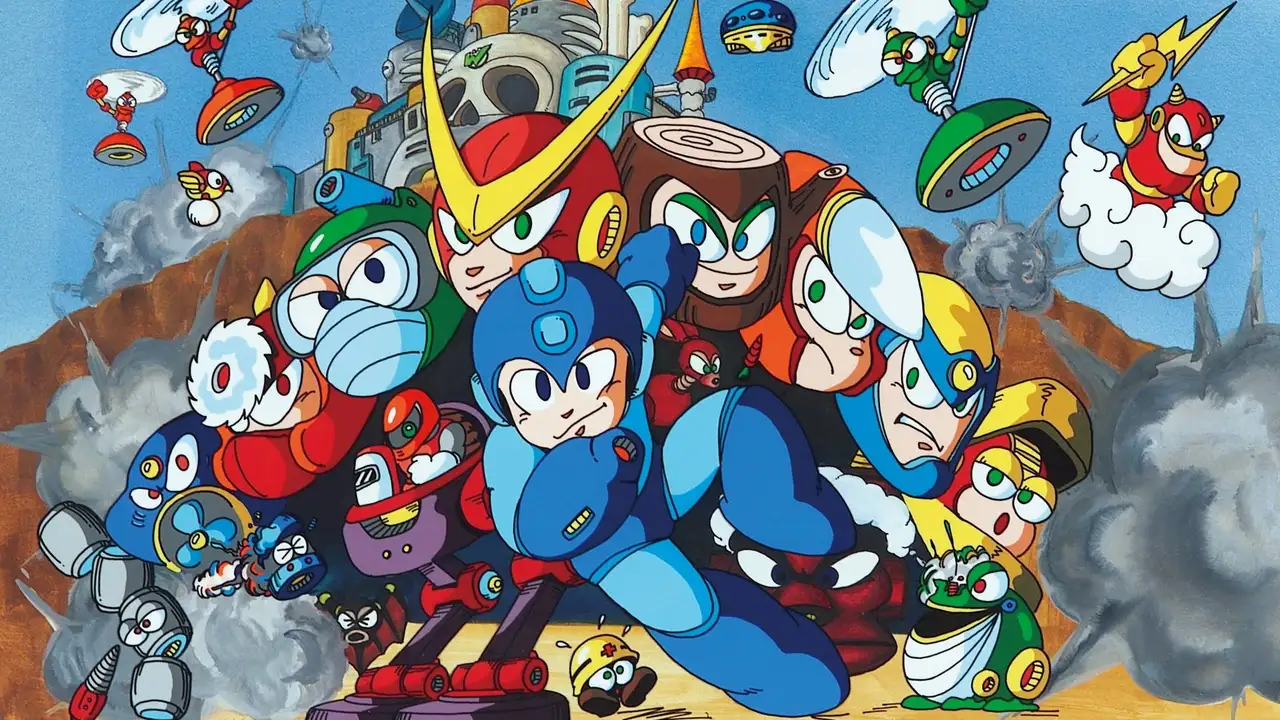
Eight new Robot Masters, a returning villain, and the skeleton of a plot the game never pretends matters. Mega Man 2 is the fan-canon high-water mark of the classic series, and the campaign plays exactly as such: a reunion with a game that defined a generation’s idea of what a platformer could be. The NES presentation carries the identity, from sprite flicker to colour-swap armour quirks, and the whole package is beatable in one comfortable sitting. The plot stays a skeleton, but nothing about the game needs more than it has.
The soundtrack is the emotional identity. Every track is a banger, from Wood Man’s theme to the fortress music, and the Wily-stage theme stands as the defining memory of the entire title. This is an all-timer NES score, the kind that pops into memory decades later, and it carries stages that would otherwise read as routine. Few games in any era have soundtracks this consistently strong, and the music alone would justify the reputation.
The Metal Blade is the best weapon in the game, possibly the series. Eight-directional fire, a huge energy pool, and usefulness in every level make it the default tool throughout, and it even kills its own master instantly in the boss gauntlet, the most pathetic of the Robot Masters by that measure. The weakness chain runs Metal to Bubble to Wood to Air to Crash to Flash to Quick, and the loop remains the series’ most satisfying. Items 1 through 3 add traversal utilities that the level design anticipates, and the E-Tank economy rewards exploration.
Heat Man’s disappearing-block stage is the design everyone loves to hate. The blocks appear so erratically that the pattern never quite settles, and the worst section is skippable entirely with the Item-2 jet, an admission many players make happily. Quick Man’s laser corridors are pixel-perfect trial and error, the hardest stage in the game, and Time Stopper exists precisely to bypass them, though using it for the first time feels like admitting defeat. Both stages test patience in ways the rest of the campaign never demands.
The Mecha Dragon fight is the personal low point. Brutal knockback over bottomless pits kills repeatedly, and the encounter tests composure more than skill. The final boss surrenders to the pause-invulnerability trick, a discovery that trivialises the projector fight the moment it clicks, and the fortress closes shortly after. The credits run roughly ten lines long, and the game offers nothing beyond them, a brevity that suits the campaign’s one-sitting shape even as it limits the package.
Emulator quirks add period charm rather than friction. Sprite flicker, a stray chain rendering through a wall, and the auto-scroll’s rough frame pacing are NES oddities treated with nostalgia. The energy-refill workaround installed for this run softens the item persistence that burned players in the previous entry, making this version gentler than vanilla. Whether the game is genuinely the series’ best or simply the one most played is a fair question, but the affection is self-aware and the quality is real.
The campaign is beatable in roughly one session, smooth apart from the dragon, and the victory-lap register suits a game this familiar. Every friction point has a tool or a trick that resolves it, and the difficulty curve asks for pattern learning rather than reflexes. The formula here is the template every later entry measures itself against.
Overall, this is the series’ consensus best, and the reunion vindicates the nostalgia with an all-timer soundtrack, the franchise’s finest weapon and stage design that mostly holds up. Heat Man’s blocks, Quick Man’s lasers and the dragon’s knockback leave a couple of pixel-perfect scars, but the campaign remains the classic run’s high-water mark.