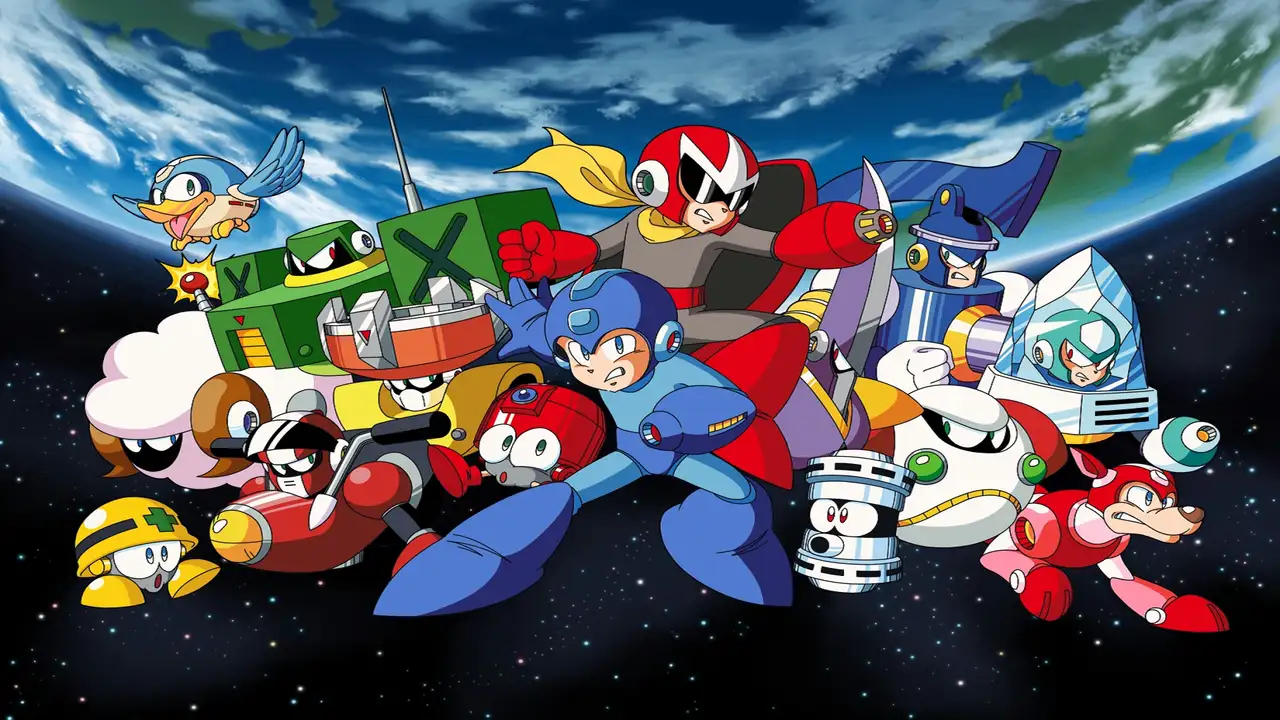
Robots catch the flu. Mega Man 10 opens on the absurd Roboenza premise, a virus sweeping the machine population while a stolen cure machine drives the plot, and treats the whole thing with the eye-rolling silliness the series has always worn. The 8-bit presentation returns in full retro form, complete with the Robot Master border overlay and sprite work faithful to the NES era. Eight Robot Masters guard themed stages feeding the classic weakness chain, and the finale of the 8-bit run carries itself with the confidence of a formula that knows exactly what it is. The story never rises above series-silly, but the twist framing wears its predictability as a joke, and the tone lands accordingly.
Special weapons carry real strength this time. Water Shield proves unfairly powerful against Solar Man, Triple Blade cuts straight through incoming attacks, and Commando Bomb’s tiered aiming gives its detonations real precision. The roster mostly avoids the dead weight that plagued earlier entries, with one notable exception, and the variety keeps the weakness chain interesting across the gauntlet. Solar Man’s theme stands out in a soundtrack that rewards patience, the songs growing on repeated listens rather than landing immediately. The music follows the classic style while adding a few genuine highlights.
The structure returns to a formula missing from its immediate predecessor. Boss gauntlet first, then two Wily fights, a pattern every classic game used until Mega Man 9 dropped it, and the restoration makes the campaign flow better. Unlockable postgame challenges arrive as a genuine surprise, a meaningful addition absent from Mega Man 9 that adds substantial replay value for anyone chasing high scores. Three playable characters round out the options, with Bass and Proto Man both available as alternate routes through the campaign. The bolt-funded shop rebalances prices, E-tanks dropping from 50 bolts, and the new Energy Balancer item removes the micro-management of weapon energy that older games demanded.
Easy mode with unlimited lives is the modern way to approach the series, and the difficulty question resolves mid-campaign: the predecessor was the harsher game overall, but the Wily stages here still bite hard enough to demand respect. Hidden blocks and trial-and-error pit deaths remain series tradition, and enemies that respawn on platforms after knocking the hero into a pit stay as irritating as ever. The classic loop of weakness chains, bolt hoarding and tank stockpiling works exactly as it should, and the challenge modes give the postgame somewhere to go once the credits roll.
The Block Devil is the low point. The recurring blob boss returns in a form worse than its predecessor’s equivalent, with no room to move and a wait-heavy pattern that crawls at a glacial pace. Whole sessions can disappear into that single fight, and the pattern memorisation demanded feels disproportionate against everything else in the campaign. Nothing else in the game comes close to that wall, and the contrast between it and the otherwise well-tuned gauntlet makes the spike feel sharper.
Thunder Wall is the dud of the weapon roster. Awkward to aim and barely reaching where it needs to go, the weapon earns the comparison to its predecessor’s concrete shot but worse, and the complaint holds across two separate fights where it matters. Every roster has its failures, but this one arrives precisely when the campaign needs it to work. The respawning-enemy irritation and hidden-block traps complete the friction picture, all inherited series traditions that the retro formula refuses to modernise.
The package closes the 8-bit era with a campaign short enough for single sittings yet dense with unlocks, characters and challenges. The retro presentation carries the nostalgic tone deliberately, and the challenge modes give the formula longevity its predecessor lacked. As a finale to the classic run it does the job with competence and a few genuine highlights.
Overall, this is a fitting, enjoyable send-off to the 8-bit era that balances harsher Wily stages against better structure and stronger special weapons than its predecessor. The Block Devil and the Thunder Wall drag specific stretches, but the challenge modes, three playable characters and the restored gauntlet formula make this a worthy close to the classic run.