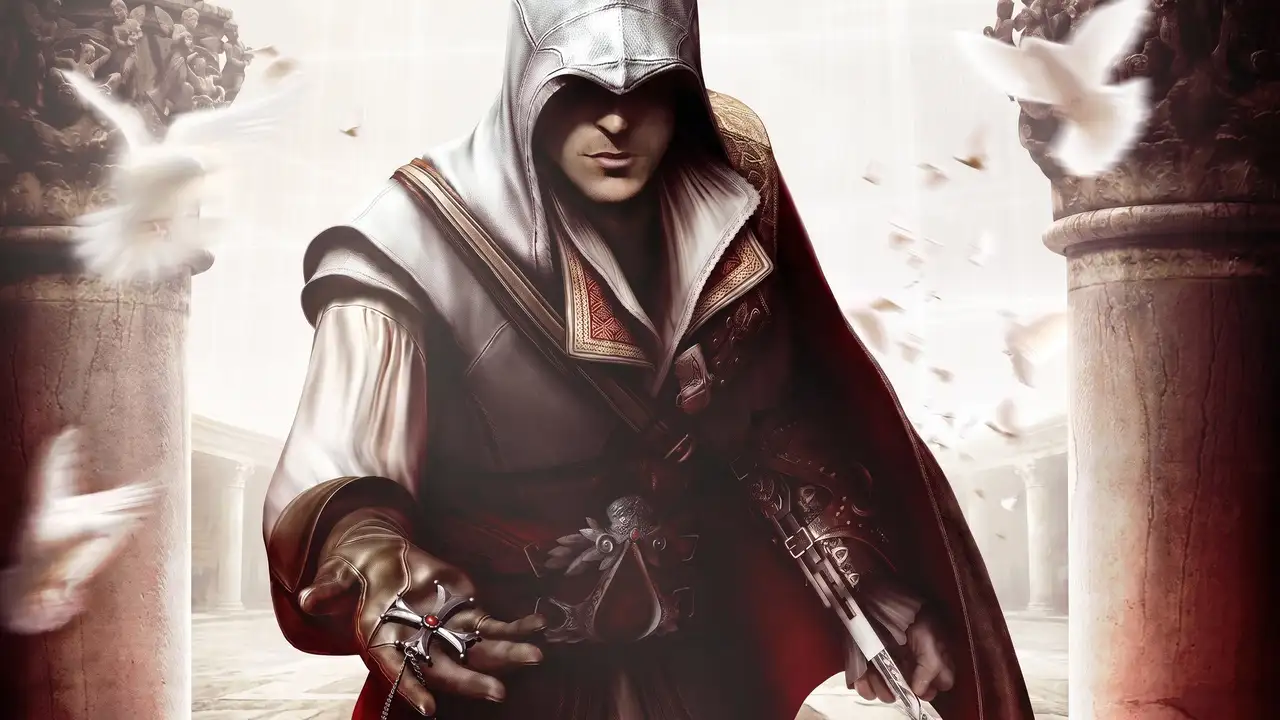
A prequel following a young Altaïr hunting the Templars’ Chalice across Damascus, Jerusalem, Tyre and Acre, rebuilt as a 2.5D side-scrolling action-platformer for the DS. The pitch promises franchise archaeology: Al Mualim, the missing ring finger, Malik in the king’s ranks and a Harash betrayal tease all appear for attentive series watchers. What the pitch does not deliver is payoff. The narrative is a chained fetch-quest with an unexplained new character whose reveal and accusation arrive and vanish without development, and nothing is learned about the protagonist himself.
The traversal and jump system is the game’s defining flaw, recurring through every chapter and worsening as it goes. Tightropes and wall-climbs expose physics with no middle ground: the hero either barely jumps or goes way too far, and the direction-press-to-climb scheme, built for a D-pad era without an analog stick, actively fights the player. By the Tyre wall sections the controls feel broken rather than merely awkward, and the Acre siege compounds the problem with buggy encounters. Nearly constant save states are the only practical countermeasure, and the platforming challenge comes entirely from inconsistency rather than design.
The checkpoint system is broken by design, placed before cutscenes and sparingly elsewhere. Dying near a cutscene forces a full re-watch before every retry, a bizarre choice that turns failure into a double punishment. Only external save tools make the loop tolerable, and the checkpoint logic never improves across the four cities. It is the kind of friction that a single placement rule change would have fixed entirely.
Combat is serviceable but exceptionally basic: spamming the back-flip and quick-strike beats every encounter, counter timing is unreadable, and most enemies barely fight back. The red-helmet Templars and elite guards offer the only resistance, and even they fall to the same two moves. Assassination, the series’ identity, only happens when the script permits it, otherwise the best kill animation is shoving enemies off ledges. That shove, with its goofy cease-to-exist effect, becomes the game’s accidental comedy signature alongside rooftop tar, random snakes and a Templar kept in a cage.
The touchscreen minigames are the most inventive element, with pickpocketing and pressure-point interrogations that feel genuinely creative for the hardware, even as repeated questions wear thin. Set-pieces carry the middle chapters: the oil-barrel arson of a target’s house, Prince of Persia-style trap gauntlets whose lineage the franchise itself shares, a scholar-disguise infiltration of a besieging camp, and a sandstorm chase. The visuals, meanwhile, look surprisingly good considering the hardware, with a quiet, ominous monastery and the siege-scarred bleakness of Acre standing out atmospherically. The DS-era licensed output deserves more visual credit than it usually receives.
Progression telegraphs the game’s brevity: upgrades are limited to two sword tiers and three health bars bought with blue orbs that trickle in at one per kill. The thin upgrade economy is itself the announcement that the campaign is short, and a pointless fetch errand for knives that are never needed sums up the padding in the mission design. The finale is a boss identical to every previous Basilisk fight followed by a hard cut to the end, an anticlimax ranking among the most abrupt in memory. Completion unlocks a hard difficulty that offers little reason to return.
Overall, the creative touchscreen minigames, the respectable DS-era visuals and the occasional strong set-piece give this prequel real moments, but the uncontrollable jump physics, nonsensical checkpoints, spam-to-win combat and an empty prequel story weigh it down heavily. It started off promising and quickly veered off a cliff, enjoyable in bursts and rescued from full frustration only by save states. Average, with a lot wrong, and its low reputation is fairly earned.