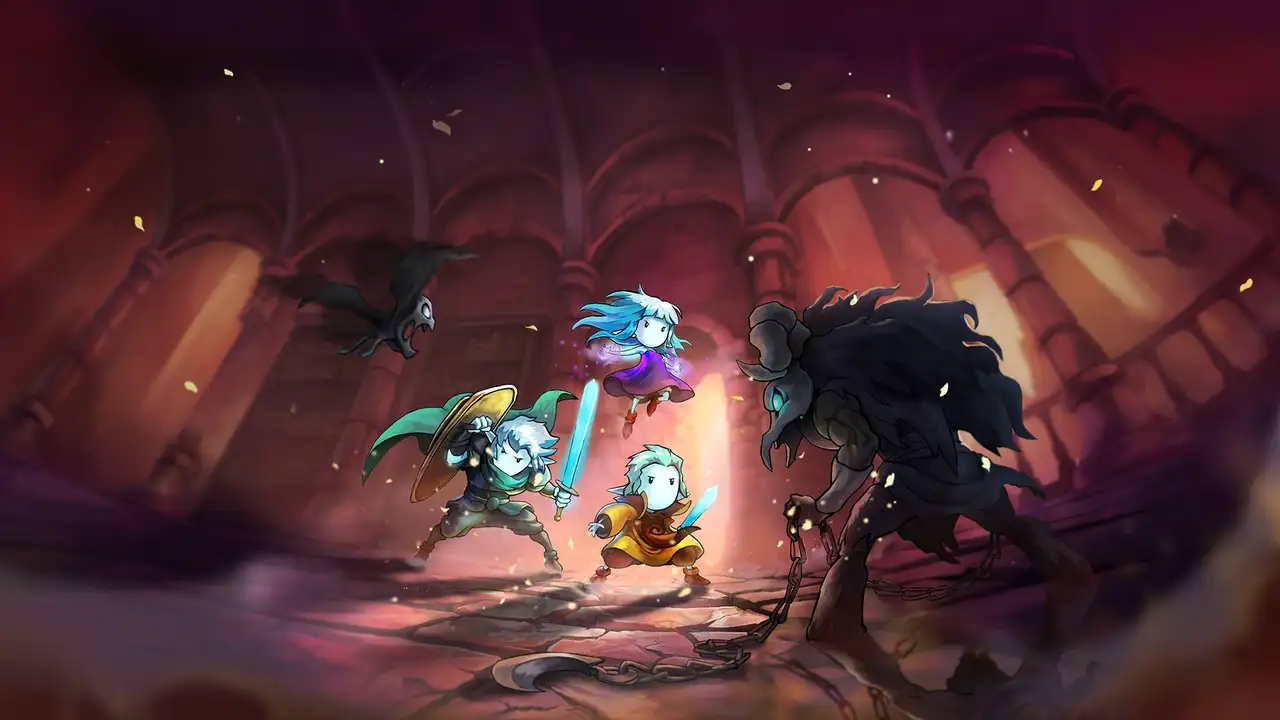
The Kirin race flees their homeland of Azur as an invasion and spreading plague consume it, and Greak: Memories of Azur builds its hand-drawn puzzle-platformer around three siblings with genuinely different abilities. Greak double-jumps and crawls through tight spaces, Adara floats infinitely and swims freely with her magic ring, and Radial grapples, blocks and hits hardest, and the puzzles exploit every distinction. The absence of contact damage registers as a mercy within the first minutes, a design choice that immediately sets the tone. The art style earns headline praise throughout, hand-drawn frames giving the flight from Azure a storybook melancholy. Few puzzle-platformers commit this fully to asymmetric design.
The environmental puzzles are where the game shines. Reflections, water levels, boats and rune altars combine the siblings’ abilities creatively, and the Aldolar labyrinth finale warps each sibling to a separate spot only their specific skill can escape, a cubby only Greak fits through, a rune underwater, and a double-grapple sequence for Radial. The colour-tinted magic aiming differently from the crossbow is a small delight of mechanical clarity. Every puzzle has a reason to use each sibling. The puzzle design sustains roughly six hours without repeating itself, and the escalation is steady.
Camp life gives the world its warmth. NPCs react differently depending on which sibling approaches, character-specific altars and relics dot the regions, and the lore books on the Guardians and Oracles are genuinely interesting reads. The cooking system combines three ingredients into healing items, with seed muffins and elixirs becoming experiments worth pursuing, and the crafting earns real enthusiasm. The old-school finite-slot inventory forces constant juggling, a resource-tight tension that suits the survival-quest framing. An old-school inventory with genuinely limited slots is a bold choice in this genre, and it mostly works.
The mid-game revelation that the scouts’ expedition ended in tragedy hits harder than expected, and the camp dialogue’s specificity makes the loss land with weight. The lore delivery stays personal rather than encyclopaedic. The ending escapes Azur by airship with no final boss, a close accepted as satisfying precisely because a three-character final battle would have been awful, and a clear sequel hook closes it. Knowing when to skip the climactic fight is a rarer design virtue than it sounds. The story earns its emotional beats without combat spectacle.
Combat with multiple characters is messy and much less satisfying than the puzzle work. Controlling two siblings at once turns skirmishes into a mess, and by the third sibling the verdict hardens: multi-character boss fights simply do not work, feeling genuinely broken rather than fiddly. Single-character combat barely improves matters, with encounters amounting to button-mashing. Ladders, weapon-swing cancellation and occasionally over-sized hitboxes draw repeated small complaints. The combat never rises to the puzzle design’s level, and the bosses are the campaign’s clear sore spot.
Teleport stones are sparse and inconsistent, with no discernible rule for which areas have them, making backtracking more tedious than the world’s structure intends. The marshes magnify the multi-character control pain specifically. Performance itself is spotless, with no crashes, framerate problems or audio glitches across the whole run. A hundred-percent sweep collecting all fifteen relics fits comfortably in the runtime. The world invites thoroughness even when the travel punishes it.
Overall, Greak: Memories of Azur is a hand-drawn three-character puzzle-platformer whose differentiated sibling abilities, creative environmental puzzles and warm camp storytelling deliver a rewarding six hours, held back by broken-feeling multi-character bosses, mashy combat and inconsistent fast travel. The puzzles and art are the reason to visit, and the bosses are the price. A visually pleasing game whose best ideas outshine its worst.