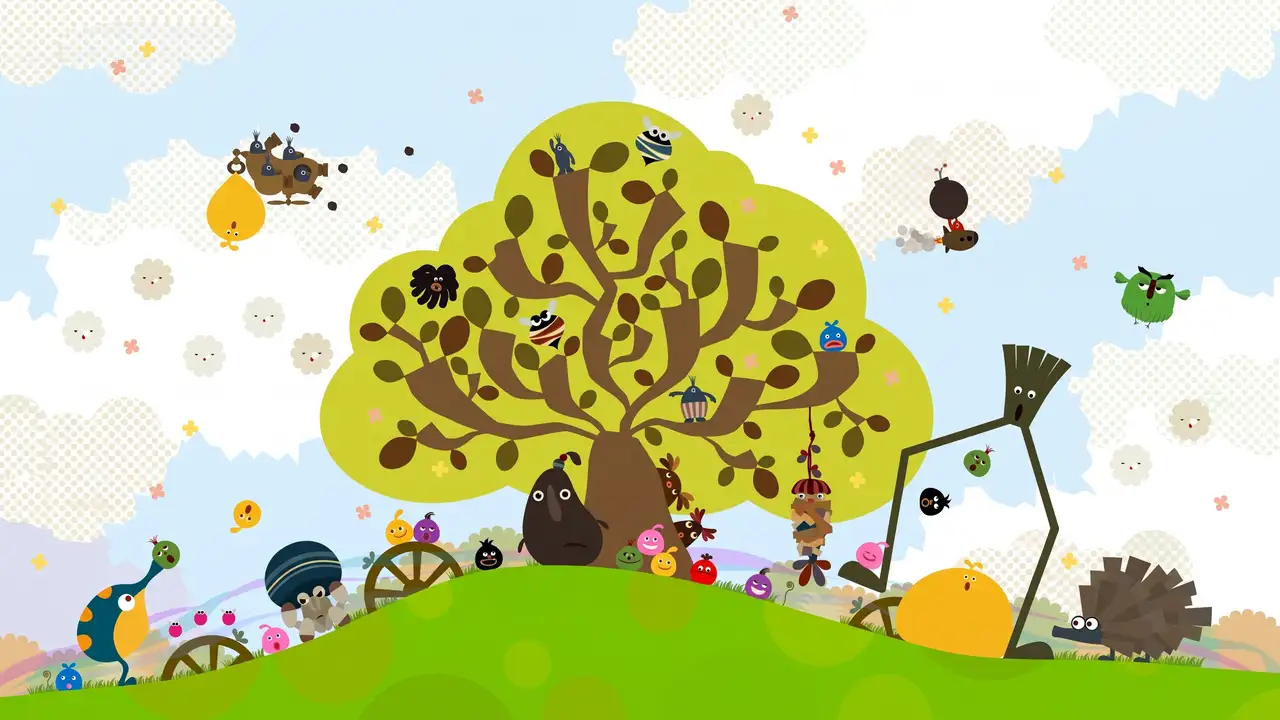
Yellow blobs return home to silence a spreading song that withers life and leaves black goo across hillsides, guided between stages by MuiMui teachers. Tone stays bright, bouncy and whimsical, favouring springy motion and sung feedback over menace. New yellow Viola joins returning friends late in the roster, widening colour choice without changing core handling. Flower gardens, snowy peaks, tropics, clock towers and creature interiors keep scenery in constant rotation. The sequel premise works as an excuse for new verbs rather than a dramatic reset.
Core handling rests on L1 and R1 tilt, Circle bounce, plus split and rejoin to squeeze through gaps or surround collectibles. Berries feed growth, Moja fragments mark cleansed patches, MuiMui rescues unlock lessons, and musical notes accumulate toward 100-note stage level-ups. Size gates shape progress directly, since larger mass presses switches, blocks drafts and reaches wider ledges. Splitting solves the opposite problem, threading narrow flues and dodging hazards as separate droplets before reforming.
Swimming arrives as a full verb set rather than a slowdown zone, with held Circle sinking the swarm to lower currents. Wall pads learned from MuiMui lessons launch blobs across sheer faces, opening alternate lines through familiar slopes. Flower fluff catches the wind for gliding stretches, while tail-to-tail swings fling the swarm between anchor points. Slam attacks clear surface goo, and singing itself cleanses afflicted enemies at close range. Learned verbs turn old stages into new routes, rewarding return visits with previously unreachable ledges.
Music layering drives replay momentum, thickening arrangement as blob count climbs through instrumental, fuller instrumental and vocal thresholds. Bare numbers sound thin and percussive, mid counts add harmonic weight, and large swarms carry full sung lines. Interactive singing timing lets button presses land on the beat for extra flourish. Playable cast members keep individual themes only on the character select screen, so identity flattens during stages despite the stronger dynamic system. Viola adds visual novelty without restoring per-character songs.
Flower gardens stage bouncy petal chains, snowy peaks add slick inclines, tropics favour dense canopy drops, clock towers stack vertical gears, and creature interiors turn ribs and membranes into springy corridors. The BuiBui factory hardens the palette into industrial conveyors and press hazards. Mini-games break up rolling: Yoki bonking tests aim against popping targets, Chap-chopper launches demand angled takeoffs, a MuiMui plane shooter scrolls through aimed fire, and cannon defence mixes trajectory with timing. Stages extend longer and more varied than first-game equivalents, avoiding repeated world categories.
Bonmucho anchors an early boss showcase around repeated nose-hair pulls, demanding positioning under a swaying target. The closing Majoline sing-off escalates into proper multi-phase structure, with pattern changes the first game lacked. Between bosses, momentum hazards dominate: spike beds punish mistimed bounces, and ice half-pipes demand straight launches from curved walls. No camera recenter button exists, so tilt momentum carries the view past optimal angles during fast transitions. Recovery after a skewed landing costs speed and rhythm.
Cutscene upscaling looks rough beside crisp stage art, with soft edges on pre-rendered sequences. Musical note purpose stays opaque early on, since pickups accumulate well before the level-up thresholds become clear. Tilt-only control remains the defining constraint, keeping hands off direct movement at all times. Growing the blob visibly thickens the song while gating switches and drafts, so size management doubles as both puzzle logic and audio mix. Singing as a cleansing tool gives the soundtrack a combat function beyond decoration.
Overall, the sequel earns its status through verb density, stage variety and a music system tied directly to swarm size. Multi-phase bosses, mini-game breaks and revisit-friendly unlocks sustain momentum across the campaign. Camera and theme quirks irritate without dislodging the central loop of tilt, bounce, split and song.