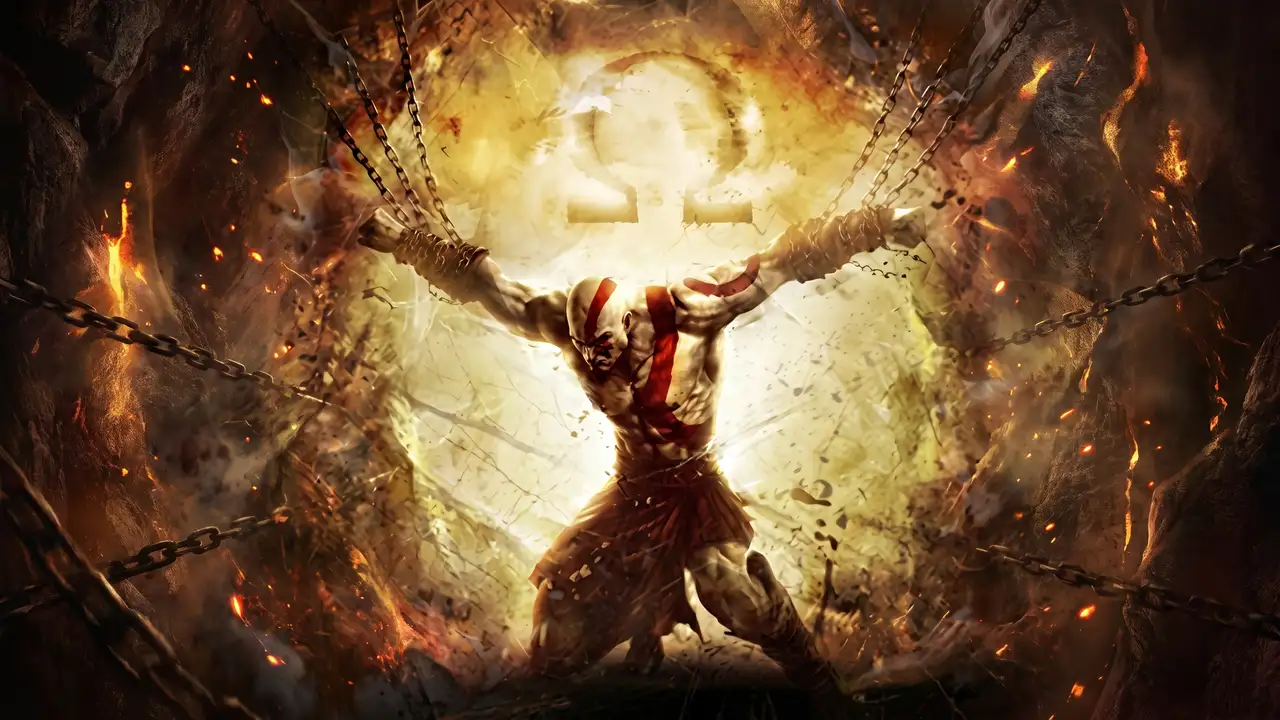
A vision-driven quest carries the newly crowned god of war from the sinking city of Atlantis through Sparta itself, the Canyons of Sorrow and into the Domain of Death, chasing a brother he believed lost. That narrative purpose is what elevates this entry above typical handheld spin-off expectations: it tells a story no other game in the series attempts, and it slots a genuine gap into the saga’s continuity rather than merely treading water between bigger releases. The locations show more variety than the predecessor’s tour, and the rare spectacle of a friendly Sparta, a town that welcomes its god home, lands with unexpected warmth. The emotional weight of the brother-quest explains much about the protagonist’s later fury.
Thera’s Bane is the standout mechanical addition, the first proper weapon-fire system in the series. Fire imbues the blades while a regenerating meter drains, and it is the only way past armour, which turns ordinary encounters into decisions about when to burn the meter and when to conserve. Minotaur horns extend the fire gauge, and the upgrade economy is generous enough that everything maxes out before the final area, the bars finally fitting their UI graphic cleanly. The combat core remains the classic blades loop, and the fire layer gives it fresh tactical texture without complicating the fundamentals.
The boss lineup is solid throughout, from the sea creature assaulting Atlantis to a quick-time-only mirror match against the protagonist’s own younger self, an absurd and memorable scrap, and a death-god finale that ranks among the handheld duo’s very best encounters. The variety keeps the four-hour structure from ever feeling repetitive, with each encounter introducing a distinct mechanical demand. The mirror match in particular embraces the series’ theatrical streak with total commitment.
Magic is the weak link. The spell set (Eye of Atlantis electricity, the Scourge of Erinys voids, the Horn of Boreas freeze) underwhelms in power, and worse, the spells are mapped to the D-pad rather than a dedicated button, a change made to accommodate the fire system that makes casting awkward mid-combo. The complaint holds from unlock to credits, and the predecessor’s magic simply worked better. The Arms of Sparta, a late-arriving spear and shield, is similarly split: genuinely handy as a mobile block, forgettable as an offensive option.
Tutorials for trivial actions arrive relentlessly, pop-ups explaining actions the player has already performed dozens of times, and the excess becomes a running irritation through the mid-game. Save points are extremely frequent, sometimes doubled within a few steps of each other, generous to the point of comedy. A harpy nuisance recurs often enough to grate. None of these flaws wound the campaign; they just pepper its edges.
The Sparta brothel minigame is the series’ most absurd and least rewarding, a curiosity worth one visit and nothing more. Edge-of-screen quick-time prompts, a genuine failing in the console entries, earn a pass here purely for the handheld’s tiny screen. On the emulation front, a mid-boss-frame crash struck minutes before the finale, though it traces to emulator settings rather than the game itself, and a texture pack transforms the visuals dramatically even though the pre-rendered cutscenes resist the treatment, producing an occasionally jarring mismatch between enhanced gameplay and untouched video.
Overall, this is a very good PSP action game whose story alone justifies its place in the series, delivering the only brother-quest narrative the saga tells and bridging directly into the sequel that follows. Thera’s Bane, the strong boss lineup and varied locations outweigh the awkward D-pad magic, the underwhelming spells and the relentless tutorials. A compact prequel that punches well above its handheld weight.