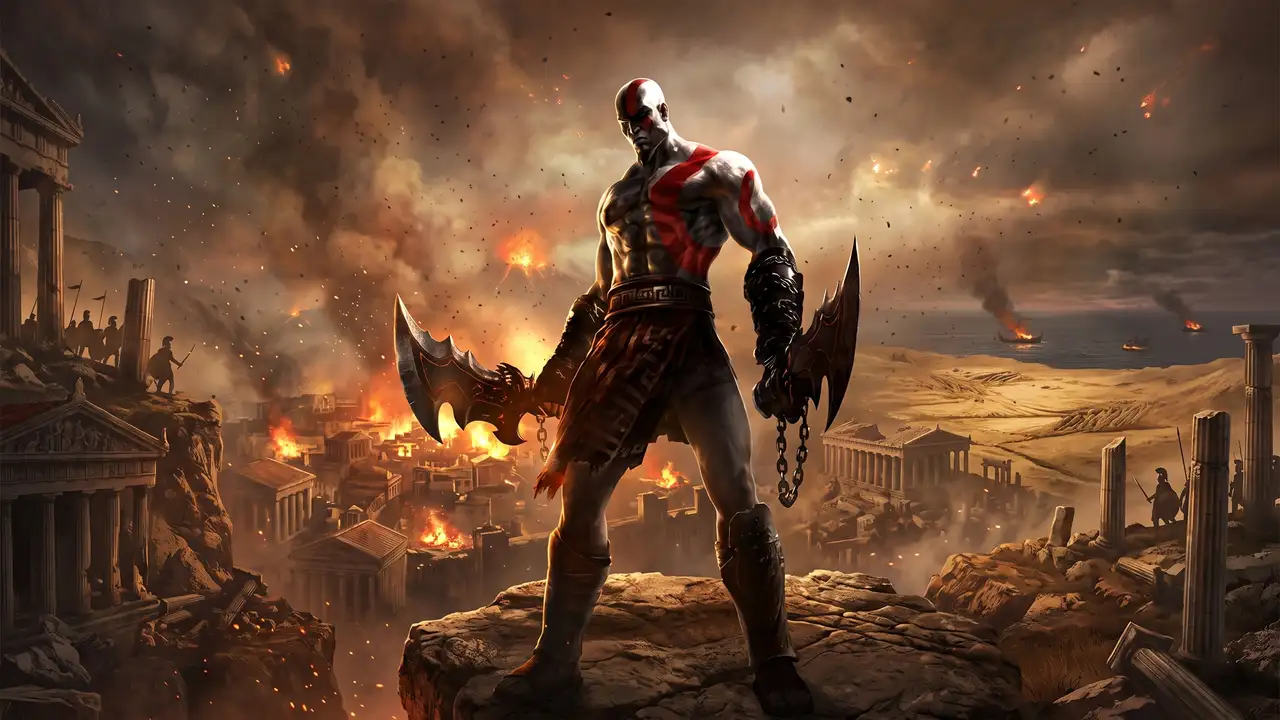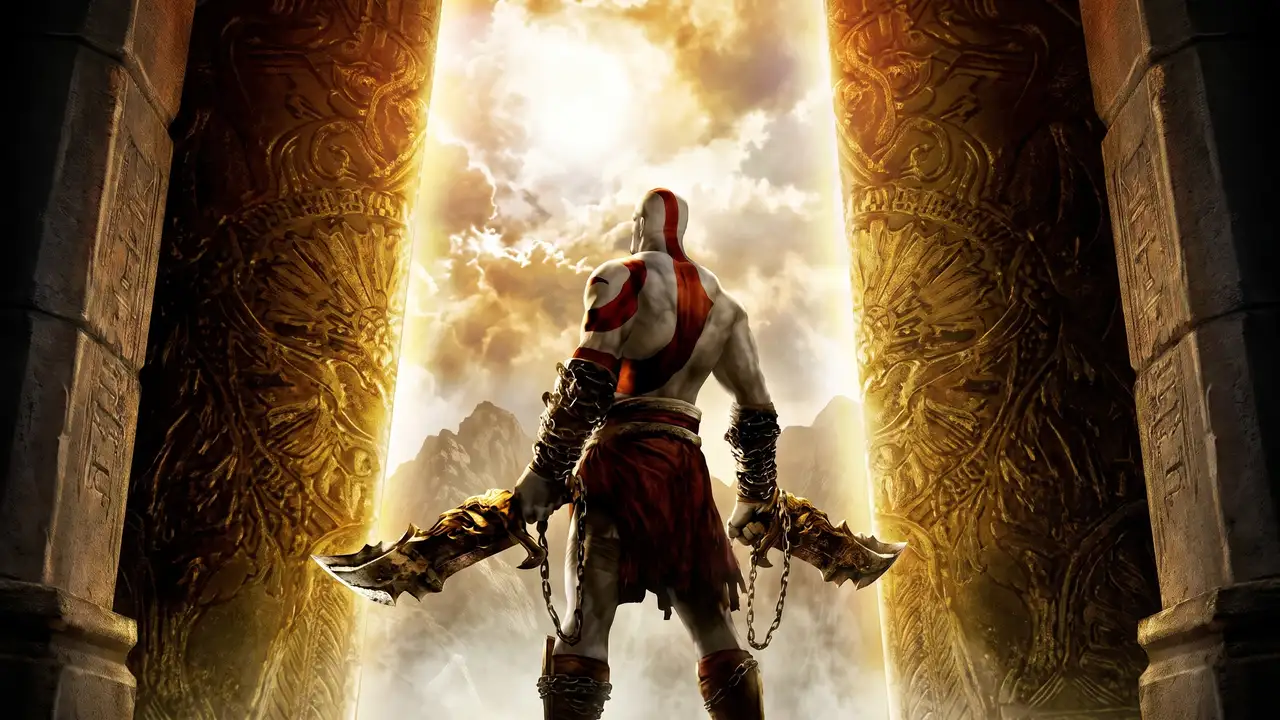
A warrior imprisoned and tortured by the Furies for breaking his blood oath to Ares tears free and fights his way across Greece, from the village of Kirra through the oracle’s temple to the island of Delos and Archimedes’ unfinished statue. As a prequel it catches its protagonist in a rare state of calm, before the tragedy that defines him, and the quieter register suits the material. The flashback-heavy structure hops restlessly between timelines with chapter cards marking the gaps, an odd rhythm that nevertheless resolves satisfyingly. Terrence C. Carson returns as the original voice, anchoring continuity. Visually the game is a small marvel, running on PS3 hardware that deserves far less credit than the results command, with cutscenes that hand off to gameplay so seamlessly the join is invisible.
The amulet of Uroboros is the headline toy, granting power over decay and restoration across time. It drives the water-wheel and gear-chain sequences and culminates in the repair of Archimedes’ statue, and the puzzles built around it are the most distinctive level design in the Greek saga. The Oath Stone, which creates a clone for paired switch work, joins it early on. Both are delightful contraptions whose usefulness regrettably fades long before the credits, the clone mechanic in particular dissolving into irrelevance after its introduction.
Traversal mostly happens without button input: moving toward a wall sends the character climbing automatically, eliminating the mash-to-climb tedium of earlier entries. A new ranged grab extends the moveset usefully, letting enemies be seized from a distance rather than closing to arm’s length first. Navigation aids communicate through camera angles alone, a pre-yellow-paint approach that still guides clearly. These small quality-of-life decisions age far better than the hardware they run on.
The three-element blade system is engaging on its own terms. Fire, ice and lightning swap on the D-pad, and the shared rage meter fills at different rates depending on the element, fastest with fire. But the electricity underperforms noticeably, sounding impressive while dealing little actual damage. More fundamentally, the arsenal never grows: no new permanent weapons arrive across the whole campaign, and the disposable pickups (club, spear, sling, shield, sword) each carry a single attack pattern. It is the thinnest weapon variety of the entire classic series.
Progression compounds the problem. Both health and magic upgrade trees max out absurdly early, roughly at the game’s midpoint, removing any sense of growth for the entire second half. Enemies that turn invulnerable during their rage phases rank among the least enjoyable foes, and quick-time events demand instant reactions while occasionally dispensing tips that do not apply. The camera, panning out in crowded fights, loses track of the player entirely.
The furnace houses the game’s worst technical failure: Hades-knockback launches flying enemies too high to stun, letting them drop aggro and despawn and forcing full room re-runs. The Trial of Archimedes follows as a brutal difficulty spike, wave after wave of tanky opponents with disproportionate health that suggests missing upgrades rather than a fair test. PS3 load times drag, and texture pop-in blurs the frame at the worst moments. Against all this, the checkpoint system itself is genuinely well judged, even as its relentless autosave popup overstays its welcome on screen.
Overall, this is a shorter, shinier and more gimmick-driven entry whose visuals, time-amulet puzzles and auto-climbing traversal outweigh its threadbare arsenal, early upgrade ceiling and one notorious bug. The flashback structure lands, the calmer protagonist register works, and the ending restores the memory of the family’s murder with real weight. Flawed but confidently made, it closes the Greek era on a warm note.