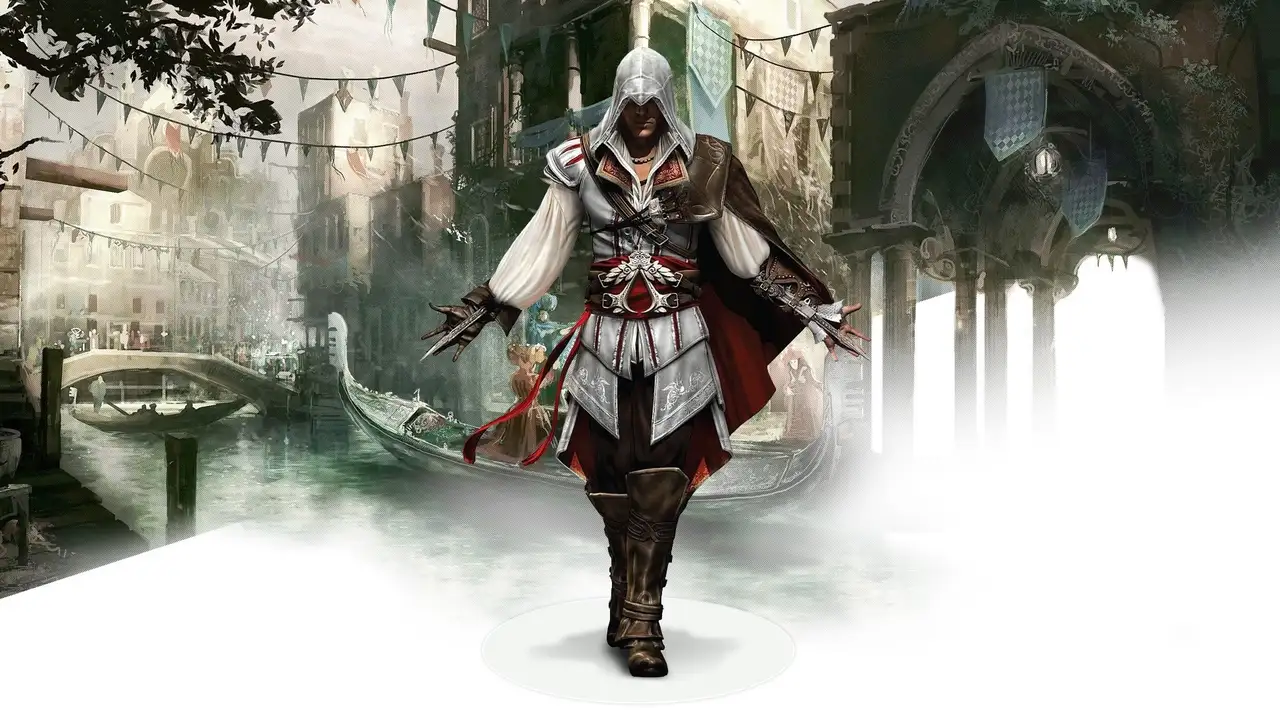
A portable sequel that condenses the original’s systems into something recognisable rather than diluted: Altaïr pursues the Templars to an occupied Cyprus, hunting the archive of their commander with Maria Thorpe in tow. The expectation for handheld spin-offs of this era is a throwaway top-down affair or a watered-down brawler, and this is neither. It recreates the open-district structure, the viewpoint climbing, the social stealth and the mission menus almost wholesale. Riots, resistance safe houses and a fanatical occupation commander give the island more narrative texture than the platform suggests. The surprise is not that it exists, but how little was cut.
The mission-structure taxonomy is the analytical spine: each district offers combat, tail, delivery, assassinate, interrogate, intercept and theft jobs, gated behind synchronised viewpoints that reveal them on the map. Memory blocks chain the main objectives while optional side tasks pad the sync bar, and the escalation runs from Limasol through Kyrenia to the Templar Archive itself. It is a menu of repeatable objective types with clear rules, and the clarity is the appeal. Nothing is ambiguous about what a mission wants or how it will play.
Assassinations are trivially easy from the first mission to the final castle: approach, throw to the ground, hidden blade. Combat is forgiving to the point of comedy, with counters that never kill and a two-move solution to every encounter. That ease never curdles into boredom because the structure keeps rotating objective types around it. Throw-oriented kills solve everything, and the hidden blade remains the punchline and the answer in equal measure. Difficulty is not the design’s currency; variety is.
Limasol and Kyrenia both work as stealth sandboxes, but the castle infiltrations degenerate into melee attrition against unlimited respawning soldiers. Guards pour out of nowhere in endless waves, the witch fight outside Kyrenia tests patience rather than skill, and the final duel with Bouchard closes a short, sharp arc. Coins fund an upgrade shop covering health, extra sync bars, auto-block and hide speed, and the purchases matter more in the castles than anywhere else. Those assaults are the closest the game comes to genuine pressure, and they achieve it through volume rather than design.
The meta-system is unusually generous: one hundred per cent completion is earned purely through main missions, with side content excluded entirely. The consequence is a tight loop with no grinding obligation, and the coin economy still rewards dabbling in the optional jobs. Combat, tailing, theft and interrogation each map to distinct behaviours, and the game never asks for the same trick twice in a row. The sync-bar escalation gives progression a visible rhythm even without the side objectives. It is a completionist structure that respects the player’s time by making the critical path self-sufficient.
Sprint-detection is the silliest inherited rule in the series, punishing running as suspicious behaviour in a game built around running, though it rarely costs anything in practice. The PSP’s missing right stick is constant low-grade friction, leaving camera control to emulation patches and lock-on to left-trigger confusion. Map icons for side objectives are floaty and frequently mislabelled, sometimes pointing at nothing at all. Falling through the floor and random detection with no visible cause provide the rough moments. The Animus conversations on philosophy with Maria are a charming oddity of backstory-dump writing that plays out while the districts go about their business.
The story expands rather than bridges, adding texture to Altaïr’s quest for knowledge and tracking Maria’s allegiance arc across escape and recapture, culminating in a quiet, philosophical denouement. The marketing line about connecting the console chapters oversells it; what exists is a self-contained chapter with real character work. The occupied-island atmosphere, the archive hunt and the closing exchange all land with more weight than a handheld spin-off has any right to expect. The narrative does exactly enough and no more, which suits the format.
Overall, the mission-structure clarity, the faithful systems condensation and the Maria storyline carry this portable chapter past its respawn-heavy castles, its floaty icons and its camera friction. The taxonomy of objective types holds the whole thing together, and the one-hundred-per-cent loop respects the clock without demanding it. As a compact, complete piece of the series’ early catalogue, it earns its recommendation on structure and surprise alike.