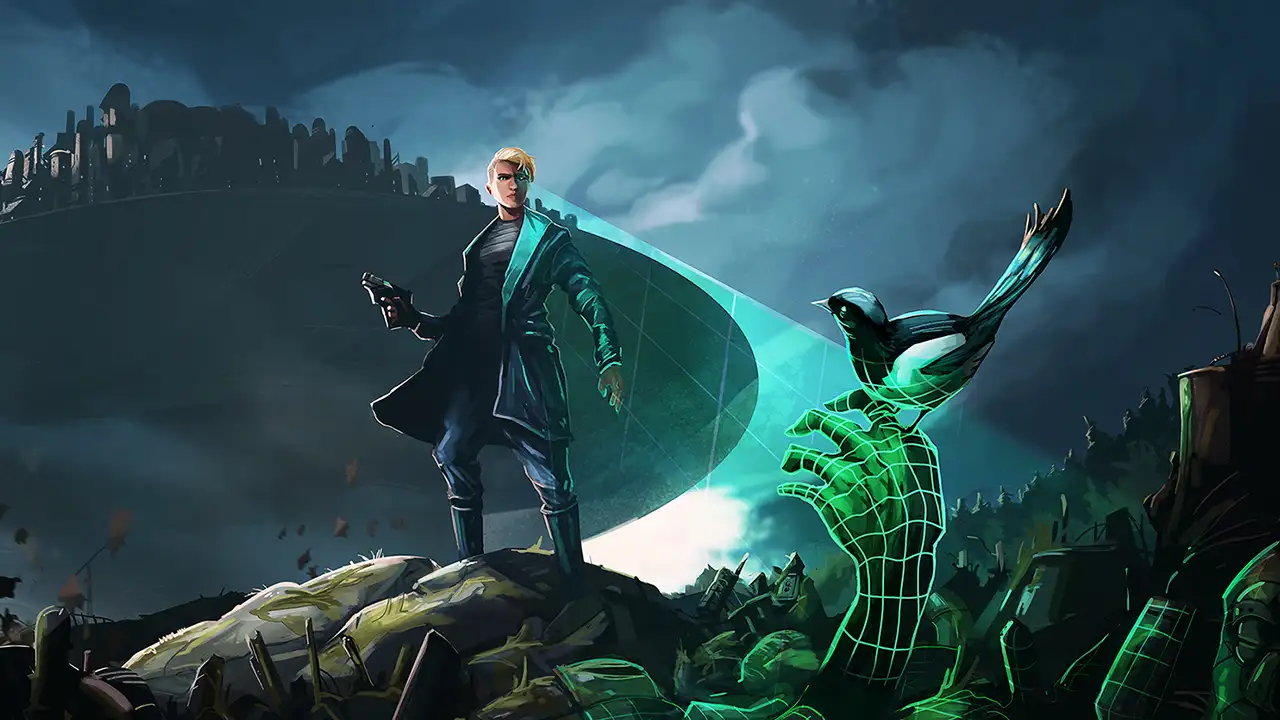
A post-collapse Nordic-noir detective story opens with a special agent arriving in the remote town of Nordson to solve serial murders, and Whispers of a Machine builds its pixel-art point-and-click from that mystery outward. The conspiracy beneath the murders runs through an outlawed cult, a black-market AI resurrection project and a councilwoman informant, all layered over the Collapse and the Third Decree in worldbuilding that is dense yet consistently reinforced through museum exhibits and environmental text. The hallucinated dead partner gives the investigator emotional stakes the case alone would lack, and the blue nanofluid augmentation lore grounds the sci-fi in bodily detail. Genre-aware from the first screen, the game wears its post-cyberpunk lineage openly. The writing is the reason to show up.
The investigation loop is the standout. Interrogating a whole town, cross-referencing address records, following saffron and soil traces, and showing inventory items to suspects delivers classic adventure-game deduction with modern polish. The forensic scanner’s smart-scan flags anomalies in situ rather than through menu examination, a mechanically fresher take on inventory logic, and the biometric analyser reads emotional anomalies during interrogations, giving dialogue a mechanical tell-system. Three murder scenes anchor the case structure. The loop never stalls across roughly six hours, and curiosity is rewarded at every turn.
Few point-and-clicks tie puzzle tools to an emergent personality build the way this one does. Empathetic, assertive and analytical choices shape the agent’s augmentations and available solutions, with muscle boost, enhanced vision and later invisibility gated by the chosen path, and sticking analytical produces a genuinely distinct toolkit. The different paths mostly change tools rather than outcomes, a design choice that keeps builds meaningful without forking the plot. The personality system gives the adventure genre a light RPG layer it rarely attempts. Building toward one philosophy is a satisfying through-line.
Puzzle difficulty sits in a comfortable middle for the genre, with most challenges fair and a few confusing rather than hard. The safe keypad code, the voltage console and the audio-tape noise filtering work well, while the tattoo jigsaw and one museum hidden-lab moment required brute force from the muscle augmentation to unstick. The final confrontation’s look-away logic (using the hovercraft to blind the killer, shooting only while she glances aside) takes a while to grasp, and the handgun’s behaviour during that sequence feels arbitrary. None of it blocks progress for long. The confusion stems from unclear signposting rather than genuine difficulty.
Voice acting carries a text-heavy game through hours of dialogue, keeping every interrogation and exposition scene engaging where lesser productions would lose the room. Some exposition delivery is oddly structured, with terms abbreviated first and explained afterwards in a way that reads strangely. The twist lands as satisfying rather than shocking, telegraphed by genre convention more than by the game’s own clues, and the story knows the difference. Achievements reward both moral choices and absurd ones, from finger snatcher to babysitter, rewarding curiosity beyond the case. The relationship narrative with the dead partner gives the finale real weight.
The old-school aesthetic evokes the genre’s post-cyberpunk classics, and the pixel art suits the Nordic melancholy of the setting. The infiltration and escape finale sequences escalate the case properly. The pacing holds across two settings’ worth of dialogue-heavy scenes. As a tight, well-acted detective adventure, the game rewards curiosity at every step and never overstays.
Overall, Whispers of a Machine is a tight, well-acted Nordic-noir pixel detective adventure whose investigation loop, personality builds and voice acting deliver roughly six hours of rewarding deduction, held back only by confusing-not-hard puzzles and oddly structured exposition. The personality-augmentation link gives the genre a fresh mechanical layer. A sucker’s game for murder-mystery devotees, and a rewarding one.