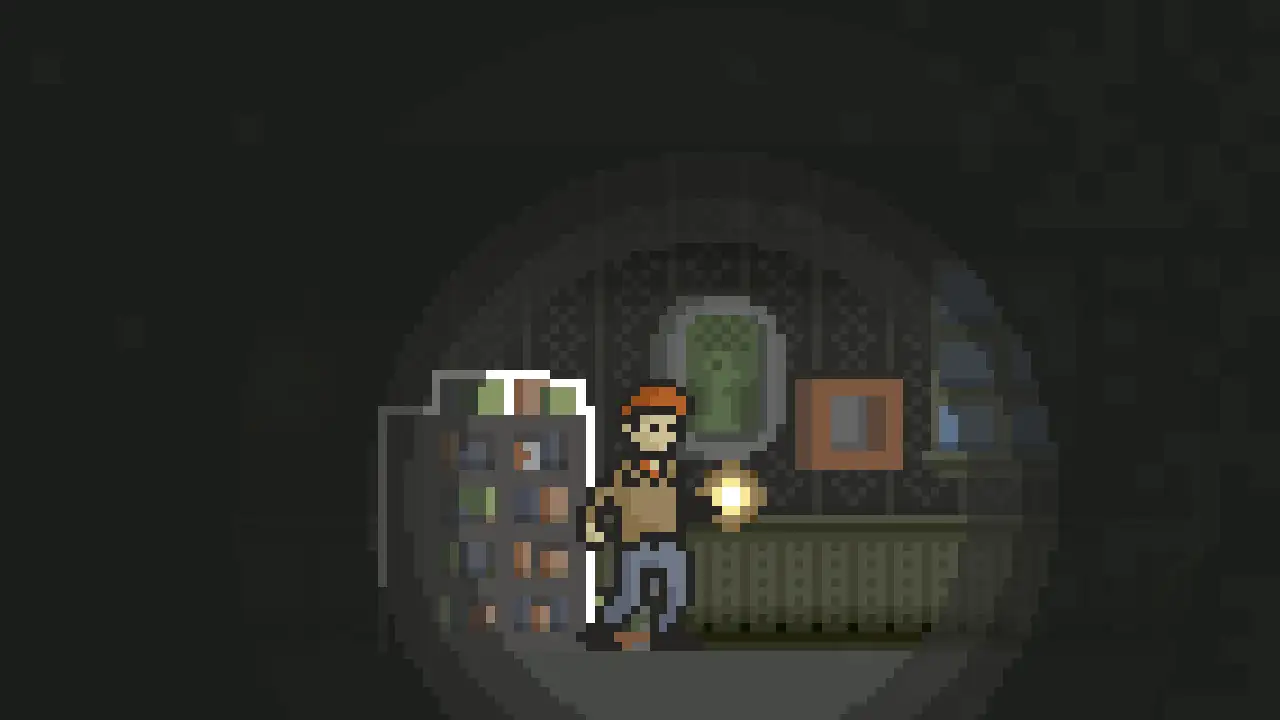
A buried gray city summoned by a cyclical red star beneath an ice-covered archipelago sets an unusually rich stage for the genre, and the writing rewards reading absolutely everything. Murals, journal entries and a dense compendium cataloguing every enemy and NPC build a world with genuine depth, and the void-shard protagonist feeds the fiction directly into the mechanics. Enemies implode into black holes when they die, pulling loot in, gravity anomalies drag travellers across the surface, and divine remnants are offered to strange stalks in exchange for power. The Hollow Knight and Grime lineage is explicit and acknowledged. What saves it from derivation is texture: few games in the mould bother building a world this worth reading.
Segmented health with one-use healing items, pogo bounces and a forward-only dash define the familiar combat skeleton, with knockback on every hit and no block or satisfying evasion anywhere. The gated ability chain runs from ledge grab through charge attack, dash, double jump, grapple, slither, wall spurs and swim immunity, each unlock redrawing the map’s possibilities. Slither’s wall-clinging vapour form is the traversal highlight, and the double jump doubles beautifully as an aerial stabiliser. Late-game damage scaling turns formerly tanky enemies into one-to-three-hit kills, delivering a genuine power-fantasy payoff. The combat is derivative but competently tuned throughout.
The shrine base grows through devotees and excavations, unlocking fast travel, mirror translocation from any save, void charges and shop stock, and the trading economy across eccentric NPCs (the shrine keeper, the archaeologist, the apostate merchant, the Gilded Emporium creature) gives the loops personality. Bosses sit close to save points, mercifully avoiding the genre’s wall-of-shame punishment. Death carries no penalty at all, an oddity early on that becomes a legitimate navigation tool once exploited. The five-phase multi-enemy council opener is a ferocious first wall. The back-to-back final herald fights close the campaign at matching intensity.
The grapple-gated mid-game is the run’s real low point, with nearly every new room demanding the grapple for a long stretch and all progress stalled until it finally drops. The turn arrives in a rush: grapple, slither, spurs and double jump landing in quick succession, flipping the tone from stonewalled to unstoppable almost overnight. The final sequence compounds confusion, expecting three heralds from three keys but delivering two, then hiding an eleventh herald whose existence only the font reveals. Completionists will find the eleventh, but only after a hunt the structure never signposts. Both friction points trace to guidance rather than design intent.
The map’s combined item and secret categorisation sours the completionist endgame, with no per-category tracking and no zoom-out, and a gravity-suction bug on the surface masquerades as an intentional mechanic until proven otherwise. The art style wins immediately and holds, all smooth outlines and strange geometry that look unlike anything else in the genre. Compendium depth extends to every creature encountered, and the murals reward close reading with genuine lore. All eleven heralds, every relic and a 100% map remain achievable within a seven-hour footprint. The presentation and writing carry the experience through its rougher edges.
The archaeologist NPC and the apostate merchant in the void give the world its human-scale warmth, and the font’s sacrificial framing ties the lore directly into the mechanics of feeding god-flesh for progress. The chamber of reflection’s recall system adds yet another hidden-waypoint layer to an already generous traversal toolkit. Progenitor flesh and divine remnants thread the economy into the fiction itself, making every upgrade feel like worship rather than purchase. It is a coherent design language that most games in the genre never bother attempting.
Overall, this is a very good, lore-dense entry in the Hollow Knight mould whose compendium depth, shrine base-building and endgame power spike outweigh a grapple-gated stall, map-tracking friction and borrowed combat fundamentals. The world is the reason to visit, and it rewards the visit richly. A clearly worthwhile addition to the genre for anyone who reads the lore, and one that earns its recommendation despite the guidance missteps.