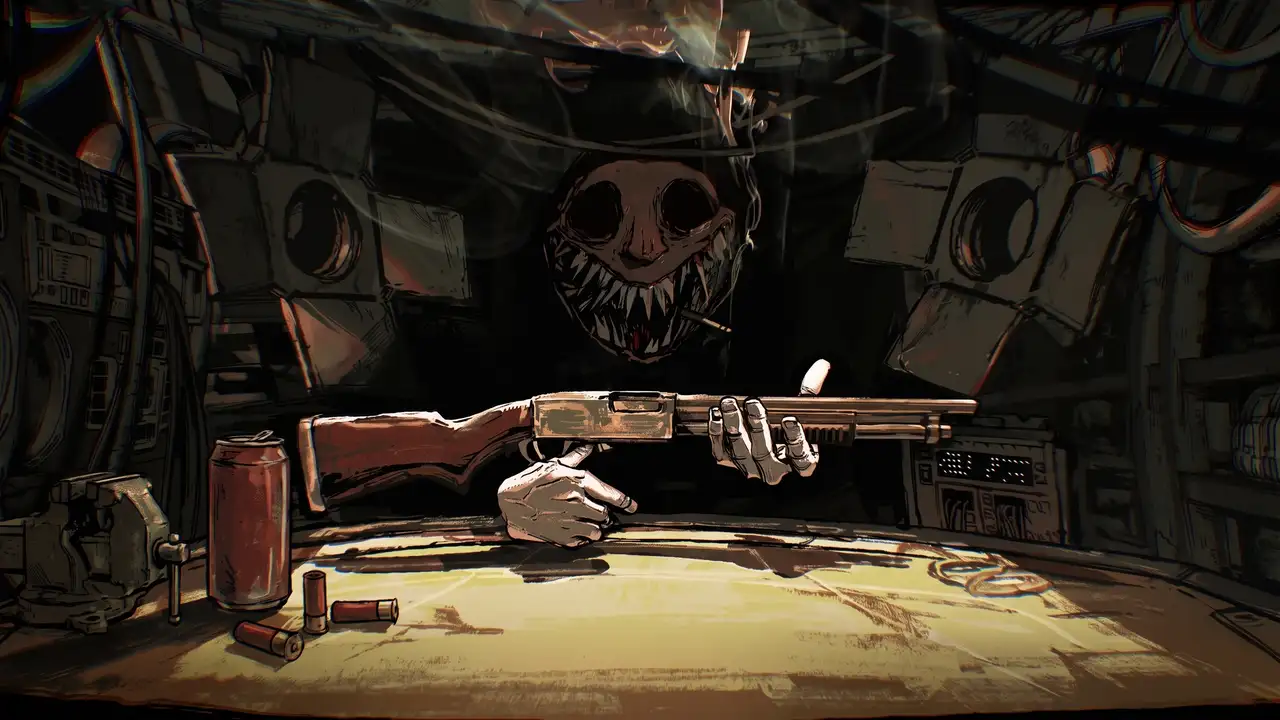
San Reno is a dying town, and the circus arriving within it carries something worse than a travelling show. Set in 1921, this pixel-art horror follows Joseph Petrescu, brother of circus owner Vlad, whose arrival opens onto dread imagery rendered in finely grim detail: a corpse hung like cattle with terror still fixed on its face, derelict facades, and a mounting sense that the tragedy foreshadowed by a 72-hour countdown is already sealed. The premise establishes the stakes through environment rather than exposition, and the art style does much of the narrative work on its own.
Atmosphere carries the experience through stretches where the puzzles themselves stall. El Dorado’s dime museum and an asylum run by nuns supply the strongest backdrops, each layering dread imagery onto the town’s decay, while Testament of Solomon lore woven through the script situates the demon Asmodeus and his guardian within a mythology far larger than one venue. The writing leans on that lore-building rather than jump scares, and the restraint suits the material.
Puzzle-solving delivers the game’s best payoffs. Threads converge across the asylum and underworld in ways that reward attention, and the moment a blood-covered mirror gate unlocks the viscera grate lands with the satisfaction of a mystery resolving on its own terms. Mirrors double as memory devices, triggering flashbacks that walk the timeline from 72 hours before the tragedy down to 37, and the structure of those retroactive scenes gives the countdown real narrative weight.
Item combination drives most of the interaction, spanning matches, aspirin, grease, cheese, and a syringe, alongside more inventive materials such as viscera and sedatives. Matches, mirrors as memories, grease, and viscera each serve distinct purposes across the asylum and underworld, and the range of applications keeps the inventory from feeling like a grab-bag of keys. Light stealth segments break up the point-and-click rhythm, most memorably a sequence hiding from the troop and locking a guard inside a train car. A final gas-and-light-switch escape sequence closes the loop with a change of pace that suits the escalation.
The refusal text deserves particular credit. Responses such as “doesn’t sound like a good idea” or “no point in doing that” map the boundaries of each scene, and reading those rejections becomes an unofficial deduction system in a game where a written walkthrough effectively does not exist. The radiator-wrench chain and the concierge keys sequence at the hotel both lean on this style of indirect communication, with mixed results.
Where the design falters is signalling. The game rarely indicates what is interactable, and long stalls follow: the blood-mirror gate, the radiator chain, and the concierge sequence each demand a specific obscure interaction with nothing on screen to suggest it. Progress halts not because a solution is unfair in principle but because the interface offers no feedback, and scene after scene can be searched in full before the one required pixel makes itself known.
The One-Eyed Joe chase is the sharpest example. Roughly twenty minutes disappear into a pursuit whose own dialogue hint about using shortcuts to cut the pursuer off is a flat red herring, and the flammable fuel strip needed to end it sits nearly invisible against the scenery. A hint that misleads this confidently turns a chase into an exercise in brute-force guessing.
The slot-machine section compounds the problem. A five-dollar curse payment is gated behind repeated rounds of RNG, and even the cheat trick does not remove the randomness, only softens it. Gating story progress behind luck in a game already stingy with signposting doubles the friction, and the section stands out as the low point of an otherwise purposeful difficulty curve.
Overall, the story work here punches well above the puzzle communication, and the balance still lands on the positive side. Lore, atmosphere, and converging threads make the journey worthwhile, while interaction opacity, the chase red herring, and slot RNG repeatedly test patience. A striking, layered horror whose flaws are real but surmountable.