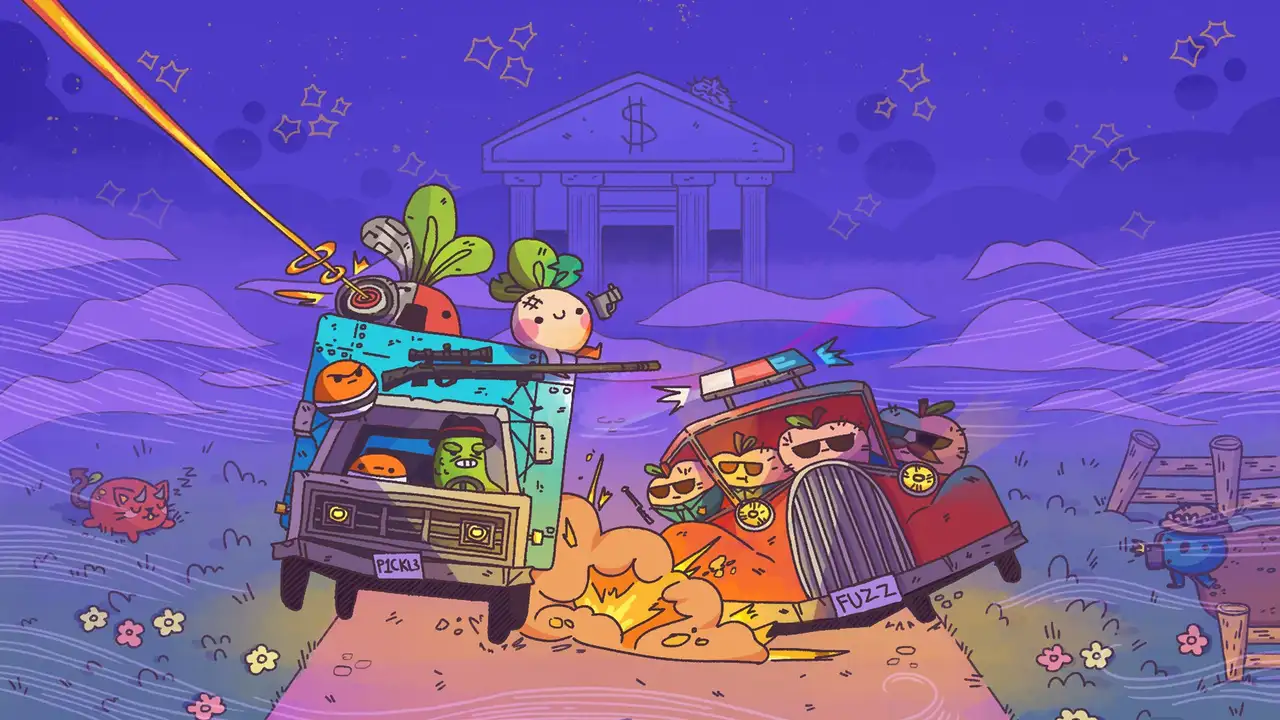
A vegetable heir joins a pickled gang to rob a botanical bank, and the sequel to a beloved tax-evasion comedy escalates its absurdity accordingly. The top-down heist structure rides three-minute timed raids through Stinky’s Botanical Bank, with money floors jumping tenfold per area from a hundred to a hundred thousand, and permanent dark-web upgrades persisting between runs. The loop is tight, legible, and immediately moreish, with each raid a self-contained heist capped by escape math.
The soundtrack is the series’ definitive strength and this entry’s headline. Every heist, boss and shop rides arrangements good enough to listen to standalone, and the end-credits radio broadcast closes the campaign with a downbeat sign-off that lands oddly moving. Soul-farming for the DJ’s songs gives the music a mechanical presence as well as an atmospheric one, and no track in the game misses.
The arsenal is generously absurd. A pickaxe, C4, laser pointer, goop boots, a cardboard box, a chainsaw, an RPG, a revolver, a minigun and a boomerang all slot into raids, and shakedowns plus photo mode round out the toolkit. Booster placement across four boss arenas adds tactical texture to the climactic fights, and the bank-to-space finale launches the whole campaign into anime-tinged spectacle that earns its melodrama. The mafia twist midway (a father’s murder on a mayor’s orders) gives the comedy a genuine melodrama spine.
Internet-culture parody stays dense and mostly sharp. Exposure-as-payment, bath water, an NFT that is literally a rock, a manga-drawing gift and a classifieds body-pillow listing all land, and the returning cast (a now-robotic mercenary, a mushroom cult, familiar faces from the predecessor) rewards series familiarity. Some streamer-parody beats repeat across the runtime, and the joke density occasionally outruns the material, but the hit rate stays high enough that the misses pass quickly.
RNG is the loop’s sharpest friction. Randomised elevators turn quest tracking (a bean in a green suit, a locker-room NPC) into a grind that tests patience beyond what the design intends, and hunting specific rooms for side quests amplifies the tedium. Loot lost on death compounds the frustration when a run ends abruptly, and the adaptation strategy (keeping earnings modest until the million-dollar areas) reads as a workaround rather than an intended lesson. Mid-game grinds, particularly the GPU hunt and soul farming, draw similar complaints.
Side content fills the bank’s corners generously. Old-world creature photographs hide on every floor, boss revivals unlock post-game encounters, and the sewer’s mysterious motherload rewards thorough exploration beneath the main vault. A blue-suited bean of an NPC, a locker-room regular and the dark-web merchant give the world a supporting cast beyond the heist crew, and none of it is required, which makes finding it feel like theft’s honest bonus. Completion runs roughly five hours with everything collected, a length the design wears comfortably.
Presentation quirks frame the experience. The fixed 4:3 window chafes occasionally, though the design keeps rooms readable and the money-bag cap (later upgradeable) reinforces the economy’s rhythm. The escalating money curve is the loop’s real genius: each area’s tenfold jump makes the previous zone’s currency feel suddenly quaint, and the permanent shop turns every failure into eventual progress. Roguelite friction here serves momentum rather than punishing it.
Overall, this is a meme-dense, musically brilliant heist roguelite whose timed raids, escalating economy and permanent-progression satisfaction deliver a compact campaign worth completing. RNG-gated quest tracking and abrupt run-endings are honest costs against a soundtrack this good and a finale this gleefully absurd, and the whole package closes on a radio broadcast that makes even the downbeat ending feel earned.