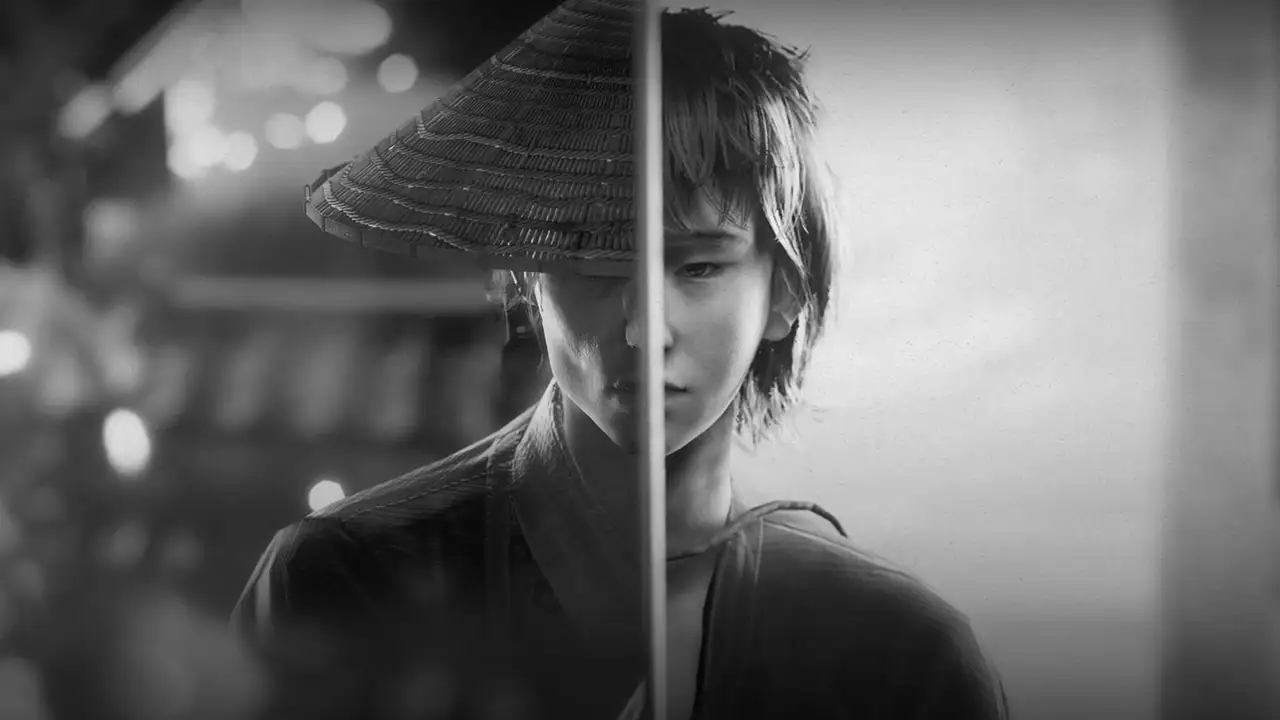
A young apprentice trains under a village master while a warlord gathers strength beyond the fields, and duty shapes every early stance. Black-and-white cinematography frames the opening defence in the manner of classic chanbara cinema, all static wide shots and driving rain. Combat locks to a two-dimensional plane, while exploration roams freely between engagements across fields, caves and shrines. Japanese-voiced delivery and myth collectibles root the journey in folklore rather than exposition. The premise stays lean: oath, master, village, and an approaching war.
Light and heavy cuts form the baseline offence, with block absorbing pressure and parry reversing it. Counters punish overextended swings, rotation attacks clear surrounding blades, and finishers close duels while restoring health. Stamina governs the rhythm, and rolling repositions behind spears or out of encirclement. Defence therefore decides most exchanges, since a clean parry opens longer than any combination. Health returns through execution rather than items, which rewards timing over attrition.
Shuriken harass at range, the bow answers distant archers, and the Ozutsu cannon breaks guards that blades cannot shift. Shrine checkpoints anchor progress through longer stretches, and skill unlocks arrive through advancement rather than point spending. Exploration between fights holds shrine-adjacent pickups, myth cards and alternate paths, free from the combat plane restriction. Ranged tools stay supplementary, softening formations before steel range closes. Progression feels steady rather than punishing, with fairness emphasised across the campaign.
Upward anti-armour combo dismantles armoured opponents with disproportionate speed and becomes the default answer to plate. Spear-wielding elites test that reliance, since thrust timing ranks among the most awkward parries to read. Musket-armed ranks spike late pressure with volleys that punish mistimed advances. A mirror duel distils the system to single combat, trading attrition for reads and punishes. Wider combination strings exist but see less demand beside the upward launcher and finisher loop.
Village defence teaches parry reliance through bounded lanes and clear sightlines. Mountain caves narrow the plane further, with stone walls compressing footwork around pitfalls and ambushes. A fire-scarred homecoming shifts the palette toward smoke and ember without lifting the monochrome discipline. Three Yomi underworld chapters extend the journey through thunder rites and trial grounds, each with distinct prop dressing. Late tower puzzles break the combat cadence with vertical route-finding before musket ambushes resume.
Monochrome presentation carries both reverence and cost across the full journey. Kurosawa framing holds long on rain, banners and torchlit interiors, and the restraint gives duels a staged gravity. Myth cards expand folklore between fights, pairing underworld figures with terse legend text. Dark underworld scenes strain that discipline, since the fighter silhouette blends into shadowed backdrops. Collectible glints suffer similarly, reading as faint sparks against busy grey scenery.
Readability forms the sharpest friction point throughout busy engagements. The pulled-back camera shrinks the fighter amid monochrome crowds, making position tracking difficult during multi-opponent rushes. Collectible visibility compounds the problem, with shrine-adjacent pickups dissolving into background texture and faint glints going unnoticed. Subtitle legibility dips against bright or patterned backdrops during myth narration. Spear thrusts remain the only consistently awkward defensive read, while musket volleys punish late positioning errors. The broader moveset beyond parry, launcher and finisher sees limited necessity, which narrows expressive offence.
Overall, parry-led defence, health-restoring finishers and a thunderous anti-armour launcher sustain a stylish monochrome campaign. Pulled-back framing and faint collectible glints dent legibility without dulling the choreographed steel at the centre.