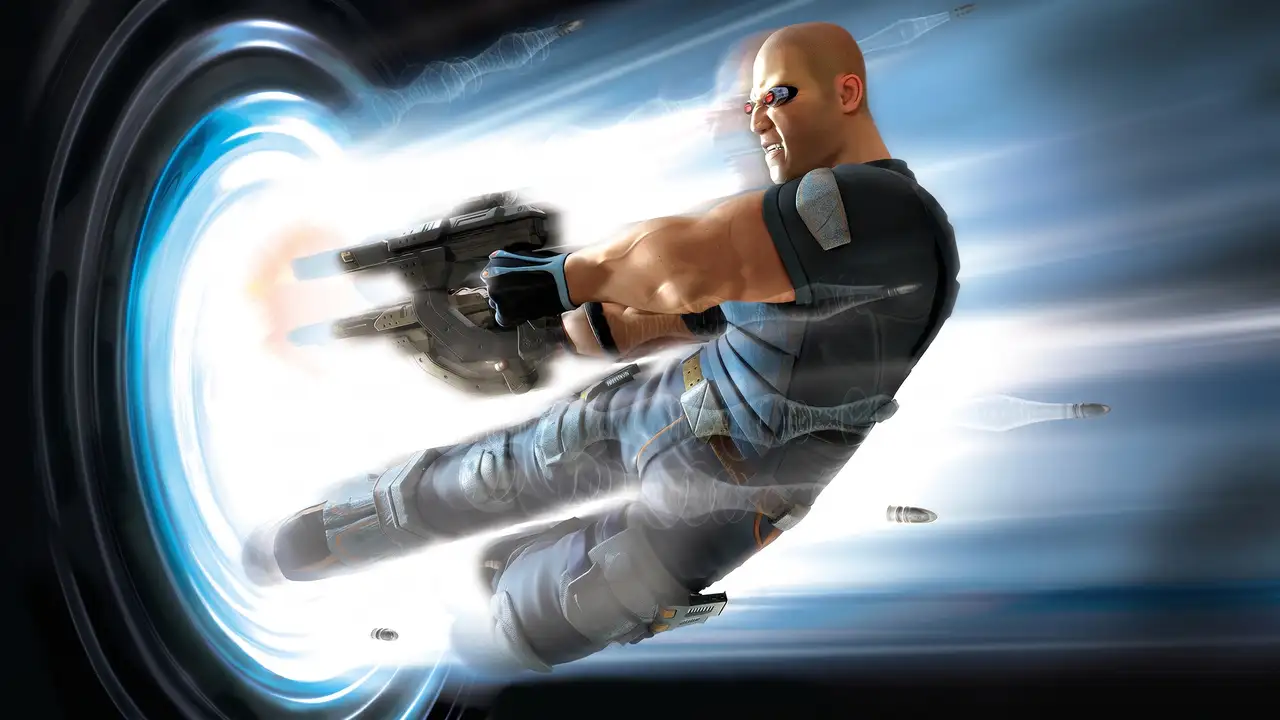
A time-hopping campaign chasing a villain across nearly five centuries gives this shooter a shape few of its contemporaries attempted. Each era brings its own register: a 1924 island assault with posh-heroic British comedy, a 1969 cult train, a 1994 haunted mansion, a 2059 stealth office block, and a robot-war future. The writing is corny in a deliberately self-aware way, with constant banter and a title-drop catchphrase that every character except the villain apparently hates. That tone carries the whole campaign, and it never apologises for itself.
Level variety is the campaign’s spine. The island assault opens with a swagger, the cult train ranks among the best-constructed stages, and the haunted mansion plays its horror pastiche straight enough to land jokes against. The stealth office block demands more patience than anything around it, and the robot-war future closes with spectacle. Few campaigns of the era rearrange their identity this often without losing coherence.
The combat kit is generous for a 2005 console shooter. Dual-wieldable weapons turn firefights into output contests, armour and health pickups litter the levels, and vehicle and turret sections break the run-and-gun rhythm. A tank battle, a drill descent, and a rail-gun mech each arrive as set-piece punctuation. Difficulty stays fair throughout, and the finale’s bosses manage themselves without the wall the genre often builds.
The self-interaction time loops define the entire campaign. Meeting, fighting alongside, and rescuing past and future selves turns co-operation into a solo mechanic: covering an earlier self’s retreat, shielding a later self during a simultaneous-hacking dual-key puzzle, and hearing the same cutscene from the other side of the encounter. A key handoff between versions of the same man is staged as a genuine set-piece. No shooter of its era builds its whole structure around this idea, and few since have tried.
Content volume deserves its own accounting. 150 unlockable characters, all earnable through play, sit alongside 14 arcade modes, and the arcade side has enough variety to function as a second game. The campaign itself runs tight, with pacing that rarely stalls and a structure that keeps introducing complications. Replayability here comes from modes and roster rather than padded campaign length.
Friction arrives in small dated ways. There is no jump button, which feels strange for the genre even when levels rarely ask for one. An auto-look aiming assist throws off shots until disabled, and the game never explains that it should be. Checkpoint-only saves mean any interruption costs a whole level rather than a moment. Sniping-and-escorting sections with moving targets test patience more than skill, and the disappearance of the series’ level secrets removes a layer of exploration older entries treated as essential.
The comedy writing sustains itself better than most of its kind. Captain Ash’s “Old Bean” address, cult satire played with a straight face, and Cornish-captioned banter give the campaign a personality that newer shooters rarely risk. The self-aware tone could curdle in lesser hands, but the game commits fully, and the commitment reads as affection rather than irony.
Overall, this is the trilogy’s most complete entry, a campaign with a structural idea no competitor has matched and an arcade suite that doubles its value. Checkpoint-only saves and a handful of dated control quirks are the only real dents in a design that otherwise holds up remarkably well, and the time-loop encounters alone justify the revisit.