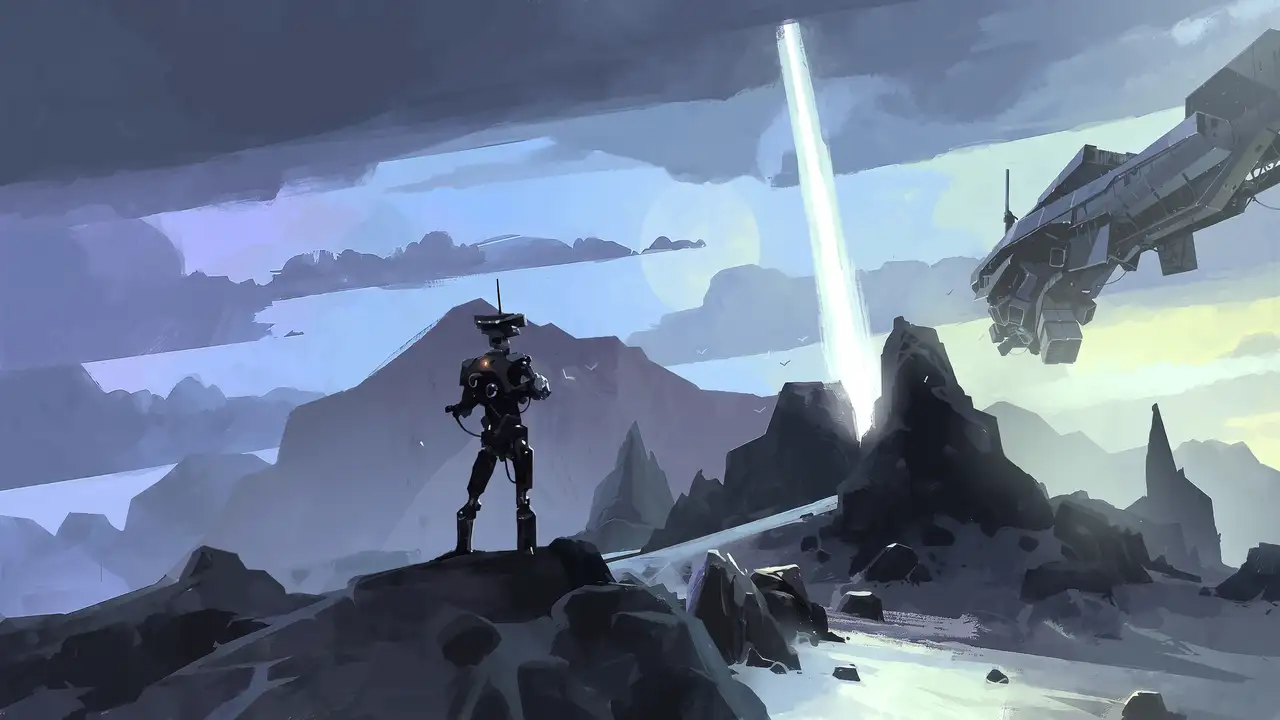
A hijacked robot chassis stalks a haunted desert world where zealot Cathedral cultists, bandits and survey teams fight over an ancient signal, and the AI piloting the borrowed metal is the only constant. The narrative unfolds entirely through transmission logs, data fragments and survey reports, each warning of AI corruption or a vanished investigation, and the fragments accumulate into something genuinely unsettling. An early thought, that the terrain feels like dead space, gets formally retracted once the objective layer proves packed; the map hides far more than its empty wastes suggest. What emerges is a slow-burn ghost story delivered through machine-readable text, wrapped around a first-person robot combat sandbox.
The lore rewards patient reading better than most combat games bother to reward anything. Signals lead to fragments, fragments lead to apparitions, and the lanky robed figures that appear and vanish the moment a glance shifts build a persistent creep that no scripted scare matches. By the endgame the pieces point toward the planet itself being an information construct, a reveal earned entirely through documents rather than cutscenes. The sunless radiated zones reinforce the dread, and the horror thread elevates what could have been a routine faction skirmish loop into something stranger.
Sniping carries the combat once its rhythm is learned. Weapon unlocks escalate steadily, and the late-tier sniper’s absurd rate of fire turns firefights into rapid-fire marksmanship contests. The loop of surveying signals, hijacking drones, capturing bunkers, beacons and spawners, and ranking up for better weapons, shields and support modules keeps momentum across both campaigns. Death carries no penalty whatsoever beyond the walk back to the objective, a design choice that removes all sting from failure and lets experimentation flourish.
The looping mazes divide opinion sharply. Early encounters trap navigation in repeating corridors with no visible logic, and the frustration is real; once the rules click, the same structures read as deliberate puzzles, though even then they consume disproportionate time. Shields escalate from absent to omnipresent, and the arc is sour: the opening hours with shieldless enemies feel liberating, while the late-game swarms where every enemy pops a barrier turn fights into chip-damage slogs. The mid-game stretch against shielded zealots around a bunker marks the low point.
Performance is the persistent wound. Loading hitches drop the frame rate toward 20 fps, the Copperfields dip to 30 during traversal, and a full crash interrupts progress mid-session, rough numbers for a 2017 release. The expansion’s shieldless enemies restore some of the early joy, and the standalone campaign’s denser pacing suits the loop better than the base game’s sprawl. Ambush sites unlock chassis auto-repair, arguably the single best quality-of-life upgrade in the game, and the expansion reaches full mission completion without padding.
The finale lands abruptly. A closing transmission arrives with no credits sequence, and the sudden stop briefly disorients before the content of the ending registers as fitting for a story told entirely through transmissions. The two-campaign structure keeps the base game and expansion distinct, each with its own region and rhythm, and the polar regions offer a colder, tighter closing chapter. Nothing in the narrative is delivered through cinematic framing, which is a feature rather than a compromise here.
Overall, The Signal From Tölva marries a dense robot-combat sandbox to a genuinely eerie data-log ghost story and lets the fragmentary lore do the heavy lifting, with a zero-penalty death loop and steady weapon unlocks keeping the loop humming. Performance hitches, shield saturation and the unclimbable terrain sting, but the atmosphere and the signal-hunting mystery hold the whole enterprise together.