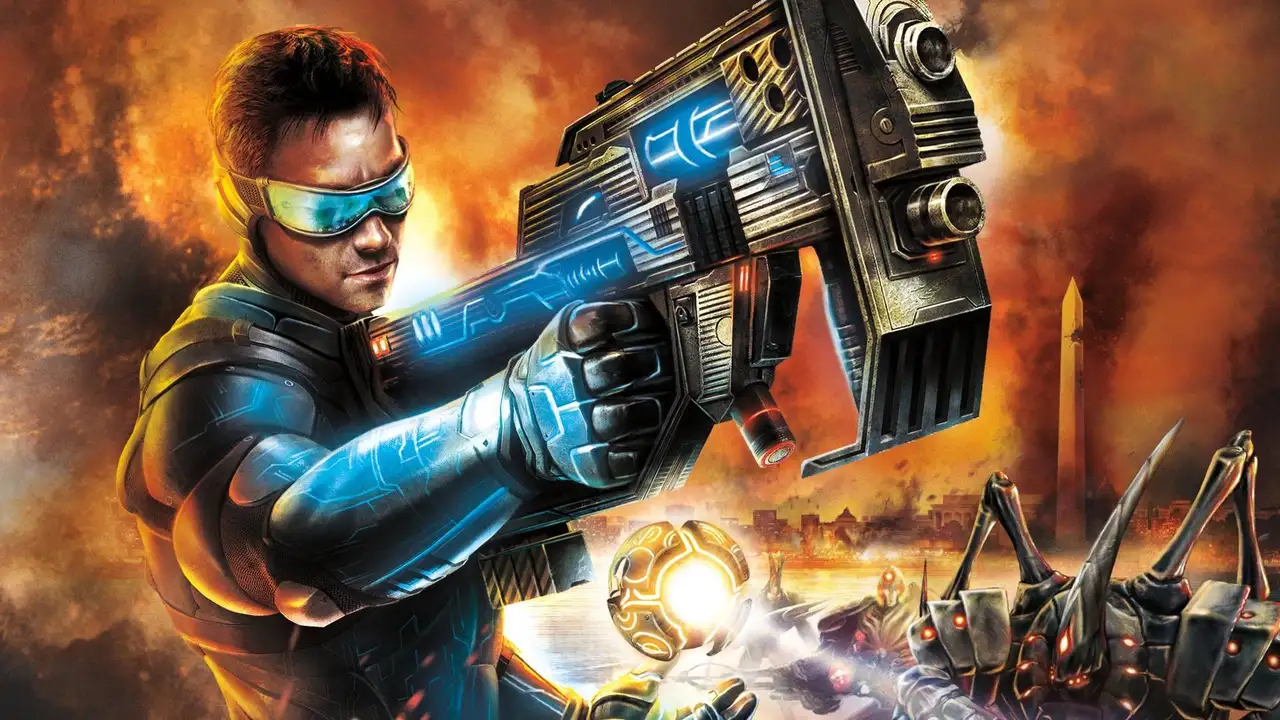
A pulpy alien conspiracy unfolds across Washington DC landmarks, complete with secret organisations, mind-control neurotoxins and a narrator delivering paranoid monologues over the action. The tone is B-movie serial: a betrayal twist mid-campaign, Masonic trivia buried in data discs, and an ending that resolves nothing because the answers are explicitly deferred to a sequel. Few shooters commit this thoroughly to conspiracy-thriller dressing, and the commitment gives the corridors a flavour nothing else on the platform matches.
Pointer aiming is the game’s best asset. The Wii Remote delivers genuine precision, and turning with body orientation feels disorienting for the first minutes before clicking into place. The ASE scanner adds a layer beyond shooting: scanning objects for secrets, hacking organic locks and terminals, and destroying alien conduits that function as spawn portals break up the gunplay with gadget work. The sound design borrows Halo’s Elite death cries wholesale, an amusing derivation rather than a damning one.
The difficulty curve is inverted. The hardest stretch arrives before the suit does: no regenerating health, medkits that fail to respawn on death, and relentless enemy spawns turning the second and third missions into a trial of retracing steps for supplies. Five or six deaths in twenty minutes is a normal outcome, and the design punishes precisely the inexperience it should be teaching. Once regenerating health arrives, the game transforms: the flow improves dramatically, and the campaign stays enjoyable to the end.
Motion controls split the difference between charm and curse. Grenade throws track the wandering reticle, producing arcs that drift where the crosshair happened to idle, and melee stabs register perhaps once in seven attempts. The SCOPE pistol’s sniper scope reads as unintentional comedy, and the non-standard mapping that puts weapon switching on the plus button generates constant fumbles. The aiming itself never falters; everything bolted around it does.
Late-game balance flips to the opposite problem. Cover becomes useless because enemies rush relentlessly, and heavy weapons like the de-atomizer shred the player as readily as the Drudge waves they face. What was once a deficit of resources becomes a surplus of chaos, and the final missions trade the early starvation for overwhelming firepower in both directions. Neither half of the campaign is balanced so much as swung between extremes.
Collectible hunting stays light but present. Trust data discs hide messages and Masonic trivia, the ASE rewards thorough scanning, and the conspiratorial tone makes even casual dipping rewarding. Enemy designs echo their inspiration visibly, Drudge waves arrive in familiar patterns, and the pace across nine short levels keeps the campaign brisk without outstaying its ideas.
The plot’s cliffhanger lands as an oddity rather than a betrayal of the viewer’s time. Entire conspiracies are raised: a betrayal twist detonates mid-campaign, the mind-control thread widens rather than tightens, and the credits arrive with every question still standing, answers explicitly banked for the sequel. As a two-part serial by design, it plays strangely against a single campaign’s arc, yet the commitment to the format has a period charm, and the mid-game twist lands with enough force that the deferral feels like confidence rather than stalling.
Overall, this is a flawed but fun piece of Wii history whose pointer precision and post-suit flow deliver genuinely enjoyable shooting despite an inverted difficulty curve, unreliable melee and grenade friction. The conspiracy dressing and the data-disc trivia give the corridors personality, and the all-cliffhanger ending reads less as a flaw than as period-accurate serial ambition.