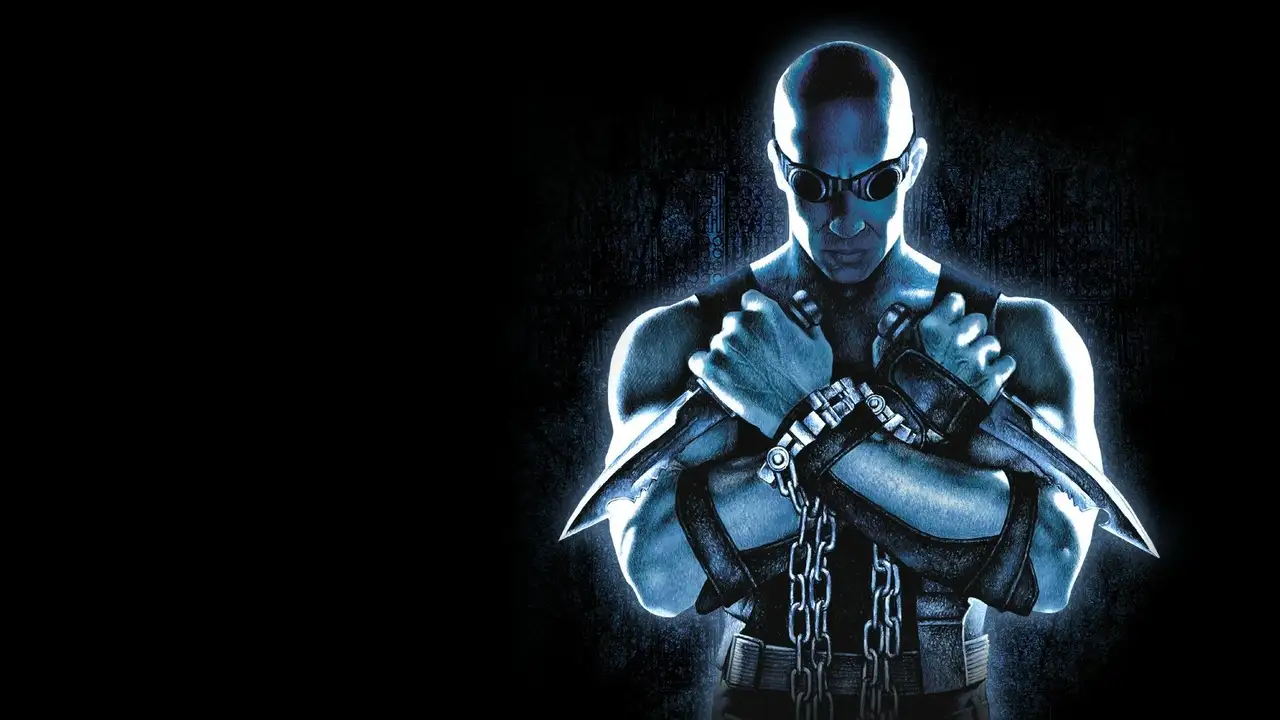
A maximum-security prison planet sets the stage for one of the rare licensed film prequels that plays like a genuine immersive-sim-adjacent stealth shooter. Grimy, oppressive and darkly funny, Butcher Bay builds its prison society with real care: the warden’s menace, Abbott’s territory politics, Pope Joe’s surreal bunker, and guards who complain on-record about inmate hangings on their watch. The writing punches far above 2004’s industry standard, and two decades on it remains the game’s sharpest asset.
Darkness is a tool rather than an obstacle. Pitch-black corridors enable light-sniping and shadow-hugging stealth, and the arsenal (shivs, knuckle dusters, tranquiliser guns, shotguns, miniguns) supports both lethal and quiet approaches. DNA-locked rifles force creative workarounds early, gating firepower behind ingenuity rather than progression, and the eight-block max-health climb rewards thoroughness. Ordinary enemies generate surprisingly effective jump-scare tension alongside the horror-flavoured sections.
Set-pieces stick in the memory a decade on. The pit, Pope Joe’s eye-shine operation, the riot-guard mech and a heavy-guard rampage each deliver a distinct flavour, and the battle-analysis deadpan (“conserve ammunition by walking over higher organic threat”) lands as dry comedy. The sniper-and-warden finale closes the escape with the same confidence it opened, and the Riddick-Johns dynamic, assumed by many to be film canon, turns out to be game-original writing of real quality.
The voice cast deserves separate credit for how much personality it squeezes from limited screen time. Despairing inmates mutter about their sentences, guards exchange lazily cruel banter, and a running gag of vague identification (“what’s he look like? kind of like that guy”) repeats until it becomes a structural joke. Every cell block carries its own micro-politics, and the game treats even throwaway NPCs as characters worth a line of interiority. Few shooters of any era invest this much writing in background population, and the investment is what makes the prison feel inhabited rather than assembled.
Navigation is the campaign’s chief friction. The mid-game mines and towers routinely lose the way, inflating a lean run by an hour through backtracking, and the mainframe bot encounter drags badly until the weak-spot trick resurfaces. The pit, terrifying to a younger audience, measures startlingly short on revisit, a curious inversion of memory that says more about nostalgia’s magnification than the game’s pacing.
Side quests exist but hide their own existence. The snitch-list and blue-skins threads spawn without any visible signposting, and a full playthrough can finish without knowing where either begins. The tranquiliser gun can be missed on a first pass through the mines, forcing a backtrack for the game’s most useful tool. For a game this confident elsewhere, the obscurity of its optional content is a genuine design gap.
PC presentation carries quirks two decades deep. No controller glyphs appear anywhere, one button arrives unmapped, and on Linux the 16-bit colour mode renders every texture pure black until settings change. The end credits run unusually long even by 2004 standards. None of these touch the underlying design, but the port layer demands patience that the game itself no longer requires.
Two decades after release, the core holds. The atmosphere stays oppressive, the NPC writing stays funny, the stealth loop stays satisfying, and the PC version runs beautifully once the colour quirk is sidestepped. That a licensed film prequel from 2004 outclasses most of its genre is the quiet achievement here, and the prison-planet worldbuilding remains the reason it endures.
Overall, this is a 2004 classic that genuinely still holds up: atmospheric prison-world stealth, sharp NPC comedy and memorable set-pieces outweigh maze-like navigation, hidden side quests and port quirks. The DNA-locked arsenal, the mech rampages and the warden’s finale confirm what nostalgia suspected, and the game earns its reputation as one of the best licensed adaptations ever shipped.