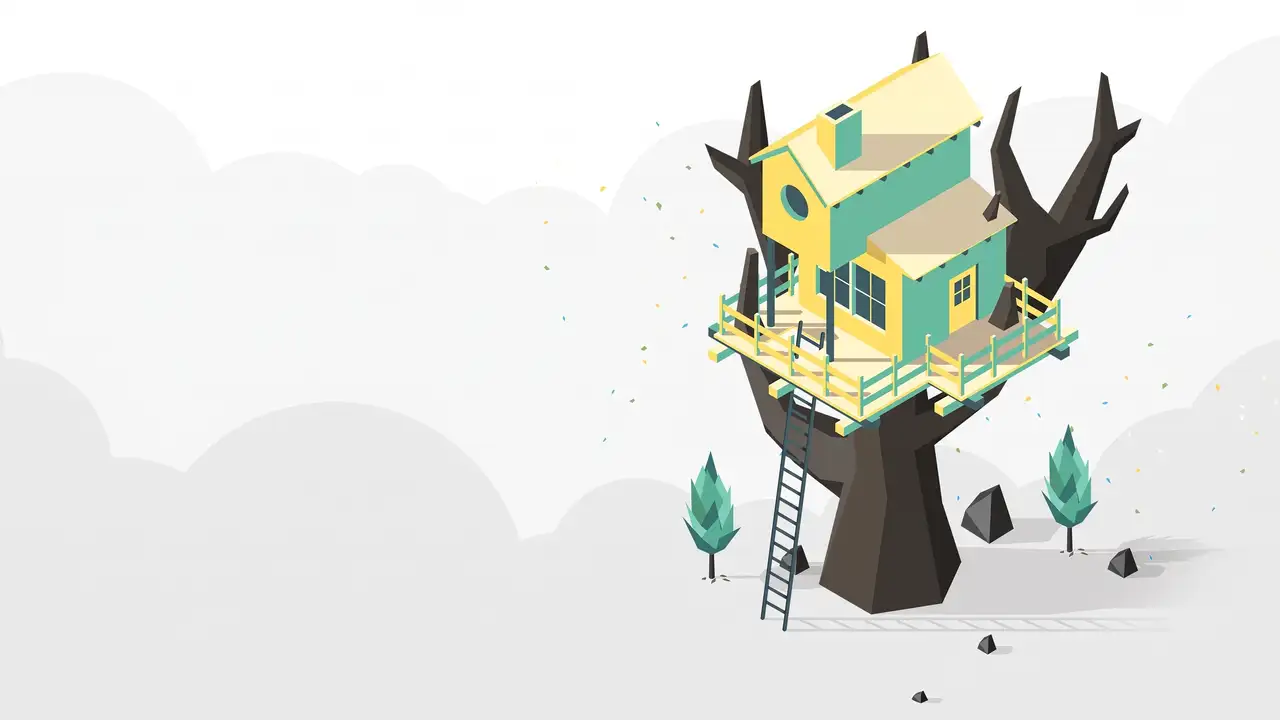
A girl in limbo walks through her family’s past, and the houses themselves do the storytelling. The Almost Gone presents its quietly devastating narrative as rotating cross-section dioramas, five acts spanning a family home, the suburbs, a 1970s apartment block, a psychiatric hospital and a memory-forest. The art style evokes Monument Valley’s clean geometry but fills it with dread, and the beautiful-unsettling tension defines the whole experience. Themes of depression, neglect and death run deep, and the content warning is genuine. What could have been grim becomes contemplative, and the restraint is the design’s smartest choice.
The object-combination logic earns genuine enjoyment even when it stumbles. Wedding-video discs slot into televisions, pregnancy tests become safe combinations, and a freezer full of labelled frozen meals reads as evidence of neglect; every object is simultaneously a puzzle component and a story beat. The laser pen bounces between surfaces in the suburb act, and the fuse puzzle delivers exactly the small satisfaction the design intends. This is the rare game where every prop carries narrative weight, and the house-as-storyteller conceit never breaks.
Cross-timeline solutions are the puzzle design’s signature. Past and future versions of the same building rotate into alignment, and clues found in one era open doors in another, with the Act 3 time-shifting apartment block the system’s best showcase. Number-code safes, tube-routing puzzles and the multi-floor room-number deduction sequence of patient 510 round out a variety that never repeats itself. Difficulty runs gentle to moderate, most acts taking around twenty minutes, and light backtracking fills the gaps when a clue slips past.
The hospital act deepens both the scale and the sorrow. Its multi-floor hunt spans the building’s full depth, and the psychiatric setting grounds the family’s history in institutional care. The memory-forest closes the campaign with a deliberately tiny final act, cathartic in its brevity and warm in its resolution. The ending returns the protagonist to her happiest memories, and the landing is surprisingly gentle for a story that promises devastation throughout. Dark tones remain, but the restraint holds.
Puzzle opacity is the campaign’s real friction. One number-truth puzzle uses poorly explained symbols that leave the logic buried, and the final suburb clue is practically invisible, small enough that a single number stays unresolved forever. The desire to return to Act 2 to find that last number meets a hard wall: no chapter select backwards exists, so the miss is permanent. For a game built on completeness, the inability to revisit feels like an oversight rather than a choice.
Navigating the rotating dioramas disorients. Mid-house, direction sense fails repeatedly, and even the button-rotation option leaves bearings uncertain. The presentation is worth the friction, but the cross-sections sometimes bury rooms behind walls that read as open space, and the kitchen-once-again-lost experience repeats often enough to note. Occasional stuck moments resolve with patience rather than design.
The tone lands dark-but-restrained rather than devastating. The story seems headed somewhere much darker than it goes, and the subversion reads as intentional restraint rather than a failure of nerve. Generational trauma, a mother’s clinical depression, a father’s childhood neglect and a grandfather’s fatal architectural hubris all surface through the acts, and the five-act structure tells its story backwards and sideways through time without confusing. The pieces assemble into something genuinely affecting.
Overall, this is a beautifully crafted, quietly devastating narrative puzzler whose diorama presentation and object-logic puzzles deliver on their promise, with the opacity of one symbol puzzle and one invisible clue the only real cost. The restraint in the storytelling is a choice that lands, and the two-and-a-half-hour campaign never overstays. A confident recommendation built on genuine craft.